

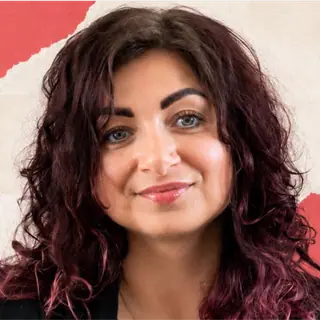
Who is Kinga Edwards?
- Who she is
- Kinga Edwards, founder and CEO of Brainy Bees, a boutique content marketing and digital PR agency. She has worked in marketing for 13 years and works with SaaS companies, mainly from the USA, Canada and the United Kingdom.
- What she does
- She runs Brainy Bees (the agency has operated in its current shape since 2018), creating, optimizing and distributing content and building links for SaaS clients and for agencies in a white label model. She also organizes SaaStok in Kraków, a recurring event for the SaaS community held in English.
- What we talk about
- The path to founding the agency, SaaStok, winning US clients through referrals and relationships, trips to New York, communication with clients, hiring, working with agencies, using AI, visibility in AI search and her approach to work-life balance.
- Where to find her
- LinkedIn (Kinga Edwards) and SaaStok events in Kraków.
Best quotes
„Business is for money, but I am not here to make money at all costs.”
„That client will remember that the project was botched, will not come back to you and will not recommend you.”
„For me AI works as a helper.”
„Work relaxes me.”
Recommended materials and sources


Related conversations



Transcript
Host: Rafał Moszkowców. Guest: Kinga Edwards.
Introduction
Rafał: Hi everyone. Welcome to another episode of Globalne Horyzonty. Today I am talking with Kinga Edwards, founder and CEO of Brainy Bees, a boutique content marketing and digital PR agency that for 13 years has worked with SaaS companies, mainly from the USA, Canada and the United Kingdom. Kinga, great that you are with us on Globalne Horyzonty. Welcome.
Kinga: Hi, good morning, thanks. In English I would say thanks for having me, in Polish dzięki za zaproszenie, so both, let's say both.
Rafał: You're welcome. As usual the pleasure is mine at the start, we will see whose pleasure it is at the end. I prepared a lot of questions for you, because you are someone who first of all does cool things. People say and tweet that you do them well, and you do them for big, well-known and cool brands, from the States for example. I want to borrow your head a bit, as we nicely say in Polish, to find out how you do it and why you are where you are. Ready?
Kinga: I am ready. It sounds a bit like a job interview, but who knows where this goes.
How did Kinga Edwards found the Brainy Bees agency?
Rafał: What inspired you to do what you do and to found Brainy Bees?
Kinga: From the beginning. I have been in marketing broadly much longer than those 13 years. If we count my teenage years, 18-19, when I promoted events in my hometown, Częstochowa, then I already got a taste of marketing. I really liked it, first of all because my actions had an impact. Without my actions the events would not work, there would be no people at those events. I did it for several years until I moved to Kraków for good, and I decided this is what I wanted to do in life. At university I quite quickly got interested in getting into some internship. I ended up in a mini agency, mainly doing campaigns for students and student products: dietary supplements, apps for students. I was there almost two years and worked with brands that were definitely too big for my experience. I was thrown into the deep end, but that was okay, I like it. Many people drown in deep water, and I try not to drown, and more than that, I try to learn to swim.
Kinga: Later I went to England for an internship in Cambridge, at the University of Cambridge in the marketing department, another taste, both of the language and of a different kind of marketing. After returning to Poland I joined a bigger agency in Kraków, with experience already. It was a typical digital agency with B2B and B2C products. I was pulled toward B2B, so strongly. Plus I wanted to work remotely, and 10 years ago that was not a case. Remote work was an invention of my generation, and Gen Z probably considers us almost boomers. So I left that agency to go on my own. At first I had a few projects as a JDG.
Rafał: As a sole proprietorship.
Kinga: Yes, I was my own ship and vessel. It was fun until the moment I took a project and decided I physically could not handle it. Either I had to say no to that project, or I had to take someone to help. I started putting together a team from people I had worked with on other projects, because I did not want to look for someone random, but someone I could answer for and would not be afraid to put in front of a client. From that moment Brainy Bees was born. From one little bee suddenly there were more of us. The agency has operated in this shape since 2018, people have changed over time, but the average tenure is quite long for the agency market: the last person joined us in June 2021.
Rafał: Then you must pay well.
Kinga: I think so, I recently verified that. I hope it is not the only reason people are on the team.
Why does Kinga Edwards run SaaStok in Kraków?
Rafał: You said you got hooked on organizing events and having influence. I read that you run SaaStok in Kraków, and you were yourself surprised in one of your posts that you have been running it for five years. Why do you do it? Is it a purely business hobby, or do you like organizing people?
Kinga: I really did not expect to do this for five years. My first event was just before the pandemic, maybe two weeks before. These are not big events, a small meetup, but the organization itself takes more. When I started SaaStok in 2020, I had some business goal: visibility for us, so that people would associate us not only with SaaS per se but with SaaStok, so there would be some business chances. But now, after five years, it is largely sentiment and the community built here, and my responsibility for that community, because in Kraków it is the only SaaS event in English. For several years I have noticed that we have many people from outside Poland at these events, not only foreigners living in Poland, but people coming from the Czech Republic and Slovakia.
Rafał: That is very motivating, it means there is a good reputation.
Kinga: They do not have such events at home, so two or three hours of travel is no problem for them. Recently I even had a person from Gdańsk: six hours traveling from Gdańsk to Kraków for my event. If you have a listener from Gdańsk who would like to do something SaaS-related, that is proof there is sense in it. It is a kind of responsibility: if I stopped, those people would not have that option. There is a lot of work and a lot of stress, but it is all rewarded when you see people in the room, nice presentations, you get mega feedback. It is a satisfaction you cannot fake. The next SaaStok will be in July, on a boat in Kraków, for the fifth anniversary. It will be the crowning of these five years. And it is not only a community that goes to events. It is a community that works together, hands each other deals, sends intros to clients. I witnessed several deals being signed at an event, word by word: I will outsource this, I will outsource that. And those were not empty words. It is motivating that I built a bit more than a mini meetup, a platform for people looking for inspiration in SaaS and maybe extra work.
Rafał: You surely do it for the dopamine hits, I know what it is like to run events. And since people network and build a community around it, which is not obvious in the Polish latitude, it has many benefits, even purely social ones. I have heard a lot of good things, I invited myself to the event, so I will have a chance to see for myself. That is why I do this podcast, to invite myself everywhere.
Kinga: Every marketing action must have a goal. If that has been achieved, we can finish recording.
How can a Polish agency win clients from the United States?
Rafał: For Polish businesses winning foreign clients is hard. Do you have a checklist, golden rules? How to prepare?
Kinga: We are talking about an agency that wants to serve foreign SaaS clients. In our case the situation was a bit different, because from the start we specialized in something. I was never an agency doing marketing for everything. From the moment Brainy Bees was founded, I already had a few collaborations with SaaS companies behind me, more as a growth hacker than a big content person, because I wrote content but also did a lot of tinkering. The projects were foreign or global in reach, but for Polish SaaS companies. Word by word people started to associate me and further projects came from referrals. I do not have a sales department in the agency, I never did. If anything, it would have to be me, but we do not run outreach campaigns, I do not spam people on LinkedIn. Those referrals would not come if we did not deliver. What was important to me, when hiring and reshaping the offer, was that it be something we can deliver, because anyone can promise, and that is a big flaw of agencies: lots of promises, and when something happens everyone washes their hands: we told you, but algorithms. For me it was important to surround myself with people who will deliver and to be totally transparent with clients, even big brands after a fourth or fifth funding round, with budgets that would set up more than one agency. I have the integrity to say no: nice offer, surely a nice project, I will not be able to deliver it.
Rafał: You do not think in Polish at all, come on.
Kinga: It is easier for me to think in English. I speak on two tracks.
Rafał: We are steeped in anglicisms, no worries. Integrity can be empty: someone says they have integrity, then someone comes with half a million dollars and it turns out they were joking. How do you hold to it? Are you not focused on money?
Kinga: Business is for money, but I am not here to make money at all costs. Integrity is something you are not born with, you acquire it, so I had to learn it, probably in the past by taking too many projects, working too many nights and then delivering something that was okay but not at my standard, which is high. If I cannot deliver and cannot stretch my process by 10-20 percent, I do not want to take it. There is also a matter many agencies do not think about: when such a project goes wrong, it is not just one project that goes wrong. That client will remember that the project was botched, will not come back to you and will not recommend you. And in the States it is very hard to do business with big SaaS companies, because everyone knows each other: a VP at one SaaS is an investor in another. Everything gets passed around there. The word about Brainy Bees also got around, that it is a nice partner for such and such activities. With link building, offers appeared like: build us links to this target for this money. 95 percent of agencies would take it, because some inquiries would set up an agency for several months. But they were controversial targets, like dietary supplements, which are prohibited, and I did not want to take them, because first I would not be able to deliver in good quality, and second I could not look myself in the face if my links helped such businesses land on the first page of Google and something bad came of it for someone. No money will compensate me for that.
Rafał: Once you sell your soul to the devil, it is hard to get it back. And to close the thread on winning clients abroad: you confirmed what I see, that it is hard to win by brand unless the brand is personal. You have to speak the language, know what you are talking about, and the first, second, third referral lead to the next. I experienced in the States that people readily recommend when something works and are incredibly willing to leave a review, while in Poland it is harder to win reviews. When we met at the pre-talk you said you had been in New York. Do you do it regularly? What does it give you?
How does a trip to New York build client relationships?
Kinga: You can have clients from the States and stay in Poland the whole time, and it can work, because there are projects that do not require you day to day. It works for us also because our communication is not only asynchronous. I am available to clients in the evenings, so in the States it is normal daytime. They see no difference between working with us and with someone in-house or an agency there. I cannot tell my team to be available at 10 pm or after midnight, but I sometimes have a call after midnight. Clients do not demand it, if I said I could not, it would be okay. But I see that because of it they stay with us longer, more willingly, recommend us further, even to agencies in the States that normally would not consider us because we are not in the States. The intro goes: Kinga is better than in-house.
Kinga: Back to New York: I was going to fly there anyway, so I let clients know I would be there, that we could have lunch, coffee, and that I could also spend a day at their office. I met clients in person, they are wonderful people, and it is important to me to work with decent people who treat others with respect, external or internal. We started with two days with one client, then a day, dinner, lunch, coffee, a walk at six in the morning because that is the only way to catch someone. It was not salesy: at the end of the visit there was no upsell. We got to know each other, and some projects changed for the better, because there was basic trust. Now my visits to New York are a different client every day. We have six clients there and will have more, because we once went to dinner, our client brought a business partner, and word by word, these are not business dinners where I walk in with Google Slides.
Rafał: You do not do a presentation.
Kinga: If you asked me for a Brainy Bees sales presentation, I would have to make it, because we do not have one. We just talked. Plus there was social proof in the form of a current client who said: Kinga has been delivering this for us for two years, so it makes sense. In the taxi to the hotel I already had an email on my phone. It was definitely a risk and an expense at the start, to fly to New York for the first time and visit those clients. I never had the approach that it has to pay back. It is an investment. If I could be in New York for a week every two weeks, I could scale it to a point. I cannot, but it set up a lot for us and gave us entry to projects I would not have entered from a position in Poland.
Rafał: Are you not tempted to move there?
Kinga: I am, but it is dangerous to say these days that someone wants to live in the States, there are different approaches, especially in the geopolitical situation. There is a mini plan to move there for a few months, heavily discussed with one of our bigger clients. It is a logistical operation, you do not plan it overnight. New York is jumping into the deep end. I like it, but I understand many people could be overwhelmed. I live day to day in a village near Kraków.
Rafał: Business in the States is relational. You have to be there from time to time, because it is another proof. You are looked at differently if you are there in person, you can high-five, talk. People are afraid to recommend people they do not know. B2B is simply relational. You have to know those people, because one deal can be worth tens or hundreds of thousands. That is why so many companies looking for B2B clients do not understand the complexity of winning such a client.
How to communicate with US clients?
Rafał: I want to touch on the communication context. In the States the expectation of clear, precise, available communication is very high on the client side. Do you confirm that in Poland it looks different?
Kinga: Expectations are there and must be there from the client toward the agency, that is what the agency is for. We also have a few Polish clients, it is not that we work only with the States. But with communication, it is not the kind of relationship building that many agencies have in mind, that it is enough to have a website in English, send someone to an event in Las Vegas and someone stands at a booth for 2-3 days and the bag of clients opens. Such a relationship is not built, nor by dozens of drinks and signing a contract on the table, like 20-30 years ago. It is about availability for the client, so they know they get enough attention. I am on 58 Slacks. If we were not on a call, I would answer within 20-30 minutes. Many agencies do not go on Slack with clients, they leave them on email. Something gets lost here, someone drops off there. I have a very high communication standard and I have deeply instilled it in the team. We have many reviews that people were afraid to work with us, because they had already worked with five agencies and it was bad, and suddenly it turns out you can work with an agency that is responsive. Sometimes it is even over communication: I do not write that I saw something, but that we are working on it, now it is this. For clients in the States this is very important.
Kinga: I got burned on this several times in Poland, making intros of Polish companies to companies in the States. For me it is natural that you thank for an intro, replying to the person who made it, in CC: hey, thanks, nice to meet you, let us set up a call. I caught myself chasing a Polish agency: did that intro reach you? The client had already replied, and the agency said they were going to reply in two days, because they were constructing an email. You can write a short email: thanks, nice to meet you, let us set up a call or we will send you something. Agencies only want to schedule a call. Our biggest contracts were signed by email: Kinga, we heard you do this, how much can you do for this much money? I say, this much. Okay, done. Often it was payment upfront. Not every decision maker in the States or Canada wants a call, sometimes a one pager in the email body is enough. You do not need to push the client into your sales funnel with follow-ups at 7, 14, 50 days right after the first email. Agencies should learn the approach of how they would want to be treated on the other side.
Rafał: Best practices are practices that are stupid, only done enough times by enough people. Sales is like that: you have to have a call, and after the call X must follow. We try to standardize and automate, dehumanize. And in B2B, when you talk about business worth 100, 200, 500 thousand, that is not the point. I do not send presentations about my company either. I did ghost shopping and when agencies send presentations with an offer, it is: we, we, me, me, give money. That is not the point. You need to adapt your sales approach to each market separately and stop kidding yourself that some International Expansion Manager who automates follow-ups will do business for us.
How to adapt communication to each client and onboard a team?
Kinga: Not only to each market, to each client. Even to individual people in the organization. Some clients write on WhatsApp or reply to one email in ten, but we know they will reply and that everything is okay. If someone gives green light faster, you go to that person: we are waiting for this, so you are waiting for this. It is a domino. I have a CRM in my head, a personal one, not everything automated in apps: this girl is like this, this guy like that, they overuse emojis, so I should also send an emoji, this person does not like a sentence with a period at the end. I cannot assess how much business this made us, but I can assess how it eased communication, delivering results and further recommendations.
Rafał: You do two things: you deliver good work at a good price and you learn clients, adapting communication to how they like it, not how you like it. But there is a risk: it is hard to scale such a business fast and far. Not every business has to scale. It is also hard to onboard someone to such a process. I made my own read me so people know how I think about business. I say: if a client wants to communicate on WhatsApp, you communicate on WhatsApp, on Slack, on Slack. People from other agencies, often Polish, get culture shock: Rafał, this is not scalable. I say: never mind, that is why I do not have a hundred clients, but ten, because I prefer ten who have a budget, ambition and are responsive than a hundred, of which 70 percent have no budget and are not responsive.
Kinga: I do not have onboarding problems, because we did so little onboarding that I am not hiring at the moment, among other reasons because I do not want to wrestle with a horse. I have no space to explain to someone that there is sense in using AI, or that it is nice they worked in an agency for 10 years in a certain model, but we do not have it that way. I had hundreds of CVs and did not hire anyone, because there was no fit, and for me that fit is mega important. There must be three factors. First, knowledge of English, non-negotiable for us. I will not teach someone English. Many people failed recruitment claiming C1 or C2 when it was a stretched B1. In communication with clients from the States your English has to be at their level, and sometimes we correct their grammar, which is satisfying as a non-native speaker. Second, marketing basics: that someone knows it is not flyers and not evil incarnate, but something we do for clients to help them deliver business goals. I do not want to convince someone of the sense of the work. And third, the hardest: that someone wants to do it. That on their own they think, maybe for this client do this, maybe here instead do that. Initiative. It is very hard to verify. The last recruitment was: write a ChatGPT prompt in the email. It is a plague, I can have ChatGPT for 20 dollars a month, why would I pay someone many times that amount for exactly the same thing?
Is it better to work directly with clients or with agencies?
Kinga: Onboarding does stop us from scaling certain processes. I will not scale communication unless I take more on myself, and I already take a lot. That is why we work with many agencies: all communication with the end client then lies with them, and we deliver what they want. We have communication with them, but not as intense as they have with end clients, because they are then that Kinga on Slack. There are processes we can scale to a point, but I will not take 50 new clients in the same communication configuration as with SaaS companies directly. Working with agencies made that easier for us.
Rafał: You work well as a subcontractor, white label.
Kinga: Each model has pros and cons. Working directly with a client you have impact, but intense communication, weekends on Slack. When working with agencies you deliver your part and there is no intense communication, but with many companies I would like to work with directly, I cannot, because the end client does not even know it is Kinga in Poland doing it, just some agency in Canada. If I am one of many agencies for a client, which also happens, my new ideas are nice to have. I pass along not a roast of other agencies, but: we saw a nice ad, nice engagement. It is valuable for the client that someone thinks out of the box.
Rafał: I had experience with big white label projects and sometimes we did not get even half the money the client paid. Though sometimes those collaborations were fair and nice.
How is AI changing the work of a content marketing agency?
Rafał: I wanted to ask about artificial intelligence. I sometimes no longer know what is going on, good that I have Radek Paluszak who explains it to me. My favorite tool is Claude from Anthropic. How has AI changed the way you work?
Kinga: I would be lying if I said we absolutely oppose AI and are only genuine content. We work with AI, we have workflows, we have prompts, I am building an app with Claude. It changed the business and it is hard to say that content agencies will always do great. For us it changed that I built processes around things we used to do by hand, so we have more time for additional things for the client, for something there was never time for: we can optimize more, propose something entirely new. It is not that the client pays for work we deliver 50 percent faster and I pocket the money. I spend that saved time on the client in other activities, for example on Reddit or Quora. I have entirely un-Polish and un-agency billing models: it is not that a client has 8 hours with us and I will do 8 hours and 5 minutes.
Rafał: What does the model look like?
Kinga: We have monthly packages: content creation, content optimization, content distribution plus link building. For white label clients it is mainly links: this many links cost this much, we deliver to the guidelines you gave. But with SaaS clients I do not do things without sense, I hate doing things without sense. If I see that with a client I am agreed on ten posts, but it makes sense to do eight and swap two for something else that takes a similar amount of time, I will do it. I will not say: that is what we agreed, we have a contract until 2050. Being agile is a challenge in a big agency, but clients require it and they see that someone cares about their product. We swap it for activities on Reddit, Quora, content distribution, thought leadership quotes, for which we now have time.
Rafał: Does the client get more thanks to AI?
Kinga: Basically yes. People may say I am doing it naively and that I have not yet been burned in business. We did not have a case where someone did not appreciate it or did not agree to get more for the same money. AI also helped us in internal projects: we have not updated our website since 2019. When I see an agency with a new site every half year, to me it is an act of desperation, but if I had time, I would probably change it too. We have a study from two years ago that nobody had time to deal with, now Claude dealt with it and we will have an interactive report. An app we have used for years, but which lacked a function, I rewrote with Claude. I built an additional app for keyword density and mini apps for each client and each guideline. I do not replace people with AI. If your agency has 200 people, maybe at some point you do not need 200 but 150. Mine is a small agency and for me AI works as a helper. I would like everyone at the agency to have their own AI assistant, and my people have communication skills that AI does not have, and personalizing activities for the client stays with them. I did not build a business model on ChatGPT, but we deliver better content because we have time to do other things around it.
Rafał: You use technology the opposite way from most companies, which would want to do it faster for the same amount and deliver nothing more. It has a risk that you will never scale it to a huge scale, but that is not your point.
How do AI Overviews affect visibility in Google and LLMs?
Rafał: You and I live off Google, in big quotation marks. Have Google's changes, like AI Overviews and the Helpful Content Update, affected your strategies?
Kinga: They definitely affected our clients. Yesterday there was an Ahrefs study showing that being in an AI Overview causes about 35 percent fewer clicks. That is a revolution for Google as we know it. Any estimates now are writing on water, we do not know what will be tomorrow. Once you could plan content 6 months ahead. Now we refresh weekly, because a keyword drops in, because something happens. It is not a nice model for agencies that are not agile. I met British agencies that send content plans that are absolutely unchangeable, for the whole quarter, and they will not touch them even if a keyword no longer makes sense after a while. We did not change strategy dramatically, but we update it. We know it matters how our SaaS clients appear in AI search: if someone searches for a tool for this and this, that our brand shows up there. But you will not get a good position in ChatGPT without a position in Google. You will not have a new site that suddenly has millions of references in ChatGPT. We see very high interest in positions in ChatGPT, Gemini and other LLMs.
Rafał: I talked to the guys from Surfer SEO and one of them published that about 15 percent of traffic or new leads come from LLMs. I also talked to Emilia Korczyńska at Userpilot, also an absurd amount. It scared me, because I have worked with search for well over 15 years. It is changing in certain niches, but more and more people take shortcuts. I do not search in Google anymore: locally I search on maps, for inspiration and knowledge absolutely not. We are recording this on April 18th. Yesterday there was a court ruling in the States on Google's monopolistic practices, another against Google, so the antitrust authority is seriously considering breaking up Alphabet, which I personally think would be very good. Have you noticed a correlation between your work and your clients' growing visibility in LLMs?
Kinga: Our tactics in content and links have changed, but it is too early to say it is thanks to this link or this post. Many of our clients would be in ChatGPT anyway, because they are big brands. I often tell people who come to us that if they are setting up a project management tool, they compete with Asana, Trello, monday.com, so they should think about whether they want to do it, because if they do not have budget or a million hours, an agency is not a magic oracle that will lift them. I am transparent about it, while many agencies will take such a client, after six months they will be unhappy, but they will have left the money. If I see something does not fit, not only with employees but with clients, for example someone treats people on their team a certain way, I do not want to work with such a person.
Rafał: Are you considering monitoring the impact of your work on visibility in LLMs?
Kinga: We test several tools. I see a very large spread of results, there is no one tool that is sensible. A lot of them are appearing, as add-ons or separate entities, but there is no onboarding or explanation of why they show what they show. I checked carefully, when I was in the States, what appears for me in ChatGPT in incognito, and it had no match with what the tool showed. There were 10 queries and none matched. I am testing one with potential, but it says that to be in LLMs I have to cover 1200 topics, and I do not know where that recommendation comes from. It is definitely too early to add this to a client report.
Rafał: It is mega personalized, how do you average that? There are tools, including one I think from Michał Sadowski, founder of Brand24. I ask you because clients are starting to require it: so how visible are we in LLMs?
Kinga: I cannot attribute all visibility in LLMs to myself. I try not to sit in the agency bubble, because then I would catch the same thing.
Rafał: With agencies, when it grows it is us, when it falls it is the algorithm. There is strength in diversity.
How does Kinga Edwards approach work-life balance?
Rafał: Finally: you live very dynamically. Do you have practices that help you keep balance and clarity of thought? Do you do yoga?
Kinga: Absolutely not. I am an anti-example of work-life balance, but it is my conscious decision, because I know I could apply it, but I would miss a lot. The FOMO after a week of vacation in this industry is crazy. I told myself I will be up to date and work as much as I can, because in 10 years, maybe 5, I will not be doing this. Not that we will not have work, but it will go more toward consulting, piloting activities, personalizing, and some things we do today will be automated. And that is okay. I sacrificed big vacations, work-life balance, watching Netflix at 6 pm to be up to date, because our clients require it.
Rafał: You work the American way, and there is a method in that madness. Do you have something that relaxes you?
Kinga: It will be tragic, but work relaxes me. I told myself that if there is a day when I get up tired and with hatred of what I do, that will be the day burnout hit me. But I do not have such a day. If I had to pick one thing, it would be travel, and that sounds bad, because it is in 90 percent of CVs. But it is never two weeks of vacation in the jungle, I go with a computer, work 2-3 hours, and the rest I spend exploring. I am a very boring person, very hooked on work, probably more unhealthily than healthily, but I know I will not be doing this in 30 years, so that motivates me to do it mega much and mega well.
Rafał: Let us do what makes us happy. Many people are afraid to say what you said, because we live in trend bubbles, the trend toward work-life balance. Putting it this way is mega honest and shows your integrity.
Kinga: To clarify: it is not a recruitment requirement that everyone has to be my copy. I have great respect for free time in my team, and if someone replies to me after 10 pm, I actually get furious that it is at that hour at all. I do require things, but it is not my requirement that it look like this. I like it and it gives me joy to do additional things for the client: I came up with something, I implement it, I do not wait for approval of an additional quote. Sometimes these are unpaid activities, which in the agency environment is often seen as naive. For me it is a pebble in building a relationship. Someone once told me that this builds a relationship so that it is then mega hard for my client to quit, because I work so closely with them that they would have trouble finding someone who works as closely. I never looked at it that way.
Rafał: You create very wide stickiness. Loss aversion kicks in: the client does not look at a new partner as a potential gain, but at what they will lose if they lose you. If you wanted to scale to hundreds of thousands of clients, it would not be a good model, but today, to earn big money at a high margin, you do not need a big team or thousands of clients. AI changes that among other things: sometimes one person can earn as much as a whole Polish 50-person agency in a year.
End of the conversation and the episode
Rafał: I wanted to end on that positive note and thank you very much for this conversation. We went through practically all the topics I had planned. Thanks for being so open. Ladies and gentlemen, I was talking to Kinga Edwards. I hope you liked this conversation.
Kinga: Thanks, see you.
Listen and watch
The same conversation in your favourite app.
The full edited transcript as a Markdown file, with the guest’s details and quotes.
Back to top