

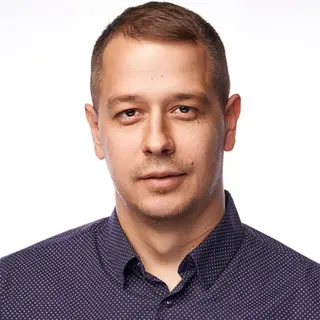
Who is Łukasz Gorący?
- Who he is
- Łukasz Gorący, a programmer by education and passion, a software architect and the creator of Tillio CRM.
- What he does
- For about 16-17 years he has worked on CRM systems and business processes. He co-built the SEO agency Sempire (Sempire Europe) for almost ten years, and its shares were sold to the company Shoper. Today he develops Tillio, a Polish CRM system that brings sales, customer service and delivery together in one place.
- What we talk about
- Where the idea for a CRM in a red ocean came from, how a single source of truth works, what is happening to SaaS valuations, what vibe coding is and why it is done on credit, how AI is changing SaaS, whether it is worth running local models, and how to roll out AI in a team.
- Where to find him
- Tillio CRM and LinkedIn (Łukasz Gorący).
Best quotes
„You have to know that when we vibe code for ourselves, internally, we are doing it on credit.”
„That is the most important thing, because without data you will not deploy anything.”
„I think that in a few years we will simply be paying extra to be served by a human.”
„Let us not be afraid of AI, but let us also not let ourselves be made to feel FOMO about it.”
Recommended materials and sources
Guest’s pick


Related conversations




Transcript
Host: Rafał Moszkowców. Guest: Łukasz Gorący.
Introduction
Rafał: Hello everyone, welcome to another episode of Globalne Horyzonty. Today with me is Łukasz Gorący, a programmer, software architect, and also the creator of Tillio CRM. Welcome Łukasz, welcome to Globalne Horyzonty.
Łukasz: Hi Rafał, thanks for the invitation, thanks for the introduction. In three words about me: I am a programmer by education and by passion, but starting my professional career, it turns out that after some fifteen years I mostly sit in business processes and in putting those processes together into nice, scalable businesses, and in delivering software and tools that simply provide those processes. Hence my rich experience and, I think, a natural inclination these days to focus more on business than on programming itself, but we will probably talk about that later.
What is life like after the exit from the Sempire agency?
Rafał: Sure. I have a whole list of questions for you, because you are in a bit of an epicenter of events. I know you also recently said goodbye to an organization you built for almost ten years, the agency Sempire, if I remember correctly.
Łukasz: Right.
Rafał: How do you feel after the exit? Do you already have your island, or not yet?
Łukasz: An exit seems to me a bit mythical, because if someone has this drive to do something, regardless of whether it brings any money or not, then I think the exit does not exist. I used to think too that I could basically do nothing, but the truth is that everyone I know who has gone through exits comes back soon anyway. And the truth is also that the later you come back after such an exit, the worse it is for you, because you do drop out of the market and out of circulation a bit. That is one thing.
Łukasz: A person feels good enough that they did something nice, and it is a good entry in the portfolio. It certainly helps me in business too. Huge experience in scaling and really a confirmation of the skills I acquired over time, from a very small agency, where we started with three people with Excel and the first clients. From the very beginning we did not generate costs, we were able to sustain ourselves, and over several years of work, with a relatively small team, we got to over 1,500 clients a month and twenty-something million in revenue in a very difficult industry, which is SEO. That is some kind of achievement. Of course I did not do it alone, but with a team, and I am very grateful for that. My contribution was processes, software, all operations, things in which I felt best.
Rafał: So euphemistically you answered that you have not bought the island yet.
Łukasz: I am already planning, choosing the acreage. I have not bought it exactly yet. I once told myself that at forty I would like to retire, but now I know I am lying to myself. It probably will not work.
Rafał: I understand you are not past forty yet.
Łukasz: I am not past forty yet, I am still a bit short. Still, it is the drive itself to do something, and these days there are so many possibilities that your hands just start working on their own.
Rafał: I totally agree. I had exactly the same plan. I started my first agency when I was past twenty, in 2009 or 2010. And I had a plan then that at forty I would leave it, I would already have earned so much that I would have had enough. Financially I do not particularly complain, but I still feel like working. I think I work differently, I think differently, but I still very much want to do it. Because I think it is also a matter of liking what you do.
Łukasz: Exactly. And above all, at some point you no longer work for money. And maybe that is a kind of psychological comfort, that you do it because you do a good job, that the clients are satisfied, that they recommend you. The dopamine flows from those positive emotions from the client, that you solve some real problems for them. That is nice, especially in the industry I work in now, because you see the effects right away. It is nice simply to do something that will remain after me, at least.
Where did the idea for Tillio CRM come from?
Rafał: That retirement is not for you. And let us talk a bit about what you are doing now. I have an idea for this conversation, that after this introduction we walk through what exists today. What is Tillio CRM? Tell me a bit about it. I have a few hard questions, because this market is certainly not easy and I also watch it closely. I would also like a bit about software architecture in general, what it is, why it matters, and I assume we will end on artificial intelligence. That will probably be interwoven through the whole course of this conversation, but around the end we will probably have more time to talk about artificial intelligence, because I am honestly curious how you use it, how your clients use it, what your plans are in that area. Does that plan sound good to you?
Łukasz: I think very good, and I would only hold firmly to the time so that we do not overdo it.
Rafał: We have barely four hours of tape left, so do not worry. Okay, listen, the first question I prepared: where did the idea come from, Łukasz, to enter, a few years ago, but not that long ago, the CRM "market", in quotation marks? Still, a market dominated by global giants. In Poland there is also no shortage of companies offering this kind of service. I wonder whether it is courage, or madness, or a real business problem that you see only you can solve?
Łukasz: You know, that is a very interesting topic. In short, I personally have been doing CRM for my eighteenth year. Let us say the first year I did not work on it, so honestly sixteen, seventeen years I have been in this. I cannot think any other way. For me work, a company, a business without a CRM is totally impossible. When I started as an employee working in a CRM, I could not imagine not doing something the way it was planned in the system, with the procedure and so on. It is terrible, but that is how I was brought up, and I really liked it, because it does work.
Łukasz: From the experience I had, we were building one product, then, starting the agency Sempire, we started building that product, our own CRM, from scratch. How did it start? Clients started looking at that CRM of ours, even in meetings, and asked: gosh, where do you get this, because it is so nice, so tailored? I say: we write it ourselves. And who, do you have a team? Well no, one guy writes it. What do you mean one guy? Yes, one. At that time I really wrote it alone. Now there are several people who maintain this software, back then I also already had others to help. But generally at that point there was already the first interest and people were circling around it.
Łukasz: We even went to some conferences, with Google, with training sessions, it was a popular industry. Other SEO agencies saw what we had and everyone was interested: listen, sell it. At some point, when Sempire was stable enough that my technological role was no longer so crucial and I had space to take this on, then with my business partner, who is also a programmer, we decided: okay, we will take the risk and start delivering this to people. We had a queue of clients who had not seen anything, had not seen the product, they only saw that we could do something. So we started doing it. That was before the pandemic altogether, or right in the pandemic year. We did the first deployment after a year and a half, maybe a bit earlier. Now that is abstract. I suppose that with today's possibilities we would do the first deployment after three months.
Why does Tillio CRM combine several SaaS tools in one system?
Łukasz: Why did it take so long? Building software for your own needs is a completely different story from building software for the SaaS market. We already knew it definitely had to be SaaS, but at the same time we had to meet the business needs of those clients who were standing in the queue. And answering whether we solve some problem: besides solving many of them, there is one biggest advantage. We have been doing it for about six years and at that time there was no single solution on the market, only now one is more or less arriving. We consolidated all the tools.
Łukasz: The SaaS market is very fragmented. We are used to having some SaaS for sales, some for project delivery, a third SaaS for the back office, a fourth for HR and so on, and the information between those systems is not exchanged at all. If a salesperson sells something, the person from delivery most often does not know what they sold, what was agreed with the client, because nobody will buy them a license, and often an expensive one, just so that they look into client data once in a while. The other way around works the same. Nobody will buy salespeople a license for the project system, which they will also visit once in a while. And that causes a big communication problem in organizations and that data is fragmented. There is no single source of truth. There are other problems with sales too, with leads, losing them and so on, but that is not today's topic.
Łukasz: We came in with a solution that we had tested at Sempire, to have a system where a good CRM is the core, but we build all the tools needed in business around that system, whether in sales or later in service. And so, from several SaaS tools, we are able to fit it all in one place. That is our USP: clients come and see, oh great, so we can throw out this, this and this, we have it in one, and at a price lower than the popular foreign solution that gives us only sales. It is a great thing altogether. Besides, we have experience on the Polish market and we focus strongly only on this Polish market. That is how Tillio came about. We launched this SaaS last year, we are actively promoting it and we have very nice feedback. It is a very hard slog.
What does the CRM market in Poland look like?
Łukasz: As you said, Rafał, there are over six thousand CRMs, more or less. That was research.
Rafał: Probably about two years back, I did it recently. Of which some 5,800 are free, the rest are not free solutions. And do we count Google Sheets?
Łukasz: Even counting Google Sheets. And in Poland there are really two or three popular foreign solutions and two or three Polish ones. The rest are rather niche solutions, which do not promote themselves in the SaaS model. So it is a terrible red ocean. But if we focus only on our market and on the advantages over foreign solutions, which treat this Polish and European market as a bit of a third topic, because they focus mostly on the United States, India, China, generally on millions of users, and there nobody looks at license prices like we do. For an average business in America paying, I do not know, 149 dollars per person is not a problem. For us it is a problem. And listen, you use those systems at maybe ten percent. There are loads of features packed in just so that investors are happy, but at the end of the day we use that core. We carve out that core, translate it to Polish business and we want to deliver it in one tool.
Rafał: I confirm that. I also confirm that there really is such fragmentation and many different tools are used, so that consolidation is a value. My organization is starting to really use your software, so we see those benefits too, because we mostly used foreign solutions.
Is Tillio CRM planning to expand abroad?
Rafał: But I wanted to ask, because you said you focus on the Polish market, you know the Polish market. I would not be myself if I did not ask whether you plan expansion. Why? Because these Central European markets are very similar to each other. The potential, in terms of population and business, seems large. You would probably need to do good research, but do you think about it in the long run at all?
Łukasz: Of course, that is a natural thing and as you say, the potential is huge, because while in Poland we are doing quite well, Germany, the United Kingdom for example...
Rafał: But I was thinking more of Central Europe.
Łukasz: Yes, okay. The Czech Republic is nicely covered, but Ukraine, I think there is also very big potential there, although they also have a lot of software. There is huge potential, only there is one thing. In Poland, actually this is even European data, on average 20 percent of companies have some CRM-type tool implemented, and that is marked in the survey as implemented, but the fact that something is implemented, and whether it is used and well implemented, that is a complete abyss. In most even very large organizations the work really looks standard, Excel and emails. Or people use very large solutions from technology giants, implemented some years ago for millions of zloty, which basically nobody uses anymore, because either they are clunky, a young team of salespeople does not want to use them because the UX is tragic, it is not available online and so on. Then we replace them successfully. So here, on the Polish market, we really are not taken care of, and we understand this business through Sempire, through business experience and through current experience. I have probably seen a thousand companies myself, and the processes, the problems to solve in Poland, number five to eight. Even trivial things, like integration with GUS or with Polish data. Foreign solutions do not have that or make you pay several thousand zloty for it. It is absurd, when you pay for a CRM and would rather just enter the tax ID and have the data. That is why this Polish market is not taken care of. Until we are number one here, we most likely will not decide to go for expansion. Besides, there are huge marketing costs connected with a representative office, a big logistics operation, so logically, developing a business in general, you have to wait for that.
Rafał: I agree, I mean, whether I agree or not is secondary, that is your plan. But it seems to me that you have a unique opportunity in this Central Europe to do research and see. We often do this, for software, but not only, for SaaS of various kinds that break through in Poland but find it harder because of the poor adoption by the market, the behemoths, that it is hard for them to get into bigger ones. It is fragmented, revenue grows, but not as much as it could. And for example they do this thing where they enter Romania with such a product, which turns out to be simply a goldmine for them, because the available solutions there were very, very expensive. We see it in e-commerce, we see it in B2B. I encourage you to do such research, because paradoxically Romania, the observations we have, is a market already nicely penetrated by Polish brands and scaling well there. Macroeconomic research says Romania overtook Hungary in income per capita and is catching up with Poland fast, so I think there is some space here. I leave you with that thought.
Łukasz: I will just close this. Indeed Romania is a very interesting example and I also know this from experience, through previous investors. I know that market is very open and that Polish solutions are relatively simple to introduce there. I have the impression that there is a bit of nothing there. In our bubble I have not done research, but that is true, Romania is an interesting market. But really the United Kingdom, for example: we had one corporate client who produces tires, and his friends from the industry, when they saw what he has with us in Poland, asked: can we have this in the United Kingdom? Because they still pay by cheque there.
Rafał: I would like to set that straight, but true, cheques do happen. Not as often as in Canada. We had a funny case, a fun fact: a Canadian e-commerce client who sent us a cheque to Poland for the first two invoices. I am not joking. And we did not quite know what to do with it. But in the United Kingdom that has changed a lot. I lived there for almost fifteen years. At the beginning, at the end of the 2000s, you got salaries even in big companies by cheque, but now digitization has gone far ahead, so it is certainly an interesting market. We could talk market by market.
Łukasz: Yes, let us put a full stop.
What is happening to SaaS valuations, and will micro-SaaS disappear?
Rafał: Okay, because you have been building SaaS for a few years now, you have interesting plans connected with it. I am curious how you see it and whether you see it as an opportunity, a threat, or whether you do not care that current valuations of SaaS companies and those solutions are the worst in history, that they are falling critically. I mean big ones, but also medium ones. Even Salesforce, HubSpot and so on: valuation and revenue forecast drops of several tens of percent. What do you think about that?
Łukasz: I would divide these SaaS companies and what is happening on the SaaS market into two areas. It will definitely not be the case that SaaS disappears, I am convinced of that. In the case of the big ones you mentioned, HubSpot, Salesforce, these are huge institutions and there is simply a natural correction, resulting from the fact that if one feature is built for a year by a hundred-person team, that feature probably does not deliver the cost of building it, but because they are so big, they do it. Such things end. Investors are also pulling back a bit, because now anyone can, at least that is the promise, make a SaaS. That is one thing, that correction.
Łukasz: The second thing, which is definitely a twilight, is the micro-SaaS products, which were a bit pointless, but generally were a good alternative, because there was nothing else. A good example is probably QR code generators. There are plenty of SaaS tools that for really huge money will generate just a QR code for you and also give you a license for that QR code for a month. After a month the QR code expires. Imagine that there are companies, I saw this at a client, that take such a QR code, print it on a banner somewhere in the city center and have to pay 400 euros to keep it for three months. That is already a twilight. It was almost brazen, but the United States is famous for just this kind of micro-SaaS-ing. Even taking a popular, expensive CRM solution, there are loads of things it does not have, but in the States that is normal: just buy this tool, this tool, this tool, and we are integrated. Suddenly from one license, from 150 dollars, you end up with 500 dollars. For them that is natural and normal. For us it is not. In this business it is even unacceptable, so those micro-SaaS products will have a hard time.
Łukasz: And for two reasons. First, someone savvy inside an organization can vibe-code it themselves. As long as it is done for the organization, does not leave to the outside, ideally secured with a VPN and so on, data is processed well, because that is also extremely important, you can say that a QR code generator we would be able to generate internally by the end of this conversation and it would work perfectly, no need to pay for it. So it is a big correction of those micro things that were really serious businesses. I suppose they will somehow retrain. Nobody will give up budgets. If they have clients, they will come up with something to beat that, but it will not be that simple. And above all investors do not want to give money that easily. In Poland getting VC for a SaaS is so hard that it is practically impossible.
What is vibe coding and what risks does it carry?
Łukasz: There are plenty of trainers who sell AI courses for especially non-technical people, who say: listen, vibe-code your idea and do it. And that is a great thing, because someone who had no clue and had no money to build it can now turn their idea into something that works and at least show it on a pitch deck, interest someone with it. But unfortunately, at the moment, if the product does not get product-market fit or generally does not start to get on its feet, nobody will be interested in it, unless it really is a unicorn, but that happens very rarely. So vibing small things is great, but it carries certain dangers, because small things can turn into big things.
Łukasz: Like how it was once very popular to build yourself loads of tools in Excel using VBA, or later Zapier, Make, which connected everything to everything for you and it worked. In theory you did not have to code, although at an advanced level you have to be able to think algorithmically for it to work. Later there were no-code tools, which also promised that everything would get done, only it turns out they were expensive, aimed more at corporations, and in corporations they sold nicely at the beginning, because you could put together a nice presentation and a promise, but after half a year, a year they simply did not deliver, because they were inefficient and there was no optimization. I am generalizing, there are better and worse cases, it depends who implements it, but most of the problems of those solutions ended up simply at performance.
Łukasz: Now we have vibe coding and generally the moment we build something big and the process grows into it, it will be the same problem as with Excel, with no-code and so on. In three, four years there will be nobody to maintain it, it will grow so much that it will have to be rewritten, so in the end you will need some programmer anyway, who will find it simpler because he is already working on some base of something, will probably vibe-recode it, but it will still cost and those are already huge quotes. We have more of the situations where clients come to us with tools they have built in Excel, and quotes very often are thick hundreds of thousands of zloty. And not in order to earn on it, because in our case we do not really earn on producing software, but on licenses, but we want to help the client who came to us. It cannot be done, simply several good hours, several hundred good hours of a programmer have to be reserved just to understand it, translate it and so on. You have to know that when we vibe code for ourselves, internally, we are doing it on credit. With that awareness it is a great thing. We can quickly validate something, quickly build it, check it in the team and if it works, then either we look for a ready-made solution or we go to someone and say: listen, we have something like this, build it for us professionally. It is best to do this as quickly as possible, because if we leave it for three, four years, the time to pay will come. On the other hand, if the process works out, you will earn money on it, that is also okay. Just keep it in the back of your mind that it is never free. That Excel was not free and this vibe coding is not free.
Rafał: So in general the big ones are falling, that is a bit of a natural consequence, the small ones disappear, and you somewhere in between see for yourselves rather an opportunity than a threat, if I understood correctly. I would still like to straighten out this vibe coding, because maybe not all our listeners know. Can you say what vibe coding is?
Łukasz: Vibe coding is, put as simply as possible, using the possibilities of available LLMs and simply typing in, in business terms, what we expect. For example I need a simple program for reading invoices from KSeF. We sit down to some Claude Code, to Gemini, to another GPT and write: listen, I have a small company, I do not know, a gardening one, I need a simple tool that will pull all the data from KSeF for me. There is a good chance that over one weekend you are able to make a nice tool that you will be happy with. It is more of a script, but it will work. The alternative was to pay some SaaS that does only that, and that used to be very expensive. Now there are loads of such small SaaS products that do it, so at least those SaaS products are relatively cheaper, but they will not last either, because you cannot run a SaaS cheaply indefinitely. Up to a point you can build it cheaply, but at some point it simply has to cost.
Do AI agents threaten SaaS, and what is a single source of truth?
Rafał: Wait a moment, Łukasz, I will stop you here at vibe coding, because there is one thing that connects with this and that I wanted to ask about. You talk about certain dangers connected with it today, okay, it is hard to disagree. I would like to add a pinch of salt. In my previous episodes, guests I talked to, from different industries, from different countries, said that vibe coding is mostly a kind of play, but they saw AI agents as the biggest threat to SaaS. What do I mean? That the threat to Software as a Service was not that someone who has no idea about building deeper infrastructure vibe-coded something small. It was more, in their understanding, that companies that can build AI agents, personalized to specific solutions, pulling knowledge from specific places in the organization, with some software layer on top of that, are a threat to extensive software, such as Tillio, but also others. Or do you not see it that way?
Łukasz: That is a fair point. If a SaaS was based, for example, on a nice, colorful interface, then in current times that interface becomes unnecessary. If in business we learn to work in consoles, to work with a chat, on data connected for example to a CRM system like ours, then de facto the interface itself seems redundant. So if a whole big company was based on having a nice, colorful product that sold well in marketing terms over the years, then now it may have a problem. Those agencies that automate and implement AI, for them it is a great market at the moment, because they are usually competent people who know how to solve problems, and those problems are relatively simple in Poland. It is usually getting hold of some knowledge base and working on that knowledge base.
Łukasz: But that is exactly why we do not see a threat, but rather an opportunity in our product: we are supposed to be that central knowledge base. We have everything from the moment a lead lands in the system, through the sales process, the customer service process, delivery, complaints, debt collection, administration, some HR if someone wants it, and so on. You have everything in one place, so at the end of the day we are that single source of truth, and we do not see, and we are even starting to work with such agencies, any problem with them taking our source of knowledge and building the client some separate wonders next to it. That is one thing.
Łukasz: And besides, the biggest problem of all those SaaS products, above all abroad, is that people are already tired of subscriptions for everything. That is why in the States the idea of consolidating this is starting to appear too. We have been doing that for a long time, because we knew it works in Poland, because we simply do not want to pay a lot, and now they have in fact worked out that it is also needed. That fatigue is one thing altogether.
Łukasz: And second, in Poland, even though AI is promoted everywhere like crazy, one thing: let us not be afraid of AI, but let us also not let ourselves be made to feel FOMO about it. When you go on LinkedIn or Facebook or whatever, you will always have some ads saying that someone made this great workflow presentation and saved 500 million zloty with it. They just forgot to add that they are 21 years old and have probably never seen 500 million zloty at any client. From the moment we build something for ourselves, internally, to the moment we sell it in production to a client, let alone a corporate client, it is such a road that it is a nightmare. If you do not know how to solve some problem, it is usually enough to tell a chat about that problem and it will tell you how to solve it. So de facto you do not even need automation agencies, but from knowing how to solve the problem to actually deploying it, so that it is production-ready, maintained, so that someone gives you an SLA, so that it complies with GDPR and all data processing policies, that is a huge amount of work. So just making something, and making a SaaS for sale out of it, is a huge road. I am leaving marketing aside.
Łukasz: So the worst thing in all this is to avoid being taken for a ride. First, by that FOMO. If you have a real problem, talk to such an agency, let them try to solve it for you, and even before that talk to a chat, simply, like to a buddy who knows the subject. That is the nicest solution altogether. That is the simplest way to start with these chats and with solving business problems. And second, do not let yourselves be taken in by someone promising, especially young people: pay just ten thousand zloty for a course and we will show you how to vibe-code your own SaaS in a month and make a million from it. Only nobody adds at the end that the product will come into being, it will work on your computer, but from working on your computer, through secured architecture, marketing, collaboration, you cannot build a SaaS alone. I mean, that is controversial, maybe in half a year I will say that you can.
Rafał: There are people who do it, but I understand what you mean. It is about a professional process and a product at the end.
Łukasz: Yes. A corporation will not buy even the best solution in the world from you, because you will not be trusted enough to do it.
Rafał: Sometimes you need ISO and so on to sell it, so I understand all of it. I am curious how it will change, and I will also be watching how Tillio adapts to it. I like this whole concept of a single place for all knowledge. I tried to translate it from English into Polish and it came out very badly, but I think everyone knows what I mean.
Łukasz: Jedno źródło prawdy, we call it. A single source of truth.
Rafał: Yes, single source of truth. My translation is like GPT-2, it comes out tragically. But I think it is a genius idea, really, to survive and to grow. So really more about gathering knowledge and making it possible to add things there. It is a nice concept, which reminds me of WeChat, that Chinese platform that WhatsApp imitates. You have software, one place. It is not the same of course, but conceptually. And on top of that a whole mass, tens of thousands, if not more, of other entities build solutions that extend your core and keep users more attached to your software. WeChat is something like that. I think that thinking this way, that you create a place to which others can add solutions, means you are not so limited by technology, you do not have to chase that technology at any cost, because if it is open, others can add their solutions to it and integrate them with yours. It is natural then, because without your source of knowledge their solutions will not work. I think that is a nice idea for developing it further.
How do we use AI at Tillio?
Rafał: I wanted to take one more small step toward artificial intelligence, into a block that I thought is interesting in the sense of telling, inspirationally, how various people and companies use artificial intelligence in their processes. I am honestly curious how you actually use AI at Tillio. I do not mean only the product layer, I also mean the operational and marketing layers. Are these integrated processes, or fragmented, how do you use it today and, if you do, are you satisfied with the results you achieve?
Łukasz: Okay, but before that, just one more thing. In Poland we observe that entrepreneurs are not so far ahead in using AI, but that may also come from our bubble. When we start with a client, they most often had nothing, we first build them that one source of truth, give them tools and so on, and after some half a year of gathering that information, the tools we even have built into the system only then make sense, because they work on data. So the most important thing: if you have to start somewhere, make yourselves processes, even on a piece of paper, and gather data in some place. Because if you want to deploy that AI two years from now, you have that data, and that is the most important thing, because without data you will not deploy anything. If your competition has already done it and uses some systems where everything gets stored, then it will have it simpler, because it will have something to work on.
Łukasz: As Rafał said, no matter what will work, you still have that one data source. A client can sit down with us even in the evening and vibe-code, on the basis of the public API, their own application next to ours, which will be based on our mechanisms and our data. And we collect practically everything, depending on configuration: emails, phone calls, text messages, meeting recordings. That is huge knowledge and that is how we use it ourselves, thanks to collecting practically all those four elements. We have such a knowledge base packed that internally we do not have to worry about whether we noted something with a client or not. We know it will be found anyway.
Łukasz: And, quite paradoxically, for some months now we have started to redesign all our processes as AI First. They are still fragmented, but I have a dream, at least a business one, to make all processes AI First within the next half year and to seat a human only at the very end, who will be the executor of the results of those processes and will be the professional customer service at the end of the day. Because that is the last thing, I cannot imagine serving a business client automatically, especially some corporate one. I think that in a few years we will simply be paying extra to be served by a human. That is already happening, by the way.
Rafał: It is already happening.
Łukasz: And it is justified, because on the other hand, if we have a SaaS that someone pays, say, 200-300 zloty for, then they want to pay 200-300 zloty, and contact with a human on the other side is unnecessary except when something goes wrong. So it can be optimized day to day and that is okay, if everyone is okay with it. But I certainly would not want to promise: dear clients, you have such a cheap service, but we sit here and everything is crafted by hand. That is not the point. We even go so far as to write in contracts that we will use artificial intelligence in the process, that it is safe, that we know where the data is, what the models are, that it will be locked down. Thanks to that the process is much cheaper, because we can focus on helping the client, on analysis, and in the end AI can prepare most things for us and we only close them out.
Local or large AI models: what about costs and vendor lock-in?
Rafał: Wait, I will stop you for a second. In the context of your use of artificial intelligence, I understand, large language models, and the fact that you write in the contract that you will use it: where do you use AI at Tillio, in your company in general, are these large models, or do you plan, because of control of the flow of information, euphemistically, meaning so that this information does not leak somewhere, to run a local model, for you, for Tillio, a safe, downloaded one? Because I suppose you do not need a gigantic model to process this data. A model with, say, 20-30 billion parameters, a small neural network, would be able to cover all your clients' needs. I am curious whether you think about it that way, that it would be some Stable Diffusion-type format, or maybe even not an LLM, but something like Mercury, which is a cheaper, faster, more efficient model you can process locally, or do you think you will use large, huge models?
Łukasz: We have even thought about it. For lack of time we dropped the topic a bit, which is a pity, because RAM was cheap then and I am kicking myself a bit that we did not buy it. I calculated that buying our own hardware somewhere around 50 thousand zloty would be enough to fully cover our clients' needs. It would be with us, on those open models, and in most of those simple everyday tasks, like transcriptions, catching who has to do what, they work great and that could be okay.
Rafał: Which models are you talking about? Which specific ones?
Łukasz: For example Whisper, or an alternative, I probably will not say it from memory, but there is a public alternative to Whisper that we tested and it was quite good. Even transcribing phone calls we could do de facto for free, on our own electricity. Some simple analyses, summaries, to reply to an email, to draw conclusions from a phone call, tasks, actions, follow-ups and so on, can be set up in-house. Only that it does not pay off. At the scale we operate, maybe it would pay off, but we do not want to waste time on it when we can develop products. We will probably do something like that eventually, because some clients would want to have that machine set up. But that is redundancy, that is IT, that is DevOps, which cannot be replaced by AI at this moment. Someone has to watch over it, it has to be secure. For the same thing we pay a fraction of the amount to Gemini or OpenAI or Claude, it is literally a fraction of the price.
Łukasz: I suppose that before the cost of buying that hardware paid for itself, we would not spend that much per year on AI for all clients. It is really laughably cheap. I only see a threat in connection with the current geopolitics, meaning what if, for example, the orange side from America decides that American companies cannot deliver solutions to European companies. We have everything set up in Google in a data center that is a company from Poland. I suppose nobody would agree to that, would unplug. Of course we already have procedures worked out for what if so, so we know how to rebuild it if needed. I even have some local partner on which, if necessary, we would be able to rebuild those things, but it will certainly not be cost-optimal. So here I would rather put a full stop: it does not pay off to do it.
Rafał: You know, I will go against that here. It will be interesting, because I often think about this. We tinker with local NVIDIA models and others for various solutions, building domain agents. So for you a domain agent, in the sense of an agent for transcription, well, de facto I would bet on the conviction that if you had such a local NVIDIA model, it could handle this for you and you would pay nothing for it, because you can run it on a PC, or on some server, say at Beyond in Poznań. Not that I am convincing you, but it seems to me there are very many small solutions, for example in your software, that those local models, open sources like Kimi, could solve without problems, and it would be safe. The machines do not have to be that big. And in the context of what you said about the orange king from across the ocean, there is a big risk that something geopolitical could happen, but even if you put that aside. What about a situation of a certain collapse in the financing market for LLMs, or OpenAI, or the loans, which are enormous, when there will be a problem with financing and it turns out prices jump ten, twenty, thirty times? If we are so tied to this software, I mean those big American AI models, which are simply pumped up with cash and keep borrowing to live, I see a trap here: at some point we will be so glued to it, it will be so hard to disconnect these processes, the price will go up ten, twenty, thirty times, and we will be sad but we will pay.
Łukasz: Well, that is a huge vendor lock-in. I do not know if you have heard, but Anthropic recently, how much marketing is in it, I suppose a great deal, made a model that does not listen to anyone and can do everything, and they will give it only to Big Tech and a few others who will probably pay them a million dollars for access. I suppose there is a lot of marketing in that, because they want to go for an IPO this year, so they will certainly be pumping up that balloon. And they will again have an advantage. But what you say: I generally think all the time about that threat, what if. This is the most important thing we commit to for clients, that you have some SLA, so if anything happens we will start it up for you and it will work. And that we have it in a Google data center, we have used GCP services for years, we know it works. We also had services in OVH once, but not in connection with this. Greetings to OVH, they burned down on me once too.
Łukasz: Everyone had a VPS for 20 zloty, but that is not the point. It has to be stable, it has to be secure. People give us data and we promise them they will have access to that data. That is our masthead altogether. Doing this locally, I really calculated it, because transcribing phone calls is the most sensitive moment, where I have a bit of a problem that it passes through external models. Of course they do not learn on it, we have all those enterprise ones bought. Besides, even at such a scale, they are cheaper than those generally non-enterprise solutions. To illustrate it for you: if we did just the transcriptions in-house, it would be setting up two machines for around fifty thousand zloty, whereas a transcription now on the Whisper model costs less than ten groszy for an average six-minute phone call. We are now working on a much better, I would say two, three times better quality of transcription and extracted conclusions using Gemini and several linked models and solutions, so that cost goes up to thirty groszy for the same six minutes. You have to calculate it quickly, see how much that is, and the cost of the hardware itself, and on top of that, unfortunately, some DevOps people who have to maintain it, and the responsibility that you do have that machine. Keeping it in our own server room would be a quite abstract idea, although we could do it in the office, but already because of data processing, GDPR, there is no point going into such solutions. It is simply much more obligations and risk. In real terms it does not add up.
Łukasz: And in case anything happens, the contingency plan is: you simply buy a VPS with suitable graphics cards, whether in Google or in AWS, and you set those models up. Then it will be more expensive, you are right, because those VPS with graphics cards are not cheap, but it is an alternative. There is a cost we will have to raise at that moment, that is clear, but it will not sink our business, and we are able to rebuild it, I suppose, within a day. We have it all secured so that all the services that use it do not query those LLMs directly. We built, probably two years ago, when we started introducing AI, our own micro-service, which is a kind of proxy to the LLM. We have long had it secured in the appropriate way, prompted, it is our central service, and underneath we can change the model with one switch. And whether it is OpenAI or Gemini, the result will be identical in the system, so equally well we can plug our local model in there and it will work too. It is really a safeguard against vendor lock-in.
Łukasz: Because as you say, when new models are published everyone jumps on them, they work great, but later, I recently read research, Anthropic was able to cut 70 percent of the power on the basic free accounts, which during the promotion for a month or a month and a half were maxed out with hardware. That the results are completely different, they are worse. I see this for example at the level of coding, that they degrade like that after a month. With Gemini you can see it terribly: when I made peace with Gemini, because I also used to dislike it a lot, I started doing things and everything worked, and after two months I literally had the impression that either I was prompting wrong or it had become dumber. And talking to colleagues from various companies who work in a similar way, I had identical observations. Besides, the world confirms it. So vendor lock-in is terrible, we have a proxy for it, in case of need it will be set up manually. For example from the angle of saying: listen, Rafał, you can pay more and your data will be in our data center, or you can pay less or have it in the price, and the data is in OpenAI, it is not processed beyond processing, it is not used for training, we even guarantee that in contracts. That is a good option to offer.
How to adopt AI in a team and keep company data secure?
Rafał: I understand. I was just curious how you approach it. We will slowly head toward the end, because we are already at 53, 54 minutes on the clock. I have one last question related to AI in an organization. We have already said a little about it, but more from the product and infrastructure side. What about people? How do you see the adoption of artificial intelligence? Do you run internal training, or any other activities meant to teach people inside? Do they happily use artificial intelligence tools? Do they assess the results of that work well or badly? Do you have some system, some framework for it? I am curious, because I consider it a real business problem and I see it in my own company. I am to blame here that we do not have a clear procedure for using it. We are changing that now, looking for one tool we will use, everyone will have a separate account and everyone will be able to work with it, and we plan some cycle of internal training. I am curious how it looks at your place at this moment, that adoption?
Łukasz: Speaking plainly, we have a team of a dozen or so people. We also have AI skeptics. I, for example, am a kind of Jesus of AI, listen. I come and say: listen, this can be done with AI. When you have to do something, first think how AI would do it, and then you. But fortunately we have a nice enough team that we work in this bubble, we work with these clients and everyone sees the benefit right here and now. If someone has, for example, to write up a conversation summary, and can click a button or copy the transcription, throw it into some Gem of their own or an assistant they have built on the side, and it did it in their style, and they have it done, they can send it to the client, then everyone sees a concrete benefit right away, above all in time. I would have to force myself to write a summary of a long meeting for a client. Fortunately when I go to a meeting, someone goes with me who wraps it up later. I simply could not do it these days, because I would be sorry to spend the time. I would take the transcription, throw it in and so on.
Łukasz: But in business terms, how to protect yourself best, because this is mega important: you most likely have some Google Workspace bought, or a Microsoft solution. We happen to use Google Workspace. For AI everyone has their own license bought, it does not cost much, some 80 zloty with all those Google services, and above all everyone has their own Gemini, that paid corporate Gemini, which has it in the terms of service, and also has a note under the chat that your data remains secure. And nobody has the right to use anything else.
Rafał: I always laugh, because Gemini belongs to Google, dear listeners, because probably not everyone knows that. After years of working with Google, what Google writes and what Google does, I always have this... well, I do not know. Because they always said they care about organizing all the information in the world and making it publicly accessible, and about everyone being happy and a rainbow always shining over us. So I laugh that with Google it is a mixed bag.
Łukasz: You know, both you and I have worked with Google for a very long time, if only because of previous industries. I remember that 2008 and "Don't Be Evil" and so on. It changed quickly for them. I find that note underneath very funny, because if they write it there, it means I will double-check. I have such a safeguard that something very important we do not put in there. Let us say these are data that would be good to anonymize, but there is no need, because they are not used for training. Most often, for example, some transcriptions get uploaded and worked on there. But if something is really handled at some corporate level, you can take NotebookLM, which is also a Google product, which first gives you a knowledge base and certainty that there will be no hallucinations there, although you have to admit that models that are given the source beforehand do not hallucinate that much. But it can happen. In NotebookLM you upload sources with files. It is, I think, even in the free versions, it seems to me there is a note that they do not use that data for training, but that needs to be checked, I am not sure, because I do not use free accounts. There we have one hundred percent certainty, because it is a hermetic solution, a kind of own RAG, meaning a source of knowledge on the basis of which you can talk. It is a bit worse in quality, but you use it in an identical way, you can share it within the organization and the answers are quite nice too.
Łukasz: At our place, for example, someone in sales recently, preparing for a meeting with a client, uploads some data from conversations and meetings and makes a podcast out of it. Recently we drove together to a client meeting offline and we played a podcast made of that data during the conversation in the car. It is terribly creepy. If you know that industry, you know there is that ping-pong kind of talking and so on, it is creepy. But on the other hand, if you do not have time to prepare for a conversation with a client, why not? It shortens the topic for you to five or fifteen minutes. You will not read it, you will listen to it in the car. Really, you have to live through that cringe. I heard it for the first time, he does it often, and it was strange for me, but on the other hand I was going there as a technical person, so I had already learned many things, at least I knew what I was using, what business needs they have, which are the main ones. We did not have to talk about it at all, it just happened along the way.
Łukasz: These are nice everyday solutions, especially in sales, or when we work with a lot of information. How many of you record online meetings: that is a mega source of knowledge. You can practically use something like Fireflies to record those meetings and later work with models on the basis of those transcriptions. They will make you a summary, pull out the tasks, prepare a document. There is no point doing it by hand. From my experience it already does it better than a human. Of course you have to verify it every time, so that no weird patterns come out of it, but it is a waste of time. Focus on the client, not on taking notes. Simple.
Rafał: It is also a matter of good prompts, because I observe this situation: we want to do things fast, we so much do not want to do it the old way, that loads of people do not bother to actually understand what a system prompt is and how to put it together so that, for example, it does not hallucinate or draw hasty conclusions. Because regarding hallucinations in Gemini or OpenAI models, or any others, maybe there is a bit less hallucination in the literal sense, meaning creating false facts, but there is a great deal of hallucination in predicting the next sequence of events, or what might have been said at a given meeting, or what conclusion from a meeting might have been drawn even though it did not come across. I observe this very often. That is why without good prompts, and how to make good prompts, we could record a separate episode, but the simplest solution: on the OpenAI platform, in their sandbox, it used to be called Playground, if you have paid OpenAI, you can go in, make prompts, evaluate, optimize, and building a RAG-style system from a prompt that will pull out information is very easy and anyone, even someone like me, can do it comfortably. Okay, so you use AI a lot, you do not have it arranged yet into some AI native, AI first.
Łukasz: No, but when we do, I promise we will do a case study out of it, because I cannot wait for it to work out myself.
Rafał: We are at a similar level, I also have a very fragmented and unarranged structure of use. I realized recently that it really has to be done, like with any other tool, simply put into processes, organized, and worked with.
What has Łukasz Gorący learned about delegating and failure?
Rafał: We will have to finish, quickly in fact, because we have gone over the hour I always promise listeners. But I have one last question then, because you have many business successes and you are not even forty yet, so are you not ashamed? I am joking. But seriously: do you have some business failure you could talk about openly?
Łukasz: You know, I do not know whether it is a failure, but certainly if we had done it earlier, maybe we could have achieved even more. Definitely try... I, for example, took as many things as possible on myself, and I still like taking things on myself and not passing them to others. And that is probably the biggest pain of an owner and of that approach: listen, I will do it better. I have basically full trust in the people I work with, and now I have basically flipped the lever the other way, so that generally I do not interfere at all. I am glad you simply did it. As long as nothing is on fire or something does not reach me, I do not interfere. So start as soon as possible. That is probably my biggest mistake, because then much more can be done. And that is probably a universal thing, the same later at a managerial level: as quickly as possible find people you can work with on trust, and put down your things. Now, since I have a thing for AI, the team has also shifted so much so as not to bother me, but to say: okay, do your AI thing, do not bother us. Later we will see what comes out of it for you.
Rafał: Later we will judge, really.
Łukasz: Yes, later we will judge whether I was right. We will do the follow-ups. But they are already becoming convinced for sure. And that fragmentation, listen, because the entry threshold into AI seems simple, but it is hard. And what Rafał said: the prompts are simply bad and that is why it does not work. If you spend, I do not know, a week of work on understanding how it works, how to build that knowledge base Rafał talks about, that RAG system and so on, then the results, the answers will be out of this world compared to what you get without it. Once you understand how it works, it is simply a fairy tale. Then you will also see where our enthusiasm comes from, that we believe it can be done. And it is not about replacing people, absolutely not. It is just about optimizing these processes better, because work with text, with content, is fully replaceable at the moment.
Inspirations and closing
Rafał: Exactly. Okay, one last thing. What do you read, listen to, where do you get inspiration? Recommend one or two things.
Łukasz: Oh, that is a good one. I am the kind of person who is absolutely unable to recommend anything, because I listen to things I would be ashamed to say. I listen to very, very many business channels on YouTube, and sometimes these are things I would not recommend even to an enemy, because it is a waste of time to listen to. But often one or two pieces of information come up that inspire me or open possibilities I did not have before, because I did not know about them, and I am able to make some element of a process out of it later. These are even those people who sometimes get laughed at as dream sellers, but once the algorithm serves it up to me, some nice topic: look how I optimized my lead collection process. Okay, out of idleness I will click, I always listen at double speed. And I will not say that I often catch something I can pull further. I am very far from reading business books. For me it is a waste of time, if someone likes reading that, then okay. Very often it is just waffle, which is out of date at this point, because it keeps changing. I will not even mention AI courses that are not updated. So rather YouTube, current knowledge of those young people who may promise that they will deliver something optimized, but they have this passion that they do great research and want to show something new. As I use them a bit from that angle, that probably inspires me most. Of course there are giants of business, from the top, I will not list those channels, but if someone works in sales and processes, they will find them in that bubble. I moved away from podcasts, because there are simply too many. That will be cut.
Rafał: We will cut that.
Łukasz: Exactly. I am joking, I am joking.
Rafał: But it is a great punchline in a podcast, that I moved away from podcasts because they are too long. No, I am joking. I understand it as far as YouTube goes.
Łukasz: There are too many of them, above all.
Rafał: There is too much of everything. The content inflation is gigantic, but quality always defends itself. I, for example, am a big fan of podcasts, even three-hour ones. The Acquired podcast is absolutely brilliant for me, and I sometimes listen twice. I walk the dog every day, I try to clean the apartment, so I have that time to listen, and I simply appreciate the quality and the substantive input. Listen, we have to finish. Thank you very much for your time. Thanks for all these insights, for telling your story and for honestly admitting that you do not have everything figured out yet, although from a distance it might seem you do.
Łukasz: I have heard stories of people pretending they have everything figured out, especially with AI, and later it turns out they use free licenses and everyone has a different one. So development is natural, you have to start somewhere. As Rafał also said, the team uses it, but there are some main process things where we have saved the most money this way. But to that ideal I would really like to brag about later, that from those separate things that worked on their own we built one flow and it saved us a million zloty and generally 50 hours a week, I will gladly brag about that later.
Rafał: I will share too. We will get there, but only in the third quarter, when we actually count.
Łukasz: I am giving myself half a year for it, because process is process, but it has to really work in business later.
Rafał: A hundred percent. Okay, thanks again, very much. It was a pleasure, until next time. Bye.
Listen and watch
The same conversation in your favourite app.
The full edited transcript as a Markdown file, with the guest’s details and quotes.
Back to top