

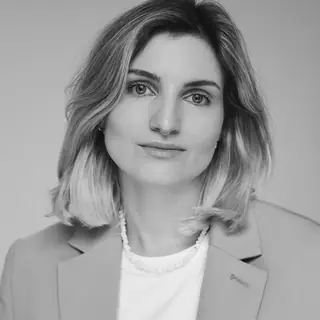
Who is Aleksandra Lemańska?
- Who she is
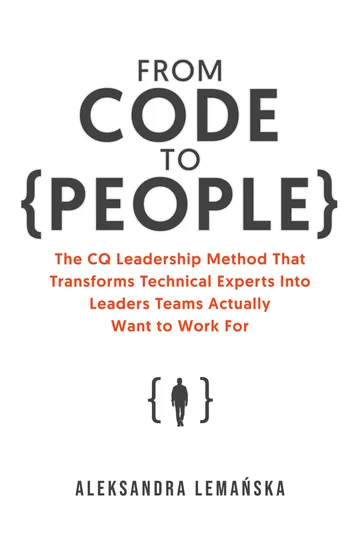
- Aleksandra "Ola" Lemańska, founder of LemanSkills, president of the Startup Community Poznań Foundation and author of the book "From Code to People".
- What she does
- She runs LemanSkills, an agency for leadership and team development that supports leaders in technology and IT. She created her own CQ Leadership Method, based on communication intelligence. She is an engineer and a business psychologist by training, and in a previous life she was a violinist. She also hosts a podcast about leadership in technology. She is the author of the book "From Code to People", which you can buy and learn more about at fromcodetopeople.lemanskills.com.
- What we talk about
- What leadership means in the age of AI, whether tools take our competencies away, how the task-pricing exercise works, what communication intelligence is, why the best employees leave, whether burnout in tech is a new pandemic, and what to do when a team is running at too high a pace.
- Where to find her
- lemanskills.com (website, podcast), the book "From Code to People" at fromcodetopeople.lemanskills.com, and Startup Community Poznań.
Best quotes
„But again, this is not about the technology, it is about your choices.”
„And adaptability is a muscle like any other.”
„We often, when we do appreciate someone, appreciate them for the thing we ourselves would like to be appreciated for.”
„Because I want to help leaders build work environments that people do not leave.”
Recommended materials and sources
Guest’s pick


Related conversations


Transcript
Host: Rafał Moszkowców. Guest: Ola Lemańska.
Introduction
Rafał: Have you ever wondered how much it costs when one good employee leaves? According to research, it is supposedly 50 to 200 percent of their annual salary, plus recruitment and onboarding. And onboarding, as I recently calculated myself at NON.agency, does not really take three months, it sometimes takes as much as a year. And do you know who leaves most often? Exactly, not the weak links, as you might think. Most often it is the best ones, the most independent ones, the ones we do not even notice day to day, because they do not cause us any problems and they deliver on time.
Rafał: My guest in the latest episode of Globalne Horyzonty is Ola Lemańska. She is the founder of LemanSkills, president of Startup Community Poznań and author of the newly published book "From Code to People". Someone who teaches technology leaders that management is not about spreadsheets and deadlines, but about a set of competencies that, frankly, nobody ever taught us. In this episode we talk about why artificial intelligence actually accelerates burnout instead of curing it. What the 10, 100, 1,000, 10,000 dollar exercise is, and why you can try it tomorrow morning. And what to tell yourself when your team does more, faster, harder, but you can see that soon it will all burn out.
Rafał: If you have ever thought: I do not have time for all these one-on-ones, leadership is Excel, or: hey, Rafał, it is somehow going along, then this episode is for you and for me. Enjoy the listen. Hi Ola, nice to see you.
Ola: Hi Rafał, thanks for the invitation.
Rafał: My pleasure. Could you introduce yourself a little for those who do not know you yet?
Ola: Aleksandra Lemańska, Ola is fine too. I am from Poznań and I do several things at once. The first thing: I am the founder and I run LemanSkills. It is an agency for leadership and team development, mainly supporting leaders in technology, in IT. For the second leg, I am the president of the Startup Community Poznań Foundation, which supports building ecosystems in Poznań and Wielkopolska, innovation and support for those founders who want to do something and build in startups. By today's education I am an engineer, by my second one a business psychologist, and a violinist from a previous chapter of life. That is my story.
Rafał: A violinist? It looks like you have had nine lives, like a cat. So many things behind you.
Ola: Every thing connects to the next one, it is a kind of system of communicating vessels, so it makes sense.
What is leadership?
Rafał: Today I wanted to talk a little about what is really happening with leadership, what leadership is. Maybe we could start there. I do not know whether in Polish it is people management. Somehow I do not like the association, but maybe that is what it is. Maybe let us just start with this: what is leadership today?
Ola: Yes, the Polish translation "zarządzanie", management, is probably the best one we have. But leadership as a term has also really caught on in Polish. Because leadership is something more. Management is strongly associated with the old management sciences and it really is a kind of steering of workers in a production system, because that is where it came from. Ford's classic school of management trained workers who later managed other teams in production, in repetitive tasks, in systems that were meant simply to produce things.
Ola: Today, in 2026, we are recording this at the end of June, we know that this is no longer enough for what is happening on the labor market and the business market in Poland and in the world. For me, leadership is a combination of a set of behaviors, a set of traits, a set of tools that a person leading a team has in order to do it effectively. It is a skillset, a mindset and a toolset: what we think, what we are able to do, and the tools with which we manage a work environment that people do not leave.
Ola: That is also my slogan. Why do I do what I do? Because I want to help leaders build work environments that people do not leave. And we are responsible for building that environment. And for me, that is a true leader.
Does AI take our competencies away?
Rafał: A very interesting definition. A lot is being said about this today, so let us move on a bit to AI. Since we already know how you look at leadership, I am very curious how this changes during the artificial intelligence revolution, how you observe it. A great deal is said about how every AI tool that automates something for us also takes something away, some competence, some agency. Does artificial intelligence change leadership fundamentally, or is it just another tool?
Ola: I do not entirely agree with what you said, that every tool, whether it is AI or any other technology, because it does not have to be AI. Now we talk about AI, because there is the most of it. But there were also various tools for process automation before, for arranging different things, for handling various business processes. So I am not entirely on the side that it takes something away. It can potentially cause us to stop using certain competencies. And that is happening now with leaders, but not only, because take the first employee you come across who starts using any LLM, for example to generate content, doing copy and paste. We are also taking away from ourselves the use of critical thinking, analytical thinking, creativity in writing copy, and so on. So a muscle that is unused simply wastes away.
Ola: So it is not that AI takes it from us, but rather that we, as the people making decisions about what we do with given processes, simply let those muscles weaken. Just like a muscle at the gym, everything works exactly the same way. Coming back to leadership, I see the tools that I also use myself as a leader as a huge opportunity to free my time from things that have to be done but can be done faster, more efficiently, often better, often with less involvement from me or my team. Of course control and critical thinking are needed, but eighty percent of things can be done much faster, more efficiently, often better, with fewer mistakes, which humans make too.
Ola: I think that in the near future a leader is a person who uses these tools wisely and looks at the list of tasks, of which we have an infinite number. Let us face it, there are always more tasks than time. We talked a bit about this before we started recording. And the question is: which of the tasks on this list can I automate so that they do not lose quality, and may even gain from it? I free my time as a leader so that I can take care of my team. That is my leadership task. And the truth is that when I work with leaders in various organizations, whether in Poland or around the world, in a startup setup or in corporations, the classic is: I do not have time for feedback, for conversations with people, for setting goals, for enforcing them, because I sit there hammering out operational things. So for me it is rather an opportunity, but it requires work, learning, acquiring new competencies, because it is a change in the way of thinking, of seeing processes, of looking for opportunities, for optimization. And it is not easy for everyone, for some it is completely new.
Rafał: But is it not the case that the more it speeds things up... I see something like this in myself, of course it is n equals 1, but it is as good a piece of evidence as any, and quite popular these days. The more I use tools, especially artificial intelligence, I mean various kinds of LLMs, the more I feel that I do even more, and it speeds up even more. And the amount of things to do does not change at all, the natural consequence of doing more is more to do. At least for me. I have this observation that when I reply to an email faster, because I have synthesized the seventeen PDFs somebody sent me, and I do not reply in four days but in thirty minutes, then that person replies within the next thirty minutes, and I feel, damn, I have to do something again, and it just speeds up more.
Rafał: And I wonder whether this is, for lack of a wonderful Polish word I will say: a vicious cycle, where we just start spinning like hamsters and have even less time for leadership. Because I honestly admit that my one-on-ones lately, and this is just a reflection, a slap in the face for me, are partly prepared by AI, and I see that I do them much less professionally, much worse in fact, much less individually than before. That is why I thought that these tools take something from us a bit... I stand somewhat on the position, for the moment of course, I may bite my tongue in a month, two or a year, that they do take something from us, and I do not know whether what they offer us in return helps us be better leaders.
How should a leader price tasks: 10, 100, 1,000 and 10,000 dollars?
Ola: You know, the question is what you reinvest that time in. Because if you take your list of tasks (and this is an exercise I often do with leaders who say they have no time, no capacity, and ask: Ola, what do you want from us). I say to them: let us take a list of tasks. This is an exercise for everyone, anyone can do it regardless of position. A list of tasks, meaning all the tasks you have, you write them out, it can be in Excel, even on a piece of paper, it does not matter, and next to it you have a column with the price of each task.
Ola: I learned this from one of my mentors. He says to me: Ola, price the tasks. Which task on this list is a 10-dollar task, which costs 100 dollars, which costs 1,000 dollars, and which costs 10,000 dollars. And now when you price those tasks, the truth is that the 10-dollar tasks you should immediately either delegate or automate. These are tasks that are important, they need to be done, but it is not quite you who should be doing them.
Ola: So that is first of all a sieve. Maybe the 100-dollar ones are worth thinking about, but if you get off these tasks and add new 10-dollar ones to your list, it makes no sense. That is what you said: we cover stones with more pebbles. So the point is to free up time, but to reinvest that time in tasks with greater value. Of course that value can be different for everyone. It might be strategic work, sales work, work with a client, work with the team, depending on your role.
Ola: That is a decision you make as a leader. Speaking about you here, since you brought yourself up, n equals 1, so let us take it. Because indeed, in the narrative you described, it takes away from you, because the reward for good work is more work, as we know. That is a very clear example. But again, this is not about the technology, it is about your choices.
Rafał: I always knew something was wrong with me.
Ola: Everything is fine. This is learning. We are learning this. We feel our way, we try, and that is also why we have conversations like this, to see what you are doing well and what you could do better. Everything is fine with you, do not worry.
Rafał: I hope it is the way you say, and not too seriously. It is great that you told us about this exercise of pricing tasks. I used to do it on the basis of annoying versus not annoying. It is kind of obvious, but sometimes somebody has to tell you that something is obvious for it to become obvious. So I am writing this down for myself and I recommend it to the listeners too.
What is communication intelligence, and is it a human edge over AI?
Rafał: You have your own method, the CQ Leadership Method, that is communication quality. Right?
Ola: Communication intelligence, yes.
Rafał: Okay. So here is the question: in a world where more and more of this communication goes through machines, there are already memes about bots replying to each other on email, Slack bots in general, AI summaries, some automated agile stand-ups, is this a deficit competence, and do you think people will invest in it, in this communication intelligence? Or will AI simply come and we will not need to talk to each other at all?
Ola: The truth is that communication intelligence is not at all such an obvious competence, because it is quite a new competence. Until now we talked about communication, about listening skills or presentation skills. Communication intelligence is a whole umbrella under which there are various competencies related to adapting communication to the audience. Can AI do that? Sure. But the human advantage over technology is that humans build relationships. And in a world of this technology, of all these artifacts you mentioned, our advantage as humans, and technology will never replace this, is building relationships, face to face or online, it does not matter. But that is what we build business on, that is what we build teams on, and that is what we build lasting communities on, which you are also part of and are building your own.
Ola: So communication intelligence in this sense is a key competence, and key in the sense that, of course, your agent can write you an email, but it will not go to a meeting for you. It can make you notes from that meeting. But what you do at that meeting, how you adapt to the audience, how you lead. It can write an offer for a client for you, but how you brief it and who that offer is to be tailored to is your competence. The same goes for how you resolve conflicts between people. It can brief you on how to run the meeting, but you are the one running it, and you mediate, for example, between employees, or give feedback. Sure, it can write you a framework for what to say, but you are the one speaking, and you are the one adapting the language to that recipient.
Ola: So you can use agents to help you, you can use technology to help you. Sure, I do not see a problem with doing that. People also often say to me after trainings, for example: if I enter everything you gave me, will it write it for me? I say: yes, but it will not say it for you. You have to say it yourself, and that will not change. As long as robots do not rule the world, and people keep working and functioning together, that will not change.
Ola: And this method, the CQ Leadership Method that you mentioned, which I created, is a set of tools that I have been collecting for over ten years, getting certified in it, working through hundreds of different leaders and teams, in order to extract from it what makes the biggest change and gives the best quality set of those elements I mentioned earlier: mindsets, meaning the way we think, what beliefs we hold about ourselves and the world, skillsets, meaning what I can do and how, and toolsets, meaning tools, checklists, something you can take and apply straight away in your life. In managerial, leadership life, because that is what we are talking about today, but also in interpersonal life in general, at home, between you and your kids, friends, parents.
Rafał: Communication has always been problematic in companies, all those conflicts we have between people. And it seems to me there is this thesis that people escape into AI and will escape into it even more, in order to talk to each other even less and communicate even less. And I think that may be a trap, that we will try to have artificial intelligence, which is pseudo-intelligence, give us suggestions, and yet still keep causing problems between people. That may be interesting to observe for a sociologist, but in companies it can turn into quite a mess. That is just a small digression in that direction. I think the kind of thinking you have is very much needed. I think robots will not replace us in the next three to five years.
How is AI changing developers' skills?
Ola: I think it is even further out, but look at what is happening already: take the group of teams I am closest to, development and programming teams in organizations. The truth is that code is now being written, and can be written with very high effectiveness, by AI. The competencies of a programmer from five years ago, or even three years ago, are no longer the same competencies. The expectations for these roles are and will be different. And what we were just talking about: social competencies, or power skills, whatever we call them. "Soft", please no, because we are educating people that these are no longer soft competencies, so as not to belittle them, but social ones, or power skills, or human skills. That is what we need and will need now.
Ola: And the whole team, or development teams, will now be in one big reskilling. Because a programmer is supposed to go to the client, talk to them, do a business analysis, so that set of competencies will be changing. So my expectations as the leader of such a team are also starting to be different. It is already happening in some organizations, especially large ones. I have the right to expect from a junior who joins that they already do a number of things and simply get on with the job. This is not a sandbox now in which you learn when you come out of university. So it is being strongly recalibrated, and it also requires a bit of a change of approach and of the set of competencies we have. So these are also interesting times to observe and to live in.
Rafał: I think I got ahead of these times a bit and I forced the programmers I work with, or used to work with, or engineers, to talk to clients.
Ola: Excellent, so now you have a competitive advantage.
Rafał: They shouted at me, and now they should simply thank me, because they have work for the rest of their lives, since they have already learned to talk to people and to explain what they do. I am applauding myself, but quite seriously, I think we should invest heavily in these competencies. Whatever we call them, in the old way they will be soft, but I know, because I heard from Ola Pszczoła, I even got a lecture from her, that I should not say that, that now they are human skills or some other name she gave them. I think this is something I personally will invest in the most, because until recently I seriously thought, okay, we have to teach everyone to use n8n, I mean automation, or some Make, or somebody has to learn anything, basically something hard. And today that is so pointless that if we are going to teach anything, it is really only skillful communication. And I include myself in that. I feel I still have thick competency gaps here, and when I think about what I will invest in, I think it is exactly that.
Ola: You know, maybe not pointless. Every role in an organization has its meaning and every person has their strengths, meaning you are good at something and that is also what you like doing most. There are still specialized roles, of course. Although when I talk to my guests on the podcast, we very often talk about what the approach is now in the world we are in, and in the, let us say, plus three years ahead, because beyond that there is no point building any predictive models. Is it more worthwhile to be a generalist, to have a broad, open head, the ability to learn, adaptability, and to have a bit of many different skills, a lot of social ones, a few specialist ones of various kinds, so that you can adapt more easily? Or a specialist, like it has been until now, for the last ten years?
Ola: Actually, we are in a change now, but when I started my professional career, a good number of years ago, and my HR career began with recruitment, as in most cases, the specialization was huge and IT people even specialized in just one technology. We often have these discussions. And now in recent months guests say: generalist, because the world is changing so fast, and it will not change, I mean it will not stop. Now we have this piece of evolution or revolution called AI, depending on how you look at it, but then, when this hype passes, the next thing will come, then the next, so this volatility will not end. So the ability to approach topics adaptively is a huge resource and always will be.
Ola: I call it a transferable skill: you are able to take a skill and move it to another level, to another industry, to another company, adapting a little, but you can make use of it. And with very narrowly specialized ones, very often you cannot. And that is also a huge change that is happening now.
Rafał: That is also a big threat, because we humans in general do not like change. We are afraid of change. There is a whole discipline of change management. People write books about it their whole lives, they study it. So I think that in a situation where our main competence will basically be change management, it will be a huge challenge for a whole mass of introverts and not only.
Ola: But you know, that is already changing. And I will add a piece, since you mentioned CQ: there are people who love change, and there are people who get bored when the work is repetitive. And not everyone dislikes it, and is afraid, and resists. But teaching all of us, and this is a mindset: I am learning, I am stretching my comfort zone. I am in it, because it is safe and good in there, but I stretch and say: okay, this is a new reality. And the question is what I will do with it. Because I can get angry that there is constant change, I can resist, I can fold my arms and wait for better times. But what if they never come, and it turns out that this is not the best possible strategy at all. And adaptability is a muscle like any other. You are able to train it. Adaptability is plastic, so until the end of your life you can learn whatever you want, speaking of books on various topics.
Ola: So I am rather on the side that this is real. It is mainly a mindset change. But when I work with various organizations and various teams, this volatility did not start yesterday. It did not start when AI arrived two years ago and began shaking the world. Because this high volatility of the business environment has actually been going on for the last five, six years, a continuous volatility in various aspects: there was the pandemic, then the whole digitalization, all these changes, hybrid, one hundred percent remote, then the return. So this volatility has actually been with us continuously for the last six years.
Rafał: It is, but I also observe from up close that many people have a problem with it, and I agree that it is a mindset, I do not oppose that in any way, but I think many people will be waiting with folded arms, or it will be Tusk's fault, because that can always be the case.
Ola: You are right.
Rafał: Will anything work out? That is such a Polish standard.
Rafał: How was InfoShare?
Ola: Loud, loud as always. InfoShare was good in the sense that I really value InfoShare for being very diverse. Now, developing the foundation I mentioned at the beginning, a great many people and institutions appear there, within that diversity, and it was a good network to meet and talk and exchange. So besides being on stage and sharing my knowledge and tools, regarding all those things we are talking about today, to talk to various people, to meet old familiar faces, get to know new ones, connect with each other, that part of good networking is always the greatest value for me.
Why do the best employees become invisible and leave?
Rafał: Yes, it is indeed loud there. It is a great place, but then I always had to evaporate for a few days. A quote is attributed to you: "The most independent employees become invisible, and they are the most exposed to losing their sense of purpose." Is that right? Is it attributed correctly?
Ola: That is right. Yes.
Rafał: Then please, even more so, expand on it for me. Why exactly are the best ones, the ones we trust the most, the most at risk?
Ola: When we talk about leadership, I think the dream of every leader is an employee or a team that is a self-runner. We give tasks, we agree on what is to be done, and everyone does their work great, in great quality, on time. A dream. And when we have such employees, we very often leave them to themselves, because they do the job, they know what to do, they deliver what they are supposed to deliver, we do not have to worry about them much. They do their thing, I do not disturb, I give autonomy. Very often, as a leader I say that I sometimes do this too, you give people autonomy, because I need it myself. And everything is great, only then this person at some point, for example, leaves, and we do not know what happened, because everything was fine.
Ola: And they do this quiet quitting, and then it turns out they leave not because the work was boring, or because they had no interesting projects, or because they could not develop, but precisely because they were unseen and unnoticed by me, by their leader. This lack of recognition, of appreciation, of seeing that work, appreciating the result that this person delivers. It does not have to be done every day, but regularly, in the form of ordinary feedback and positive recognition. That is exactly what makes the best, the most independent and best-delivering employees leave most often.
Ola: And it is a huge loss and a huge cost for the team, for the organization, and a very difficult recruitment, and a very difficult, long onboarding. It costs you triple, and the truth is that it is very easy to avoid. And now an examination of conscience.
Rafał: I am just having therapy here.
Ola: How to avoid it? First of all, step number one: you need to know your team, meaning map your team in terms of personality, and from the personality building block come motivational needs.
How to show appreciation with the Process Communication Model (PCM)?
Rafał: But are you talking about Gallup, for example? Sorry.
Ola: Rather not, because I use PCM, the Process Communication Model, since Gallup is about talents and resources, so it speaks about something different. PCM says we have six personality parts, everyone has everything. So it is not that you are one way and I am another. We all have everything, only in a different arrangement, in a different order, with different access, let us say, to that resource. Your battery bar is different. And it is kind of algorithmic, speaking of what I do too: algorithmizing this approach to the human being, because people are repeatable creatures. So you have your patterns and you behave in a repeatable way too. You speak in a repeatable way, you use key words in a repeatable way, your favorite ones. You have a favorite way of communicating, which you also need from others. And again, there are six of them, so not infinity.
Ola: It is not pigeonholing, but rather arranging these blocks so you can somehow map and catch what is most important to a given person on your team. And again, it is all described, you do not have to guess. So for example, if you have a person, I will give an example, who speaks mostly in data: data, numbers, facts, short. The email is: hi Rafał, here is the data, bang, bang, bang. Please decide, regards. Short, concise, to the point. Well, that person has two needs. They have a structure of time, meaning they need to have their topics arranged. Deadlines, as they plan their day, so that you do not throw something at them at the last minute, because that wrecks their whole day. And second, a need for recognition of effective work, which is exactly what we just said in this example: they need to be recognized, seen for what they did, meaning for what they delivered, for the results of their work.
Ola: And that recognition can be simply saying: listen Rafał, great job, thank you very much for delivering this podcast episode, the quality is great, it all looks and sounds well done. And that is it. I do not need anything more from you. Only not once a year, but a bit more often, a few times a month would be optimal at least. And it takes ten seconds. Saying two sentences like that. And that is it. That is the solution: to know who you have on the other side, to make a strong hypothesis, and to appreciate adequately to the needs of the other side, because the truth is that we often, when we do appreciate someone, appreciate them for the thing we ourselves would like to be appreciated for. And it is the same with communication: I most often communicate the way that is most convenient for me and the way I myself need people to communicate with me, and I do not look at the other side. And that is what the whole of communication intelligence is about.
Rafał: I will come out of this meeting a different person, a new person. We have a recognition channel at our place, on our Slack for poor companies, meaning on Mattermost. Open source, I recommend it, always a free Slack, basically. But it is interesting what you said, that we reward for what we ourselves would like to be rewarded for. Damn, I am guilty here. I try to do it fairly systematically, I somehow make a point of doing it well, but you gave me something to think about. I think it is better than nothing, but I will definitely think it over, because there is a bit of a lesson in mindfulness here.
Rafał: Maybe I will go straight to this: when I talk to other founders, leaders, they are a bit scared that they will not include someone in the praise, that it was a team, and then it will turn out that this person was not there, or that it did not concern that project, because they have too little time. I mean, they have just as much time as anyone else, but they allocate too little of it and have too little attention. I have too little attention too, I think. My team, which is also largely remote, I know like that too: some people better, some probably not at all. So there are many such risks. It seems to me that leaders do not fail to appreciate because they do not want to, partly they are simply afraid, they do not know how.
Ola: Sometimes they cannot, sometimes they do not know they should, they do not know it is important at all, and it is not out of ill intent. Or, for example, something is not important to you but to someone else it is. So I agree about those priorities you mentioned: we need to catch this, and it takes a moment sometimes, but that moment is important too, and we are in such a rush, such a frenzy, that we often simply lack that moment and that attention. So yes, it is a muscle to train, definitely.
Is burnout in tech a new pandemic?
Rafał: Yes, and let us sum it up this way: you have to train it. And positive feedback is not just dressing someone down, right? Publicly, while lynching and flogging happen in private. At your talk at InfoShare, which I did not attend because they did not give me a free ticket, I waited until the end to see whether I would get one, no, I am joking. Well, a bit not joking, but seriously, you apparently had a very interesting talk and I really regret that I was not there. Its title, I think, was "Burnout in Tech: Is It a New Pandemic?" And burnout is a topic that has already been turned over from every side for many years.
Rafał: We said a little today, I mean I said, that in my opinion AI speeds up our work, but that does not mean we have less work, it just means that instead of three full-time jobs, as a founder, we do seventeen, I sometimes feel. So I am curious what your opinion is: was it just a hook, burnout in tech, or is it a new pandemic, or did it come out of that talk that quite the opposite is true?
Ola: You know, it is not even that I can have an opinion, of course I have one on every topic, but we have data on this and we have research, there are a great many sources of data that indeed burnout... I deal mainly with technology, mainly IT, so that is where the title comes from. And I also have the most data on that. When I was researching the book, I also took a lot of this data for analysis, market data from reports and from what is available, but also my qualitative data from working with teams, because I have a lot of that data. And it clearly shows that indeed, especially in leadership in technology, burnout is really a new pandemic and is reaping its harvest. More and more people are professionally burned out, and burned out to a very severe degree, because the degrees of burnout are different too.
Rafał: Can we say, sorry, what professional burnout is? I know there is probably a scientific description, but how you understand it, given that you are in technology, and most of our listeners are from that niche industry too.
Ola: Well, burnout is a state of both mind and body in which a person is in constant distress, meaning in the negative kind of stress, which is also rarely talked about. We say "stress", and the truth is there are two kinds of stress, and the negative, burning-out stress is distress. We are on edge and very easily react reactively, in a negative sense, to what is happening around us. We withdraw, we stop having contact with people we had contact with until now, we cut people off. Sometimes we withdraw altogether. And in this state of burnout a person has a very low level of energy, a very low level of inner motivation, a low level of engagement, which in turn affects a low level of effectiveness, productivity, missing deadlines, and we are simply exhausted. And that is burnout.
Rafał: I have met many such people in my life. Me too. Before I even started thinking about what burnout is and whether it ails me, because I had such a moment too... You gave a kind of checklist.
Ola: A checklist, yes, yes, kind of.
Rafał: It turned out that I was simply overworked and it was temporary and I dusted myself off quickly. I mean, in a few months I had to change some habits, which also changed my thinking about many things, and bet a bit more on myself and not only on those rotten deadlines. Now I treat a deadline as a conventional date that can be moved, like any date and any term, you just have to say so. So a piece of advice: when you move a deadline, you have to call someone and ask whether we can move this deadline. But I have met many people who, it seems, did not come out of it, I mean their productivity fell to almost zero.
Rafał: And that again brings us back a bit to this: I agree, basically you are saying it is a pandemic, we have data that says it is indeed a burnout pandemic. It seems to me that again AI speeds everything up, because the way you work with IT companies, and let us say I do in a way too, it is a work system based on continuous delivery to a deadline. When it is delivery, delivery, delivery, it never ends. It is not like I climbed K2 and I am done. I climbed K2, I am one of three thousand people who have been up there, but there is a next one and a next one. It never ends, and AI speeds up delivery even more, because we talked about code: that code is written faster, and to a large extent, let us say, writes itself. Some programmer will write me some slander in a comment that it does not, but I do not know much about it, so I repeat what people say, that it is written much faster and largely by itself. So is this not some kind of total recipe for some human collective catastrophe, some intellectual and mental hara-kiri? Because we already had a problem with delivering, because it was already fast, and now it will be ten times faster and the expectations will rise with it.
Ola: But they have already risen, because if you have this technology that can speed up your work and, let us say, also improve it in quality, then you should be delivering X times faster. And that is also how it is when I work with burnout in technology, I have a method, speaking of methods. I have a sequence of examination where in burnout the first step is awareness. You have to realize that yes, maybe this is that moment. But the methodical, analytical step is to examine the different areas of what may be causing the burnout. Where might the source be? Because you also said that, gosh, you were overworked, you had to shake it off, get your act together, take care of yourself, and it was fine. And that is one of those buckets, meaning workload is one of the buckets. Meaning I have too many things versus the time I have available. And most of us would probably say we have too many tasks and too little time. A classic.
Ola: But there is also a second bucket, a mental load related to pace and to internal and external expectations. Meaning I expect a lot of myself, or the world expects a lot of me. So there is also this FOMO, but at the level of being up to date regarding what is happening, for example, in technology. Take those developers, for example. Every day dozens of new solutions appear in the world that can support you as a developer. And it is physically not possible for you to be up to date with everything. Even if you set yourself a good plan to collect it all, either way you are not physically able to get familiar with everything day to day, straight away, and keep knowing everything all the time, because it is impossible.
Ola: But there is this belief or this command in the head that many people have, that we need to be like that to be competent, trustworthy, to have a competitive advantage and so on. And that is also one of the buckets of burnout, because it is a vicious circle. There is a good Polish expression for that, "błędne koło", that we somehow rush ourselves in all this, we want to be perfect, we want to be super competent, and on top of that we Poles in general have to prove to the world that we are worthy of even sitting at some table, that we can already sit at the grown-ups' table, because we already speak English, and so yes, this is our moment. We still have this mentality that we have to prove ourselves.
Ola: So in this context, is AI a threat that can raise the level of burnout? Of course, because of this volatility and this pace of iteration. We are in Poznań, where Startup Community Poznań is developing very strongly as a startup system. Even locally we can see how many startups are being created, how many ideas are being created that are meant to solve something, strengthen something, and are based on AI. There really is a lot of it.
What to do when a team is running at too high a pace?
Rafał: I had to pull back a bit from LinkedIn, that tool of the devil, because if I did not filter it, FOMO would just come at me down the highway, because every moment I see some guy who runs three companies saying that, in two nights, he made an app and coded it and now there is a new DeepSeek, a new OpenAI. And that is exactly it, fortunately I am already old, so I caught myself: oh no, no, no, I have to withdraw from this, I mean stop getting practically electrified here, but it is not that easy. I have friends who read all of it, take all of it, try to do something, but in the end after half a year they have no product at all. Nothing is done, because there is so much of it that they consume this knowledge all the time. All the time there is this feeling: okay, I will do it, and next week there will be a new model and it makes no sense.
Rafał: It is a bit of a trap. But on the other hand it seems to be a big change, because artificial intelligence, like it or not, however you look at it, is a gigantic change in very many areas. And here I would like to ask you for advice. If you had one piece of advice for a leader. Let us say a leader sees: damn, my team is going at a gigantic pace, thanks to AI they are delivering more, faster, harder, and people are more and more tired. What would it be for such a person?
Ola: I would say that you need to say stop for a moment, because this little wagon could tip over any second. If tools are well implemented in an organization, it should not come to a situation where the team does more, even more, and is exhausted. So perhaps something went wrong at the level of implementation. My first piece of advice is this: freeze-frame, even for an hour. I am not saying you should stop the train, because that is often impossible, but do a freeze-frame for an hour. Put it in the calendar: deep work, do not disturb, turn off your phone, airplane mode, zero notifications, and look at what the business goals are that you are supposed to achieve with your team, and whether those goals are being achieved, plus at what cost. Because sometimes we do a mass of things and do not contribute to the organization's strategy at all. It is something I keep seeing: there is a lot, a lot, a lot, we tick it off, everything is lit green, but the truth is that we do a lot, and it has the value of a small pebble and not a big boulder.
Ola: Plus I would look very closely at how the team is loaded and where, and whether AI or any other tool can help them get their breath back, free up the time they should also spend on themselves, on health, on development. To free that time, but not for more work, which is what we discussed in your case, but to take a breath. Because they are about to collapse and it will be over. And the cost of employee turnover is between 50 and 200 percent of their annual salary. You can very easily calculate financially how much an employee's turnover costs, especially a specialized one. The more specialized, the more expensive. So I think that is how I would answer.
What does onboarding a new team member involve?
Rafał: Recruitment in itself is a gigantic stress test for an organization, bringing in a new person. I used to think that onboarding is about three months max, then some conversation, nice. Recently I came to the conclusion myself, looking at our new people, that basically they are fully onboarded only after a year. At best. They already get where, what, in which corner things lie. So we paid them for a year, luckily not much, because I keep losing money on this business. I am joking, of course. It is a weak joke when you have to explain that it is a joke, right?
Ola: Yes, yes, because onboarding is that whole period in which the employee is not yet one hundred percent independent in performing the tasks I agree with them on. It is about knowing the organization, knowing the processes, about competencies, and about knowing the clients and their specifics. It is a process. It is not a matter of clicking something in systems.
Rafał: Even more so, and again a parallel to this speed, to this change, because I noticed, okay, we taught them the processes, I mean we presented the processes, we did something, and that person, let us say, performs some task and it is great. Only that in the meantime it is already out of date, it is all rubbish and it is from scratch again and the person has to chase it, so it is a continuous onboarding process, especially in technology topics, because with assembling pens it can perhaps be easier, but with technology topics it seems to me to be continuous. And only after a year does that person have some relationships inside and outside and then has, it seems to me, full weight for the organization.
Rafał: And heading to the end, unfortunately, because we could go on for a long time here, I need that mentoring support really. I feel that. I see that, one, you know a lot about this, and two, you tell it well, but we will slowly head toward the end. You also run a podcast, as you mentioned. You have something like 183 or 184 episodes. Congratulations. I do not know how you did it, but it is simply chapeau bas. So I am thinking: what is the one topic that keeps coming back in conversations with guests, regardless of company, technology or country? I know it is probably artificial intelligence for the last two years, or not. A question with a thesis, a bit, but can you say whether there is something that returns, in the context of leadership, for example?
Ola: AI does come up, but it is usually not the main driver of those conversations. The main driver of those conversations is the transformational role of the leader in technology, meaning who I should be today, what the people who join and are in my teams need from me as a leader to be able to succeed. And we talk about that the most with my guests. And also those solo episodes I create, because there are conversations with guests, but also solo episodes in which I give tools, pieces of answers to questions, a bit of Q&A. Sometimes there really is the most about those, on one hand traits, but on the other about mindset, about what I should be learning at the moment, which competencies are worth developing and which not, because there are also warnings often. What are the worst things you have experienced from other leaders in your life, or what are the dumbest things you did yourself as a leader, where now when you think about it you facepalm, you just think: oh my, what happened there. So the most about that.
Rafał: I once solved a problem between two employees with a book. I simply brought the book "Nonviolent Communication", communication without violence, I think, that is literally the Polish translation, and they have no idea how to do it, I just read fragments from it and, you know, here, now we will resolve this problem. Guess whether it worked?
Ola: Listen, I think not. But the method is as good as any other and bravo to you for taking on the challenge and reaching for a good source, because NVC is in principle good. But since we know each other a bit, I think it just was not quite the method for you.
Rafał: Okay, I had absolutely no idea how to approach it, but you know what is the strangest thing? Later I was watching "The Office". Michael Scott in one episode has a conflict and he just goes in with a book, reads the book and that resolves it. You, dear listeners, may agree or not. She may agree or not, but I think every leader watching "The Office" will at some point see themselves. And whoever I talk to, it is like: oh, in season four, episode five, totally me.
The book “From Code to People” and closing
Rafał: You also said that you wrote a book recently? I would like to end perhaps this way, that you tell us a little about it and tell us where we can buy it or find out more.
Ola: Thanks. Yes, I have a new baby, meaning the book. It is coming out any moment.
Rafał: Maybe by the time this episode is published...
Ola: ...it will already be live. The book is coming out in the original, in English. For now I will be working on the Polish translation. The title: "From Code to People", that is the main title, and the subtitle: "The CQ Leadership Method That Transforms Technical Experts into Leaders Teams Actually Want to Work For". So it is indeed about the method you mentioned, but with very many examples, checklists, very practical, aimed mainly at leaders in technology, because that is who I work with the most. But the truth is that the tools are very universal, so you can use them regardless of industry, management level or approach. It is available on Amazon. I invite you. If you would like more details, there is also my website, lemanskills.com, and in the podcast I will also definitely talk about it a lot. If you want, you are welcome. I am very proud, I cannot wait, so yes, it will be great.
Rafał: I think this is a great achievement and I congratulate you very much. I once tried to write an essay and I did not even manage that, let alone a book. I definitely really intend to invest in these competencies and in knowledge on this topic.
Ola: Then you will stay for an autograph, in that case.
Rafał: Thank you very much. I appreciate it even more. I understand that you can be found on your website, you can also listen to your podcast, and I will link all of it. And we invite people from Poznań to Startup Community Poznań, because you organize it every month.
Ola: That is right. Startup Community Poznań, scpoznan.com, all the information and events are on the site, so you are welcome.
Rafał: Great. Thank you very much. It was a great pleasure. See you.
Ola: Thanks, see you!
Closing of the episode
Rafał: And that is all for today's Globalne Horyzonty. I really care about your opinion, so let me know in a comment which thread from today's conversation was the most interesting to you. Your activity is the simplest and best way to appease the algorithms and help me develop this project. Do you want to talk about this episode more broadly? Then add me to your network on LinkedIn or write to me directly by email: [email protected]. I love getting feedback and information from you. For now, thanks for today and see you soon!
Listen and watch
The same conversation in your favourite app.
The full edited transcript as a Markdown file, with the guest’s details and quotes.
Back to top