

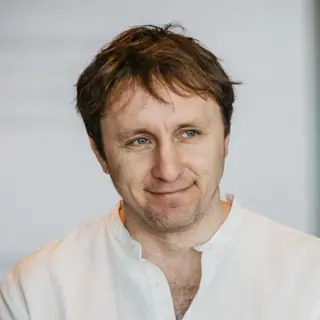
Who is Tomasz Domański?
- Who he is
- Tomasz Domański, CEO of Whitepress, business psychologist and marketing expert. He went from salesperson to head of an international company. For 16 years he has coached an amateur basketball team.
- What he does
- He joined Whitepress as International Expansion Manager and led the company's expansion to foreign markets, including Romania, the Czech Republic, Hungary, Turkey and Brazil. Whitepress is a platform for link building and sponsored publications that is also developing digital PR and influencer marketing.
- What we talk about
- Basketball and leadership, how to analyze foreign markets and why you have to be local, hiring salespeople instead of SEOs, the SEO Vibes conferences, failures in Brazil and Turkey, and plans to enter the American market.
- Where to find him
- LinkedIn (Tomasz Domański) and the SEO Vibes conferences organized by Whitepress.
Best quotes
„If you want to do something well, you simply have to be local.”
„I want to recruit good salespeople, good businesspeople.”
„I do not even treat these things as failures, but as a certain experience from which you have to draw conclusions.”
„When I see a talented person, then even though I do not yet know where they would fit in the organization, I want to have them in that organization.”
Recommended materials and sources
Mentioned in the episode
- SEO Vibes SummitEvent · seovibes.pl
 StatistaReport · statista.com
 CIA World FactbookReport · cia.gov
- Model HofstedegoReport · hofstede-insights.com
 Google TrendsTool · trends.google.com
 Google Market FinderTool · marketfinder.thinkwithgoogle.com
 SemwawEvent · semwaw.pl
 Kulturalnie o SEOEvent · kulturalnieoseo.pl
Related conversations




Transcript
Host: Rafał Moszkowców. Guest: Tomasz Domański.
Introduction
Rafał: Welcome to another episode of Globalne Horyzonty. Today I have the pleasure of hosting a man who proves that a psychologist in business is not only someone who helps you survive board meetings without damage to your mental health. With us is Tomek Domański, CEO of Whitepress, business psychologist, marketing expert and a man who can find a common language both with Google's algorithms and with the most demanding clients and employees on different continents. Tomek went from salesperson to head of an international company, and after hours he has coached an amateur basketball team for 16 years. In today's conversation we will find out how to conquer foreign markets successfully and whether the rules of basketball have anything in common with running a business. Tomek, welcome to Globalne Horyzonty.
Tomasz: Warm greetings to all the listeners, thank you for the invitation. It is a great joy and a great privilege for me to be here with you.
Basketball and lessons from Michael Jordan
Rafał: Thank you nicely. How is it with this basketball? It is incredibly interesting that you have coached an amateur team for 16 years. I wondered who your favorite basketball player is and why it is not LeBron James.
Tomasz: Exactly. My history with basketball began basically in the third grade of primary school. As a young person I was hooked on football, I am a guy from Sosnowiec, so I went to Zagłębie Sosnowiec matches and trained a bit. And suddenly a basketball coach came to school and said: listen, we are making a basketball-profile class, who wants in? My friends raised their hands, and I told myself, well damn, I will not stay out, I will gladly join that project too. And from then on, from the age of ten, I was in a basketball-profile class and trained twice a day: at school and in the evening. For the next 10 years I went through the whole path from youth, cadet and junior to senior in basketball. When university started, I had to give it up, but it planted in me the spirit of sport and love of basketball. And sport itself, I believe to this day, shapes character.
Tomasz: The best basketball player of all time is of course Michael Jordan, and only him. There is no discussion, he is several lengths ahead. Comparing him with LeBron is a mistake. I appreciated him terribly, because I watched all the games, I got up at night, I watched the NBA finals and I always rooted for the teams against Michael Jordan, because he annoyed me that he takes everything. I was a devoted fan of the Utah Jazz and John Stockton, a kind of point guard more like me. I was always against Jordan, but when there were those finals and I saw how Jordan played them, how he took over games, what a killer instinct he had and in the end he won, what a drive to win he had, I would get up and say: the rascal is the best after all. And I applauded him. Maybe he was a rascal as a person to his coworkers, because he squeezed the maximum out of them and demanded more than average, he was not the kind of buddy who pats you on the back, because he cared terribly about winning. But you have to give him that: he was and is the best, from the psychological, mental and athletic side and in how he knew how to close out series. He had that killer instinct.
Rafał: He was kind of superhuman. I remember being a kid and watching the Chicago Bulls, because I had a friend who was into basketball, while I was into football, and he often forced me to watch. I was very impressed, but I did not quite get the sport, I must admit. When someone is hooked on football, it was a bit of a war: those throw into a basket, and we play football. But what you said is mega important, because playing sport, amateur or professional, shapes character, because it teaches patience above all. You cannot work out expertise or mastery in five training sessions. It takes years, sacrifices and hard work. I played football for many years and it taught me that you have to wait for something good. I always played right midfield and I knew it was a very hard role and that I would not become a super winger after 10 or 20 training sessions, or even after a year of daily training. In business it is similar.
Tomasz: Exactly. In many basketball franchises in the NBA there is a saying: trust the process. Striving for excellence, winning the championship is a process that will take time, and you will not do it in one day. And as you said, in sport we learn patience, but also cooperation with others, because most of what we do in life is teamwork or has some human elements involved in the process. Even Michael Jordan, although he was an outstanding player, at the beginning achieved nothing great apart from his statistics and scoring records, he did not win a championship. Someone had to help him build a team around him. In business it is similar: you have to reach the moment when you say you cannot carry it alone on your shoulders. You have to build a team of people who understand the shared goal, have it somewhere on the horizon, and you act as a team. Then you have team synergy. The task of a leader like Michael Jordan in sport, and in business of the CEOs and managers, is to be a leader who carries those people along and convinces them that together we can do more. Even in individual sports, tennis, Iga Świątek, she also has her team. Most things we do are a team matter, and that is what sport teaches.
Is business psychology enough to lead people?
Rafał: I cannot disagree, but I will say honestly that for me leadership is the hardest part of business.
Tomasz: That is true. At the last round of recruitment for Whitepress, a lady from the fund asked: what do you think will be the biggest challenge? I said without thinking: people. Because people will either carry us or not carry us. And being a psychologist I know it is what you have the least control over, because people have their psyche, their needs, there are so many variables in personalities. Every person is a ball of needs, also aimed at professional career development, and looking at all those people, you have to think how to combine it so that it converges with the organization's goal, with the business goal. That is the most complicated element. I have such a rule in business: when I see a talented person, then even though I do not yet know where they would fit in the organization, I want to have them in that organization, because if they are talented, we will soon figure out how to use them. Hiring talent is important.
Rafał: Where does business psychology end and the art of leading people begin? Sometimes I feel they are not the same.
Tomasz: No, they are not. Although I studied business psychology, it helps you gain certain knowledge, but in the end you have to learn to use it yourself. There is a saying that the cobbler's children have no shoes: we often fall under the very laws we learn, and although we know them, we make mistakes we should make less of. For sure psychology gives you insight into yourself and a better understanding of people, in theory. I suspect I understand a bit more about certain human processes, individual or group ones, that happen in organizations, and that lets me manage people better.
How did Tomasz Domański end up at WhitePress?
Rafał: I wanted to go back to your beginnings in the context of SEO or content marketing broadly. People in the Polish environment are most often people who have been in it for fifteen years, like Paweł Strykowski, who did SEO before there was SEO. And with you it probably did not look like that. How did you get to Whitepress and how did it happen that you went in that direction?
Tomasz: From the very beginning of my professional career, even at university, I knew I wanted to do business. People excite me, business excites me and marketing always excited me, especially digital marketing, because I was around when it was being born: the transformation from traditional marketing to digital. Those were three things that always fascinated me, which is why I studied psychology, and at the same time management and marketing, and later digital marketing. SEO was somewhere in the picture. I remember the beginnings of SEO in Poland from the client side, because I was involved in various businesses and we used the services of firms that did SEO for us. I was never an SEO myself, I never did SEO with my own hands. It was always outsourcing to someone outside.
Tomasz: How did I get to Whitepress? I was involved in an international expansion project of another Polish product, but the organizational culture in my previous company did not quite suit me, because it was a typical iron-fist style, where we squeeze people for all they are worth.
Rafał: The so-called Prussian Polish company.
Tomasz: Yes, a Polish company, with the thinking that there is no leadership, there is to be controlling. You are to keep people on a tight leash, and that is not at all in line with my personality and the way I want to lead people. After some time of that expansion, which was going well, the product was great, I came to the conclusion that I was a bit worn out because that culture did not converge with my approach to people. I thought: let us see what is on the market. And I saw that Whitepress was looking, and the ad was written exactly as I would have wanted someone to write it to me. I thought: they must have written this to me. I applied and some two hours later I got a phone call with an invitation to an interview. I met Paweł and sometimes after three sentences you already know whether you are on the same wavelength. Paweł said: you are in the next round, you are in my top three candidates. I was invited to Warsaw, where representatives of the investment funds already were, because Whitepress then had three owners: two funds plus Paweł and the other co-founder with their shares. They grilled me. I am a fairly modest person, I do not like being in the spotlight, but on the way to the funds I thought I had to put on a mask of a sure thing: I will deliver this to you. Later Paweł told me that after that conversation the people from the fund said that this guy is probably too sure of himself. But fortunately Paweł saw that something in me from the start and felt we would get along.
Tomasz: I also had a conversation with the last fund, with a lady who was the fund's representative and who pressed me. At that third stage Paweł made the decision. He called me and the first words were: hi Tomek, you won the internet. We are taking you.
Rafał: In Paweł's style.
Tomasz: Exactly. He said they hesitated between two candidates, but he had the deciding vote and he went with me. When I later asked him whether it was worth it, he said it was definitely a good decision.
Rafał: What was the position?
Tomasz: International Expansion Manager, something like that. Paweł offered a good range for those times and showed right away what I would be doing. Several hundred people applied for that position, so it was the hardest recruitment I ever had. I am glad I managed to beat those candidates, because organizational culture is created by the board, the CEO and the managers. From Paweł, right when I met him, I felt the people around: yes, it is nice here, I feel good here. The lady at that recruitment said: Tomek, looking at you, you have a very similar psychological profile and a similar vibe to Paweł, so you will probably work together great.
How did WhitePress choose its foreign markets?
Rafał: It looks like it turned out that way. When I talked with Paweł a few weeks ago, he attributed Whitepress's foreign success largely to you, not to himself.
Tomasz: I do not want to attribute all the merit to myself, because it is not only me. But when Paweł hired me, he said: listen Tomek, I have Poland in my fingers, we do not know how to do foreign expansion, we have some product prepared to go out to foreign markets, take it and do it. Besides the first longer analysis of many markets, because the investors and we ourselves had to think about where to go, what next steps to take after Poland, I prepared, as Paweł also told it, a sheet with about 20 factors that we took into account in the expansion. We did that analysis. Although now I can say that we manipulated the results a bit, because looking at the size of the market, we know the United States cover practically all the other markets put together. The difficulty we had was that nowhere is there data on the SEO market. It is not milk sales, which you can check somewhere. SEO works in a gray business space, elusive in various reports. We can find out about performance marketing, but practically nobody reports on SEO, so we had to estimate on the basis of how it looks in Poland: we assumed that the market compared to Poland would be this or that.
Tomasz: It came out that the United States would be best and if we had gone to the investors and said: we are flying to the States, they would really have been happy. But our assumption was that we have to take the first steps safely. I already knew the CEE markets: Hungary, the Czech Republic, Slovakia, Romania, Croatia. I knew it would go well there. There was also proximity to our market, which was one of the parameters, and sentiment toward Poland, whether someone likes Poles or not, because that matters.
How does WhitePress expand in Czechia and Romania?
Tomasz: Contrary to appearances my experiences with the Czech market were not positive and to this day are not especially positive. Compared to Romania, where Romanians truly look at Poles like: wow, you are the ones. They say we are the China of Europe, that we produce a lot. Most products in Romanian stores are Polish: Tymbark, juices, sugar. We export a great deal, Romania is a very good market for us. And Romanians look at us like we did the transformation from socialism-communism and it ended in success in Poland, now we are shown as an example that Poland changed brilliantly, and they see it, because that transformation is happening later for them. Poles are a synonym for something good for them. The Czech Republic, though: I remember when we did recruitment in my previous company, and they said: you are from Poland? We remember your road salt sold as edible, poisoned chickens. Poland is not associated with a good product for them. Plus historical baggage. It seems to me that Czechs look more to the West than to the East.
Rafał: Apparently that is changing a lot. Recently I read somewhere research on sentiment and perception of Poland and Poles. In the Czech Republic the anti-Polish campaigns have also faded, because Czech companies ran such a campaign, especially in the FMCG sector, using stereotypes. Czechs in my experience always laugh at Polish Catholicism and backwardness, but more as a joke. Overall sentiment toward Poland is changing, but I think also because the German economy is no longer so strong and does not provide the Czechs with everything they need, because Czechs were mainly based on the German economy as its first subcontractor, and now a lot is changing thanks to the Polish economy growing. And tell me, how did you approach it analytically? How long did it take to prepare such a plan?
Tomasz: It took me a month. I started work on March 3rd at Whitepress, and on March 29th we already had to meet with the investment funds and show them the map. For a month I collected data for my analysis. I did so-called desk research and collected a lot of nice data from various sources like Statista, CIA World Factbook, our own studies. From the psychological side there is the Hofstede model, which studies cultures and the sentiment of some cultures toward others. I used Google Trends, Market Finder, the KUKE organization, which had analyses of foreign markets. At the end I looked at LinkedIn, which gave us a lot of information about how many SEOs there are in a given country and how much e-commerce. We broke it down into factors with weights and from that this sheet came about. We divided it into four categories: ease of entering the market, culture, competition, market size and the local SEO and e-commerce market.
Rafał: Ease of entering the market from what angle? Legalization, setting up a company, hiring?
Tomasz: I took into account labor costs, sentiment toward Polish companies, KUKE recommendations, OECD recommendations for doing business, distance from Poland, which mattered at that time, and our own experience with different markets. We assigned weights to each factor.
How does WhitePress reach break-even with local companies?
Tomasz: You have to know that going to foreign markets costs a ton of money. Our competitors do it all from Poland or from their own country: there is a headquarters, a team is built there. We thought about two models, but we knew right away, because I already had that experience: if you want to do something well, you simply have to be local. I have a motto: go global, but be local. We wanted to open offices in those countries right away and hire people there who would win the market. We did not want to win the Romanian market with Polish hands or look for Romanians in Poland who would open the Romanian market for us from an office in Poland. I knew there are loads of financial and accounting problems, withholding tax questions, foreign invoicing. That creates big barriers and gives no security. So entering a foreign market, we opened our own company in a given country, hired people, and that company acts as a local company toward partners, publishers and clients on that market. In the end the market did not even have to know we were from Poland. It costs time and money, but fortunately Whitepress was resourceful enough and had that way of thinking that this is how it has to be.
Rafał: Did you measure the profitability of those companies? Did you set a horizon that Whitepress Romania should be profitable after 24 months?
Tomasz: We did not set it in advance. Opening the office and salaries were low costs for us. When I showed the investors how much money we could do expansion into those markets for at the beginning, they were shocked that it could be done for quite reasonable money. We decided: let us do it and see when we reach profitability. In Romania I was hired in March, and in April I already had people recruited. It went very fast, because I had my own experience and knew which paths to follow. From July the office was working and we started acquiring publishers. The assumption was that we wanted the first five hundred publishers in our portfolio. From October we started selling, and I think in April we did break even in Romania. In short, in not quite a year Romania closed nicely for us, because we hit a good moment: there were no such platforms there, there were many people trading links and sponsored publications, and we came in just when they thought: oh gosh, this is a nice tool that will help regulate the market. Like with Paweł in Poland, in Romania we also had many haters: we do not believe in such tools, you will not make it. And Paweł said: in Poland it was exactly the same, do not worry, let us go.
How to recruit salespeople in foreign markets?
Rafał: Mindset is probably the most important, because you cannot calculate everything right away. It caught my attention that break-even came very fast, but also the hiring of people. How did you do such fast hiring? Did you do it personally, did you hire a recruiting agency locally?
Tomasz: Everything personally. It is my talent: finding people. Maybe the psychology background matters here. I think my soft skills are my key skills. A plus was that I had worked on those markets earlier: Romania, Hungary, the Czech Republic, Slovakia and so on. In my area I already had some verified people and those people followed me from previous companies. My biggest challenge was that the market de facto did not exist. An SEO link market simply does not exist in some markets. It is not like in Poland, where there are loads of SEOs trading links: come to Whitepress, we will do business. In many places we simply have to create that market first. But my assumption right away was that I do not hire SEOs at all. I do not care about SEOs, sorry. I want to recruit good salespeople, good businesspeople. People with nice soft skills, because they do not have to know SEO. We at Whitepress are an intermediary that acquires publishers, and that is selling a certain vision: you will earn with us. And then we look for agencies and end clients: this is a nice tool that will help build visibility. So here we sell and here we sell. I looked for salespeople by design.
Rafał: Good advice: look for people who will introduce you to that market and acquire clients. I often see that companies from a Polish headquarters, sometimes very large ones, try to do foreign expansion without getting into the cultural issues at all, not hiring locally, trying to transfer a carbon copy. I do not have as much experience as you, but I know it never works, at least I have not seen real success done that way.
Tomasz: Exactly. Go global, be local is key for me, because who will build relationships with publishers or agencies better than a Romanian with a Romanian? I saw our competitors send emails in English to Romanian publishers and it landed in the trash, because nobody will read such an email. Our salespeople in Romania were trained to pick up the phone and call. I think that is also why Paweł hired me, because I told him: we will open all the doors, we will not wait like in Poland, because Whitepress in Poland grew somewhat inbound, content-wise, for so many years there was no sales department. We made a lot of content, the tool was presented in groups and people started using it, and then word of mouth. But with foreign expansion we do not have time to make articles and campaigns and wait for something to grow in three or five years. We have to, to put it bluntly, call people. I had experience building such call centers and I knew people who can talk to people on the phone. To this day the most effective ones are not those who write emails, but those who pick up the phone and settle the matter in 30 seconds.
Rafał: Most of the market has stopped calling, people are afraid, and those who are not afraid and settle things on the phone, close the deal, solve a problem with a client, are the most effective. I am not a big fan of calling myself, but I know that when I want to get something done fast or establish a relationship, the phone is the best shot. Writing emails or automated follow-ups on LinkedIn has some effectiveness, but I like your bold approach.
Why does international expansion take courage?
Tomasz: You have to be bold. When I went to England in 1999, we were not yet in the European Union, that is when I instilled it in myself. I go in blind. Everyone goes, studies the language, works, earns money, at that time you had to do it under the table. I worked on a construction site for three months. I saw what it looks like in London and thought: next year I will come here and work in hospitality. I arranged references, because that is the standard there. My friends worked through agencies, where they were sometimes paid under the table. And I sent my CV to five-star hotels only, even though I had no experience, and went to a normal interview, where I was hired at a super fancy hotel in London with practically no experience. I put on a suit, I had good English. Nobody even asked about a work permit. Only after half a year they asked whether I had a permit, and once they had come around to me, they arranged my visa themselves. I also had a funny situation: I had to go to the dentist without being insured and I had to pay 70 pounds, which for a person from Poland was a ton of money. I filled out some form for a poor student from Poland and they gave me the money back. Fortune favors the bold: sometimes you have to have a bit of drive and not worry, because then we can build something nice. In foreign expansion Paweł gave me complete freedom: I handle Poland, you fire it up, do it the way you think it should be done.
Rafał: We have very similar experiences. I first went to the United Kingdom in 2004 for three months, looking for work, and I had experience with an agency that took 20 pounds and paid out 3.50, because it also deducted for the uniform and the bus. Then I came back and was in the United Kingdom for 15 years.
Tomasz: I was there only two years, because I took a leave of absence from my studies. I remember a funny situation: I arrived in the evening, someone gave me a number to an Irish construction company that hires quickly for three months. I called and collided with Irish English. They told me to be on "Aaron Street" in two hours. I thought it was some Jewish district. I went, I was looking near Trafalgar Square until I saw Orange Street. Only then I realized that Irish English is like that. For the first three days I understood nothing, then I started to get what they were saying to me. Most of my managers were Irish, it was a pleasant experience. On a construction site you grind 10-12 hours, and I saw friends working in hotels through agencies. I thought: why they in 3-4 star hotels and not 5 star, it is better there. I wrote, they invited me to an interview and I worked a normal job. I even managed to get promoted, and when I went back to my studies, I filed papers for a tax refund and they even gave me the tax back. If you want it, it can be done.
How does WhitePress build the market with SEO Vibes conferences?
Rafał: Speaking of going out to foreign markets: you are not going out anymore, you are already there, and on many markets you are the leader. And you said you shape the market, you build it. I read that you organize about 20 conferences around the world. What is the purpose of those events? How do you measure them? Is it your main tool for building the market?
Tomasz: The approach to link building in Poland is very positive. Everyone does it, practically nobody nitpicks that it is black hat. It is done, which is why Whitepress grows, why our competitors grow. The question is not whether to do it, but whether I will buy it at Whitepress or elsewhere. In some markets, for example in the Czech Republic, it is not talked about in groups. It is taboo. There is a narrative that it is against Google policy. Everything is done under the table there. We work with all the biggest players on the market, but nobody wants to talk about it officially. We even have NDAs signed: nobody can know that they use us, because everyone knows it works, but nobody wants it officially. In Poland everyone talks about it. And there are markets, like the Balkans, where business does not know at all, SEO is not strongly developed.
Tomasz: Poland has that quality that we managed to build an SEO community very willing to share knowledge. The number of conferences organized in Poland compared to other countries is astonishing: every two months there is a conference, Festiwal SEO, Semkarka, Semwaw, Kulturalnie o SEO. We share knowledge very willingly. In other countries, in Romania, in Hungary, there is a belief that I have my secret knowledge, it is my competitive advantage and I do not want to talk about it. That is why in my opinion Polish SEO is very good and advanced. We should not be ashamed of anything against the whole world, we are one of the top nations doing SEO. In Turkey some things work that worked for us five years ago.
Rafał: Google rolls out changes to English-speaking markets first. Now you have AI Overviews, which I think are not yet in Poland, but are in the States already, and SearchGPT: with clients from the States that is the number one topic of conversation. And in Poland they ask what SearchGPT is. It does not come from a lack of knowledge, but from how Google rolls out changes and how many people use other tools.
Tomasz: Still, when it comes to sharing knowledge and learning, we are at the top. There are markets abroad that have to be educated and pushed. Going abroad, nobody had heard of Whitepress. In Romania, individual people. And how long can you keep calling, so we had to build a brand. When entering a given market, it is very important for us to establish contact with so-called SEO influencers, opinion leaders. At first they were distant: some platform, what do they want from me. So we made a conference, because in those countries there was no conference. The first SEO conference or meetup: let us invite them as a speaker, let them brag, let us tickle their ego. When I call and say: do you want to be our speaker at a nice event, do you want to build your personal brand with us, we spend money to organize it, then suddenly the talk is completely different. We created the SEO Vibes brand. It gives us recognition, lets us build contacts with speakers. I often joke that I do these conferences for the people who come only to build relationships with the opinion leaders. And third, at such a conference there is a pool of potential clients that comes to us. We had to invest: finance and organize the whole conference from scratch and build a team that deals only with that. When we calculated it, it is sometimes more profitable than heating up performance.
Tomasz: We have a Polish flagship, SEO Vibes Summit, which we named so that it would be international. Last year we did an international conference in Dubai, earlier in Cyprus. Besides that we have smaller SEO Vibes on Tour events, local, in the local language: in Greece, in Istanbul, in Helsinki, even in São Paulo. It gives brand recognition and lets us build relationships.
Rafał: You can see it in revenue, your revenue is growing.
Tomasz: It is nice that it grows, because looking at the market, not everyone managed to grow. Here and there we see declines. We manage to grow, but it is paid for with hard work and we spend money on it. Anyone who thinks foreign expansion does not cost, it does: in the first year of SEO Vibes on Tour we had to finance everything ourselves. In the second year, when they knew us, we had sponsors. The first big conference, two years ago in Budapest, right away at a high level: practically at every conference we lost about 20 thousand euros. The whole conference cost us 100 thousand euros, and after it we were 20 thousand euros behind. But our earnings were the contacts and building the brand. We could afford it.
Rafał: I appreciate that long-term thinking. What impresses me about Whitepress is that you plan much further than half a year. You invest in something for a year, two, so that in the third, fourth year you keep earning. I do not want to say it is unique to Poland, because that would be an exaggeration, but it is refreshing.
Tomasz: We were lucky: I got into a company that was already successful and had resources, Paweł trusted me and gave me a free hand, and third, right away we told ourselves: we want to be a world leader, not a local player. We want to be global.
What failures has WhitePress faced abroad?
Rafał: Since we are talking about successes and the road, Tomek, big failures. Where did you stumble in that expansion?
Tomasz: It is hard to say. Many things worked out very well, some middling, but still well. Brazil: only now is it doing break-even. We had to wait two and a half years for the market to develop. Brazil is very expensive to maintain a company in: we had to set up a joint-stock company, because as a foreign company you cannot simply set up a company there. You have to have a local partner at least on the board and you have to pay them. Plus Brazil is a socialist country, the number of privileges that must be provided to employees is costly. And the third matter is taking money out: if we issue an invoice to a company in Brazil and the money is to leave it, it is taxed at 35 percent. They gladly accept capital but do not want to let it out. The market is theoretically big, there are agencies, but there are one or two influencers who set the narrative that link building is against Google policy, so it is hard to break through. There are many link dealers who sell cheap. Brazil is a bit of an experiment for us, because in Europe we benefited from cross-border transactions: Poland invests a lot in the Czech Republic, Hungary, Romania, so from the beginning we had foreign clients who invest there. Brazil is a lonely island, without internal demand it is hard to break the market. We pumped two million zloty into it to survive to break-even, and now we will have to work it back over the next two, three years.
Tomasz: Turkey is another great market for us, but there is hyperinflation there, economic and political matters strongly influence business. We have many clients, the business grows if you look in lira, but when you convert to euro, we have to keep raising prices and salaries. We earn there, but not as we would wish.
Tomasz: There were also recruitments that did not work out. I remember when we were entering Slovakia: I hired a man and before he started work I had already fired him, because I felt there was no chemistry between us. That entitled attitude from the very beginning. I had to move the first training by two days and that man was outraged and had claims. I thought it would not work. I do not treat such things as failures, but as an experience from which you have to draw conclusions and move on. I do not even treat these things as failures, but as a certain experience from which you have to draw conclusions.
Tomasz: One more thing: we started hiring salespeople from other industries, we invested a lot in teaching them, they learned our SEO market and link building, built relationships, and then foreign competition came and poached them. We had several such situations: trained, they know the clients, so we will pay a bit more. One Danish company, for which overpaying a Polish employee is no problem at all. One, two, three employees poached. We introduced a non-compete. We have a non-compete agreement with all employees and we pay when they leave. Honestly, I was very angry then that our competition operates this way, because it is a shortcut: we had to educate these people, and they leave with all that knowledge. It was a lesson for us.
Rafał: As a company grows, you have to look for such options to protect yourself. Not everyone can be Netflix: apparently at Netflix, if someone gets a better offer, they add on to pay the most, and on the other hand they may also say they no longer want to work with you if they do not care that much.
Tomasz: From experience I know that when someone reaches such a point, most often in 90 percent of cases, that they mentally made the decision to leave because someone offers them something, that person is a bit lost already. People rarely come with: you know, they offered me more, but I would like to stay with you. Most people agree things elsewhere and come only one way.
Rafał: I agree, but it is also a matter of culture: it is okay to go elsewhere for an interview and measure yourself against the market. We had such a rule: go, measure yourself on the market. And very often people measured themselves and it turned out nobody would pay them more.
Tomasz: Sometimes it is not about finances, but about the whole: work culture, what you can and cannot do. I have a bittersweet satisfaction that some employees who left Whitepress, although on good terms, decided there was a better offer and later came back and said: we did not appreciate what we had at Whitepress, we would like to talk about returning.
Rafał: That is a big reward.
Tomasz: Yes, we hold on to that. As Whitepress we do not have a big drawer of money and we do not want to compete with everyone, especially since the world has changed: you can sit in Warsaw, in Kraków, in Bielsko-Biała and work for an American or Danish company at a Danish rate. We try to be an overgrown startup, although it no longer works, we are already a geriatric startup.
Crazy ideas and the startup atmosphere at WhitePress
Rafał: In a startup atmosphere I appreciate courage and space to make mistakes. I do not appreciate contempt for processes and procedures, wishful thinking. But that note: nobody has done this yet, so let us try, is an element that is nice for you to keep as long as possible. Because big companies with thousands of employees develop and take far fewer risks when they do not have that element of madness.
Tomasz: For example the idea of organizing conferences was a bit crazy, because it is a ton of money. I even had an idea last year to do a conference in India for 10 thousand people, in a stadium, and we ride in on elephants, pardon me. Such a rock star. When I told my friends from India, they all got fired up and still call me to ask when we are doing it. Or that Dubai: in July we were at a conference in Birmingham and I said: let us do a conference about AI, SEO-style AI, what would be the best, innovative places? Dubai. Who did an SEO conference on the Palm? Probably nobody yet. So let us do it. And we did. It was the best conference ever, I have a video on YouTube, to this day everyone calls me.
What are WhitePress's plans for the US, digital PR and Asia?
Rafał: I wish that note of positive madness is always in you. Finally about the future: what are the next steps for Whitepress? India, Asia?
Tomasz: We are already throwing out tentacles toward Asia, because it is nice when a client helps you get out to certain markets. Clients come to us whom we would never have gotten, because we offered them Lithuania or Croatia, and they ask about Vietnam, Thailand, Singapore. But from my experience, if we want to earn, and investors want us to grow, every year they asked: which markets do you put on the table? In practically every country of Europe we have planted a finger: maybe Andorra is left, we already have Luxembourg, even Montenegro. We have all of Europe covered, Brazil, Turkey and quite a few clients from the States. The market we thought about from the very beginning, even after that analysis, is the United States, let us be honest. Those several years were like packing on at the gym, building form so we could get to the States. Now as a pumped-up player we are taking the first steps on the American market, because that is the promised land. In the metaphor of a computer game, we are reaching the last level: we passed level A and B and now we go to the game master.
Rafał: My conclusion about the States is that you are needed there. Awareness of link acquisition is high there, and there are loads of companies from all over the world that need this service for the States to sell their products there. That space is gigantic. There are companies that for 15 years have sold packages of links, a pig in a poke, complete rock bottom, I bought it and tested it. A service like yours, with outreach, digital PR and a tool for promoting different formats of content, totally yes, although it will surely cost a lot of energy and money.
Tomasz: Exactly. We are developing the platform, expanding our services with digital PR, we do not want to be only a provider of guest posts. We have influencer marketing, which is developing great for us in Poland and abroad. Whitepress is links and content and that will not change. We will ride that to the end of the world and three days longer, or as long as it works. To the end of SEO. Of course SEO is dead as every year, but we also have other revenue streams, because clients increasingly expect comprehensive service: not just guest posts, they need content, digital PR, other link acquisition techniques. I would like us to be the number one brand in the world for digital marketing, content marketing, around SEO. I have been at many conferences, met many companies and we are in the top of our industry. Our SEO industry is not big compared to e-commerce, the giants are Ahrefs and Semrush, but compared to others we have nothing to be ashamed of. Whitepress is practically recognized in the world, wherever I go someone has heard of it. Looking at the revenue and the number of people we employ, we are high in the industry. What worries me is that maybe there is a ceiling not far away, but looking at the American market, I think we have a long road ahead to earning.
Rafał: You have to move fast, probably even faster than before, because the bigger and more recognizable you are, the faster they start to copy you.
Tomasz: We now have Serbian competitors who copied our whole site with AI. Someone recently did an analysis of about 120 platforms like ours and fortunately we came out third. The analyses are subjective, but I am glad someone copies not just anything, that we became a benchmark in the industry.
Rafał: Absolutely. I met Whitepress somewhere around 2014 and thought: oh, they will drop it all, who will buy this. Living in the United Kingdom then, it did not even occur to me that you can buy links this way and that it would evolve like this. Today I am your client and quite a big one. That ease, that you are able to connect me, I need Croatia and I do Croatia with you, I can do Ireland, Norway, is incredible. Thanks to that it will be hard to copy the whole model. Whitepress can be copied piece by piece, but the unique model of development, building relationships with publishers, that cannot be copied.
Tomasz: Most often these are aggregators: some shop set up, a system where they collected whatever hangs around the internet. Either those companies do not deliver, because you have so many intermediaries, or the price is cosmic. Having a team of two hundred people scattered around the world costs, but thanks to that we theoretically have the best prices, because we have direct relationships with publishers and solve problems fast without intermediaries. Competitors are there, like mushrooms after rain, and I know we must always be two steps ahead, in expansion and in an innovative approach to selling our products.
Rafał: I wish you to keep the pace and that you keep wanting to do it. I keep my fingers crossed that the States develop as well as possible. Thank you very much for the conversation and for sharing the details of your expansion, above all your plans. I thought you might want to dodge a bit how exactly you did it, but you were very honest.
Tomasz: I also thank you very much for the invitation. You have to be honest, because as you yourself said, in certain things we are five years ahead. If someone wanted to copy it, I have even had several such conversations: competitors come to us and say they had an idea to do it, but let us agree something with you, because you already have it done and we cannot buy that time. I hope our paths will cross again somewhere.
Rafał: All the best, Tomek. Bye.
Listen and watch
The same conversation in your favourite app.
The full edited transcript as a Markdown file, with the guest’s details and quotes.
Back to top