

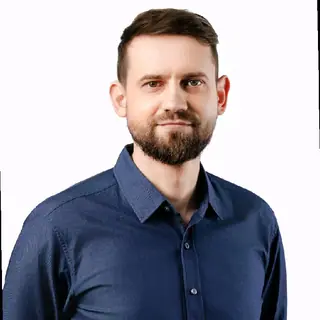
Who is Bartosz Jóźwiak?
- Who he is
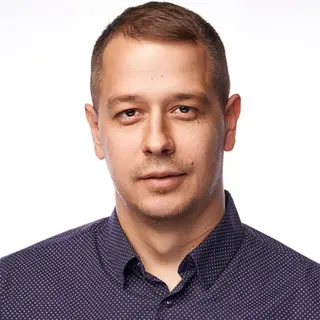
- Bartosz Jóźwiak, a lawyer specializing in intellectual property and new technology law.
- What he does
- He has worked in intellectual property throughout his career. As a partner, he manages the intellectual property and new technologies practice at the Kolegial law firm in Poznań.
- What we talk about
- Whether artificial intelligence can be a co-author, whether content it generates is protected by copyright, what risk of infringement comes with using AI, how to protect your own creative process, and what the AI Act and compliance say about accountability for AI.
- Where to find him
- The Kolegial law firm in Poznań.
Best quotes
„Admittedly, what has been spat out by artificial intelligence is not protected by copyright, but it can infringe copyright.”
„That is how the law works, so it is always a bit behind, there is always a bit of catching up, and this matter of interpreting it and applying it to specific cases is precisely the whole art that we practice.”
„Whether we use AI or not, we do not create in a vacuum.”
„It will not be bad advice to archive the creative process, the sketches, what we are building on.”
Recommended materials and sources
Guest’s pick
 openlibrary.org
 lubimyczytac.pl



Related conversations


Transcript
Host: Rafał Moszkowców. Guest: Bartosz Jóźwiak.
Introduction
Rafał: Hi, welcome to another episode of Globalne Horyzonty. Today with me is Bartek Jóźwiak, in my head a lawyer for artificial intelligence, for copyright, but I think it is better if he introduces himself. Hi, Bartek.
Bartosz: Hi, hi. Thanks a lot for the invitation. Well, not only for artificial intelligence, mainly for intellectual property. That is how I would place myself. I have actually been doing this basically throughout my whole career, and for many years now I have been working in this business. Now I work as a partner who manages the intellectual property and new technologies practice at the Kolegial law firm in Poznań.
Rafał: Thank you very much for finding the time to come, especially since today is a holiday and you should be celebrating, but maybe you have had enough, because we had two and a half weeks off.
Bartosz: Yes, how much can you take. It is a good day. I am here at my office, it is quiet, nobody is here, so first the podcast, and then I will work on my lecture.
Rafał: All right. I hope the podcast warms up well. I wanted to talk about a great many things today, but we will try to focus on what bothers me personally, as you already know well, and also my clients and business partners, that is, artificial intelligence and copyright related to what artificial intelligence produces, and how it can be used to transform finished works. I think this is something that is still not clear. I know there is a lot of legislation. Maybe we will touch on the AI Act too. I tried to get into it earlier and recently as well, and I do not understand everything there. Probably some question about related regulation will come up as we talk. I am very curious about your opinions and your experience. If that is okay with you, we can begin.
Bartosz: Sure, sure. This is a subject which, I do not want to say that it arose recently, because these are not really new topics, right? And what we have in the regulations does cover these topics. It is just that often we simply have to address issues related to a new form of creating, using tools that we have actually had for over a hundred years. But that is how the law works, so it is always a bit behind, there is always a bit of catching up, and this matter of interpreting it and applying it to specific cases is precisely the whole art that we practice.
Rafał: Well okay, that law does not keep up with technology is also a classic thing. I think it creates some problems, and among other things the AI Act is an attempt to move forward with this, but we will come back to that. I would like to start with something simple. Well, I think it is simple for you, and bothering to me. AI as a co-author. Bartek, is it possible in Poland to recognize artificial intelligence as a co-author of a work? Whatever the work is: a painting, a photograph, a book, or maybe a podcast?
Bartosz: Not really. Well, no. Let us go back a few steps. We are in the field of copyright, and copyright concerns human creativity. People have already tried before to wonder whether there is such a thing as animal creativity, whether a photograph taken by a monkey is protected by copyright. And there is a general agreement here that no, that we are talking about creativity that is human.
Bartosz: The problem that arises is this: if something is generated by artificial intelligence, then that something is not protected by copyright. This is now also becoming structured in documents such as the guidelines of the US Copyright Office. They issued guidelines in which they show what is protected and what is not. It is a practical document which says directly that what is generated is not protected. The office refuses to register, because that is where works are registered, things that are generated solely by AI. However, if something is the result of human work, where artificial intelligence is also used in a supporting way, then there is no obstacle to obtaining protection, or obtaining it partially. As in the case of the comic "Zarya of the Dawn", which its author created with Midjourney.
Bartosz: She generated the graphics in Midjourney, but besides those graphics there is of course the plot, the text, so also putting it together into some whole. The Copyright Office registered it, but clearly indicated that the protection is partial, meaning it does not cover the graphics, the things that were generated, but only the plot and the text layer. That is protected for the author of the comic. This also agrees with my own view of the situation. So if we generate something directly, if something is generated by artificial intelligence as a result of a prompt, because that is how it works, if we assume that is how it works, then that output in my opinion will not be protected. The prompt may be protected, because if it is elaborate, there may be creativity in it. However, if you work on something that is an element you created yourself, whether it is a painting, a photo or music, and you use artificial intelligence tools in the further processing, that does not have to mean that you lose protection. That is how I would put it.
Rafał: I suppose such cases before courts will later be very, very long and very complicated, if considered in such a multi-layered way. I am not saying whether that is bad or good, because I do not know anything about it, but I just imagine it is not easy. And tell me, moving on...
Does AI content fall into the public domain? The problem of proof
Bartosz: May I add something? You know, you touched on something that really troubles me. It is nice to say ex cathedra that something is not protected. What is the effect of that? If I say that some work, some creation is not protected because it was generated by artificial intelligence, then the effect is that it belongs to the public domain, meaning anyone can use it. And now a doubt arises at the stage of a possible court case. How do I prove, if someone decides that what they have generated is protected after all, and sues me? If they say it was generated, then I have a simple matter, right? But I assume they will not say that. How am I to prove that it was created by AI? In graphics you can often still see it, right? Well, less and less. But in code, in a computer program? How do I verify that? This is a whole sphere that opens up a completely new space, not fully explored. I know that in the linguistic sphere tools are being developed for verification, and that it is possible to detect certain mechanisms of automation, of this generating, that show that a text was not necessarily created by a human. How to do that in coding, I have no idea.
Rafał: Frankly, I think that is impossible, because if code is subject to some review, is compiled and so on, then how do you assess it? It can simply be better than most programmers. Sorry to all programmers, a silly joke. And as for texts, I have the pleasure of working with generative artificial intelligence tools basically since 2020. We have created tens of millions of articles and hundreds of thousands of photos and graphics since then. A few years ago we already created a mechanism for humanization. How does that even sound: a mechanism for humanization. I do not know if it is scientific terminology, but that is how our industry communicates.
Rafał: That is, we are able to teach one machine to create content, and another machine to humanize the content created by the previous one, so that it is absolutely undetectable. Not even one percent is detectable by any detectors. So I think this creates a field for abuse. And since you already mentioned the United States, I suppose interesting cases will come from there.
Bartosz: Sure, they already are.
Rafał: Exactly. And tell me, because there is one more issue that bothers me, I recently got a question like this. We have a tool that can produce semantically coherent content from a single word. It is not just spitting out content through ChatGPT, but a multi-stage process of fetching content, analysis, humanization, matching, semantics and so on. A client buys such a thing from us, gets it, publishes it, but asked a very interesting question, one I never wondered about before, and I should have.
Can you sign content generated by AI?
Rafał: The question was: okay, so we have this content, it is great, it has photos in it, slideshows, GIFs and everything, but can I sign it as myself? From the ethical point of view I did not know how to put it, whether it is okay, without a disclaimer, meaning: hey, this is AI, and I put my name on it. The way people sometimes do, and the way I sometimes do myself, because I think I probably should. On the ethical level I do not quite get it. I do not know how it should be in the end. And that person also asked me a question on the legal level. Because if you sign it, then by presumption it is my content, so if you take it from me, I will sue you, because these are my copyrights to this content, even though it is generated.
Bartosz: Yes, yes. I would reduce it to the statement that it is not nice to lie. However, the world can be brutal and we have to be aware that there are people in the world who lie. There is indeed room here for such liars, because if I do not have the tools to take that lie apart and prove that someone is lying, then I expose myself to a shot, potentially a lost case against such a person.
Why does intellectual property exist, and what is the Thaler case?
Bartosz: There is a very interesting guy who is trying to dismantle this whole system. We are talking here in the context of intellectual property rights, meaning exclusive rights, meaning monopolies, something that was meant in principle to boost innovation. To give a kind of...
Rafał: To break up, to speed up, in that sense?
Bartosz: Yes, a kind of speeding up. I do not like it, but I have a word in English: incentive.
Rafał: Incentive. Okay, okay.
Bartosz: Exactly. That is the basic role of intellectual property. You get a monopoly, which is delimited in some way, whether in copyright or in patents, for example. And thanks to that you can earn from it, so you have the motivation to keep creating. You simply get value from it. That is the original premise of intellectual property. And now we are in a world in which this is going a bit off the rails. People ask themselves whether it is not the case that this exclusivity, these patents, stifle innovation. You have copyrights on so many things around you, and there is a drive to widen this protection. If someone has built a portfolio, they want to protect it as widely as possible, not only against direct infringements, but also against similar things. That is a natural drive to expand your garden. It is the same in patents. And there are technological standards, which on one hand allow interoperability, and on the other stifle you, because if you want your device to communicate with your computer, you have to use Bluetooth or connect it some other way, I do not know, infrared is still used for something. But these are all standards, so you are somehow limited. That is this whole sphere.
Bartosz: I am saying this because I want to bring up Dr. Thaler. Thaler is a guy who, I think, has been trying to dismantle this system for thirty years. He does not lie in his applications. He files patent applications in various jurisdictions and also copyright applications for things generated by his machine. His tool is called DABUS. It is an acronym I will not decipher, but he files various solutions created by this tool and tries to obtain patent protection. And usually he meets with refusal. I think he obtained something in South Africa, if I am not mistaken, a design patent, which we would call protection of an industrial design, which is already a kind of foot in the door, once you get such protection somewhere. He clearly states that the creator is the tool, that the creator is DABUS. So we are also dealing with a situation where the legitimacy of the anthropocentric approach to intellectual property rights is questioned altogether.
Rafał: Do you think this is the direction things will go? That the law will be expanded?
Bartosz: Well, there is certainly such a drive. I think the simplest way to expand it is simply not admitting that I used artificial intelligence in the process. I do not encourage that, absolutely. However, I am concerned about it. Because I am convinced that protection belongs to human creativity and that it is a human who deserves that protection, and on the other hand I see that I may have no arguments when facing someone who, maybe not openly, but I will suspect, is trying to protect something that should not be protected.
Is a photograph the work of a machine? The Sarony case
Rafał: Let us stay a moment longer and explore this. You say that the interpretation is that what is created by a human is subject to copyright protection. And now I think to myself, I am a layman in matters of law, as you have probably figured out. Photography. Maybe it is a silly example, but it comes to my mind first. I took a photo with a machine. It was not me who took the photo, I did not take it with my eyes. The machine did. I can set it better or worse, but it also has its native settings. Maybe these were the machine's native settings. A photo is taken. It is great. I won, I do not know, a Grand Press award. And someone takes that photo and uses it. Is it subject to copyright protection or not?
Bartosz: That is a real-life example, because already at the beginning of the twentieth century people were wondering about this. No, even earlier. I had a look at my note about a case which is very interesting in this context. It was the year 1882. People were already wondering there whether photography deserves protection at all. And exactly such arguments were made, that photography is a reflection of reality made with the help of a machine and should not be protected as a work. There was a case concerning a photograph... wait, what was the name of that guy whose photo they took? The case was called Burrow-Giles Lithographic Company versus Sarony. Sarony was the author of a photograph of a writer. I will tell you in a moment what his name was: Oscar Wilde.
Bartosz: Oh, a photo of Oscar Wilde. And arguments were raised there that a photo is a reflection of reality and does not deserve protection. And the author of that photo argued that it does deserve protection, because he created the composition of that photograph. But the truth is also that not every photograph will be protected. There are photos that are protected and photos that are not protected by copyright. Because if you have a composition, if you work out the shot, if you set various technical issues, then it deserves protection and that is how I would prove that creative contribution. However, if it is a photo taken by chance, a simple shot from the hip, or a photo taken by a device mounted on the roof of a car that drives and takes photos of the street, then these are not photos that are protected.
Rafał: You know, I think only creativity is needed, because in general you can build a theory for anything and say that we set up this radar, lidar and the camera related to it so that only at a certain angle, with the setting sun, it took a photo, I do not know, in the afternoon.
Bartosz: If so, then so, but...
Rafał: But that is some kind of definition of madness, in a way.
Bartosz: Yes. That is something incredibly attractive in intellectual property law. That elusiveness and a certain flexibility, which can be tiring. Very often there is no zero-one answer, we are just able to build an argument for two sides.
Is AI the biggest intellectual theft in history?
Rafał: You know, there is one more thing that bothers me. Because we work with these artificial intelligence tools, you can see their development. I am talking about generative artificial intelligence, not traditional, because that also needs to be distinguished very well. The traditional kind has been with us for decades. But generative artificial intelligence did not come from nowhere, in the sense that it does not produce things from itself. Even if it hallucinates and predicts wrong words, divides tokens wrongly, it takes them from information supplied by people. They say this is the biggest intellectual theft in the history of the world. I am curious whether you share that opinion.
Bartosz: That is interesting. Technically there is a discussion going on about whether what happens in the course of feeding, building models or artificial intelligence tools is an action in a specific field of exploitation that is permissible or not. And it seems that rulings are already appearing which sanction that it is permissible. However, I think there are two things here. One thing is whether this action itself is permissible, whether it is theft or not theft. And here, as I say, on one hand rulings appear, and on the other settlements appear. Anthropic is entering into settlements with creators whose content was used, so that is one direction. And the other direction is this: whether specifically what you created using some AI solution, whether that output does not infringe someone's rights. Of course it is not the case that it will take a piece out of one work and just put it in yours, but it could be, right? It could. So there is that risk.
Bartosz: My conclusion is this, and this is the most interesting thing for me, because this is where I think things will happen in court: admittedly, what has been spat out by artificial intelligence is not protected by copyright, but it can infringe copyright. And there is the risk. Because on one hand you should not have protection for it if it is only generated, and on the other hand it does not mean you are not doing something wrong to someone, that you are not infringing and that you do not have a risk. In other words, there may be a risk that someone will drag you through the courts for it.
What is remix culture, and will AI lock us in an echo chamber?
Rafał: I imagine some such stories in the near future. It is probably already happening. I did some preliminary research and there are quite a few such cases in the world, but I promise myself that in the near future there will be more and more. An additional threat I see is a kind of echo chamber, because it seems to me we will see more and more of the same. You said, and I generally agree with that, I do not oppose it at all, that it is a development of innovation and creative invention and that the barrier to entry into technology has never been so low. But I have the impression that we will see more and more of the same solutions, the same things.
Rafał: And I wonder whether we will fall into... This is a philosophical question in general. I wanted to move on to the AI Act, but philosophy in my podcast always has to be somewhere, when my thoughts run away with me. Do you not see, even not as a lawyer but as a human, the risk that we will fall into a loop, that we will simply live in an echo chamber, in a loop of making, creating, repeating the same thing, that innovation will be completely killed by the fact that when we ask AI for help, AI will give us something that has already been done, and then someone who takes it will do the same thing again. Or we will just wipe ourselves out as humanity because of it.
Bartosz: Well, I do not see that kind of black scenario, actually. You know, if you go on YouTube and start watching videos about predictions of the near future, it gets really bad there, so I see other chances for eliminating humanity, but not necessarily in the context of creativity, because really, whether we use AI or not, we do not create in a vacuum. I mean people, creators, artists or creative people. This creativity is never made from zero. We already have a backlog, such a mass of what has been created, what is in the public domain, what was created by other people, that we inevitably process it somehow.
Bartosz: Even Professor Lawrence Lessig wrote about something like remix culture, meaning that we function in a context of processing. It is most visible in hip-hop, where you have direct sampling and processing, but B.B. King and Bob Dylan said the same thing. Bob Dylan in the world of music rooted in folk, B.B. King in the blues. They also said that they process, they repeat certain... I do not know if "pattern" is a good word to use in the context of music, but B.B. King said that we all borrow from each other. The blues is based on a certain canvas, a certain template. Only what goes beyond that will be your creativity. It is the same in graphics, in literature, in film. We take inspiration, often in a completely unconscious way.
Bartosz: A clear example for me is Rod Stewart, who made the song "Da Ya Think I'm Sexy?". I do not know if that is the title, but you surely know the tune. I will spare you the humming.
Rafał: But I was hoping you would hum it after all.
Bartosz: Unfortunately, that would be painful. So no. But the guy made a hit that is simply an evergreen, right? And it turns out it was largely plagiarized from a song by Jorge Ben, a Brazilian artist, called "Taj Mahal". And it is really very clear if you play it. Jorge Ben is online, on Spotify and on Apple. That song, "Taj Mahal", has exactly the same riff used that Rod Stewart has in his song. I like telling this story because it shows the epic nature of certain figures. Rod Stewart was on holiday in Brazil with his buddies: Elton John and Freddie Mercury.
Rafał: Great!
Bartosz: Just like that, right? So they went to Brazil, and there Jorge Ben was then totally on the radio all the time. He is truly a star of the Brazilian music market for years. And that tune just got into his head. When he went into the studio and his label told him they would like something more disco, he went into the studio and started humming, and he came up with a great song "Da Ya Think I'm Sexy?", and did not even know about it. I think it was Elton John who told him: man...
Rafał: Kind of lame.
Bartosz: It is a bit lame, right? But there is a happy end, because Rod Stewart behaved like a gentleman and got in touch, at least that is what I read. It is of course borrowed, but the gentlemen came to an agreement, they reached an agreement as gentlemen and generally arranged that the royalties from that song go to UNICEF.
Rafał: So you can copy like that, it happens. You can come to an agreement like that. So I understand you do not see such a threat. What you say makes a lot of sense, only it seems to me that one more thing has to be added to this equation: scale, and also the change in technology in the context of sharing information. I do not want to go from digression to digression here, but take predictive algorithms, self-learning algorithms. The point is that this creates a kind of loop. You can be inspired, but really it has already been done forty times. And here let us even leave music and art aside. For me it is largely about science, progress, independent thoughts, new ideas for how society functions and so on. I see some risk here, but okay, let us not go there.
Bartosz: Yes, yes, but I feel what you are saying, that it is indeed so. Only really most people probably function in that mode anyway, right? We learn something, we reproduce something, we process what we know, and there are individuals who are brilliant, and progress belongs to them. So I feel that it may indeed be the case that for most of us there is a risk that we will function in some kind of...
Rafał: Someone even said in this part: "AI, this is the end of the independent thought". I do not remember who, maybe when I find it later I will attribute it. But I see it a bit that way. Okay, let us leave it.
How to protect AI-assisted work: archiving the creative process?
Rafał: I would like to sum up the issue of AI copyright in Poland and so on. In such a way that, before we move on to a question about something else: if you could give advice, requested advice and free, so an important matter. That is, what can I do. I, as a person who uses artificial intelligence and creates things: sounds, graphics, images or texts, or maybe software, let us say. Let us not go further into automation, robotization, hardware and so on, because that would be too far, it is probably a different topic. What would you advise such a person? I mean how to protect themselves, so that, first, someone does not steal it from me, take it and say: well hey, but this is AI, so I am taking it. Or second, so that I would be sure that what I took, I did not take from someone, and that someone will not come to me from the other side and say: hey, but you took this from me. What can I do?
Bartosz: Well, I think that in every such creative sphere it can look different, but it will not be bad advice to archive the creative process, the sketches, what we are building on. This is something I ask a person who wants to go to court against someone who is infringing their copyright. I ask how we are able to prove that you are the author and that what we want to protect is your work. And this, again regardless of AI, we have to prove in court. So how much we are able to document, for example, the creative process and show where the creativity lay. Because it does not have to lie in a specific graphic. For example you make a graphic that consists of elements, and you generate those elements, well those elements will not be protected by copyright, but their arrangement may be creative.
Bartosz: There is an example of such a graphic, "A Single Piece of American Cheese". It is a graphic that was specifically made in such a way that it is generated and the elements are generated. At the same time the creation process was documented and the outcome was that it was shown that the creativity lay in the arrangement of the elements, and in this way it was submitted to the American Copyright Office and protection was obtained.
Rafał: So protection of the composition, in fact.
Bartosz: For example the composition, yes, absolutely. The arrangement. And I think there may be room here for seeking protection for things that use generated elements.
Will AI replace lawyers, and how law gets made?
Rafał: Oh, that will be an interesting matter in the coming years, I think, because it is very broad. You will have plenty to do. You do not have to worry, there is more work ahead of you than you can do.
Bartosz: Yes, I think so. Unless artificial intelligence replaces me. It is also being predicted, we talk about the death of lawyers, because artificial intelligence will replace us. To some extent it is happening.
Rafał: Probably, but I always answer that question for myself when I think about lawyers, not that we have any antipathy, just so it is clear.
Bartosz: Fine.
Rafał: Who makes the law? Lawyers with politicians. So they will not calmly simplify this law. They will make it even more tangled, so that without experience and without many years of study it is simply not possible to get through this minefield. That is my unsolicited theory. I figured it out for myself once. It is not a conspiracy theory, though it sounds a bit like one. But okay, I am cementing it half in jest, half seriously.
Bartosz: But that connects a bit to this, because you also wanted to mention the AI Act. I think this kind of...
Rafał: Go ahead, go ahead.
Bartosz: Ah, okay. Well no, because I do not know if I will be able to answer a specific question off the top of my head, but it also shows the evolution of the law-making process. I see it this way. Precisely in the example of the AI Act, and earlier GDPR, because these regulations are similar in their assumptions and you could say there really is room for lawyers there. These provisions are written quite flexibly. The point is that at the date of their creation they should not be outdated. And often they are, but for them to keep up with development... You cannot write it now like this: we write a statute that something has to be in a box, and for it to qualify, it has to have points A, B, C, D.
Bartosz: In the past, implementing regulations to statutes were written like that. And now it is written a bit differently: you are supposed to meet certain requirements, and those requirements are, for example, some kind of transparency. And how do you achieve that transparency? By applying appropriate measures to maintain transparency, right? But it is no longer stated what those measures are. You have to assess that on your own. And now that is the whole art and the development of the compliance sphere, meaning conformity with the law, which consists in keeping up with technological development, meaning applying solutions that are appropriate. And here I see room for lawyers, to say what appropriate means in a given situation, because a tool protecting personal data will be appropriate differently in a bank, differently in a hospital, and differently in a shop.
Is the AI Act theatre of compliance or real accountability?
Rafał: Yes, these are also the issues of different risk: high, medium and low, because it is divided like that. I recently touched on this a bit with a person who took part in creating it. Those conversations were amazing, what a huge process it was and how very flexible, contrary to popular opinion. Again, I am not an expert, so this is my opinion, that it is very well written, for the future. That somewhat confirms what you said. But that person also said that they focused on having different levels, so that it is not just that AI is XYZ and that is it, but that it has many levels and is to have an application that is meant to protect consumers above all, but not kill innovation.
Rafał: I do not have much time left, so one question. I know you are not an expert on the AI Act and so on, so this is more about your opinion. You mentioned compliance. We have a kind of theater of compliance on one hand. I wonder whether this is it, and real protection. And I wonder whether it is perhaps the case that a company ticks all the checkboxes, fills in the documents, and the system, for example, will still discriminate. I mean, you know what I mean, there is a process, we go through the process, we are transparent, secured, data is safe and so on, but this algorithm, a set of algorithms of different levels, will for example keep discriminating or will do XYZ. Discrimination against a human, that is the first example off the top of my head. It is partly a thesis, partly an opinion, and now a question: how do you enforce real accountability? And are we able to enforce real accountability?
Bartosz: Well, yes, you can enforce it, probably. Actually even by way of such legislative development, a legislator is able to introduce such solutions, putting lobbying aside, whether it happens or not, that will simply punish manifestations of discrimination. And then the role of the discriminated person will be to show in court that they were discriminated against in this and that way. The service provider, the operator, will defend themselves in a certain way. The court will decide whether discrimination took place or not. And the legal act should state what such a discriminated person is entitled to. Is it a form of compensation? Because discrimination can lead to compensation, meaning not only a hard damage, although material damage can also arise, but simply harm, a sense of harm. And that is less quantifiable. And here is the role of the court, to assess whether, first, discrimination took place, and second, whether the fact that someone feels harmed by it is justified, whether they have grounds to demand something. So yes, it is enforceable.
Bartosz: But I wanted to say something else in this context. Because there will always be the question of whether discrimination actually occurs. The fact that someone feels discriminated against does not mean that an act of discrimination actually took place. But you said that this operator "checkboxed" themselves, meaning they have a formally carried out compliance, that they are in conformity. But if discrimination is still taking place, and it is, let us say, prohibited, then it means they did not do it well. That is the overtone of it, that is how I understand this regulation.
Do machines need a law of their own?
Bartosz: And really, there is also that level, and here this somewhat apocalyptic YouTube talk begins, which sometimes gets to me deeply, that we do not really know what is going on in there, that it is a black box, and that there are experiments which show that these models build their own levels. That you have a level where it is in contact with a human and does something at that level, but it has its own second level where it does something else, and you do not see it, and it is already scheming there how to take over the world, communicating with other models. And of course that sounds a bit funny, but at the same time scary, right? And I see that topic there. It is total science fiction to me, but whether there is room for a conversation about a legal system for machines.
Rafał: And we are only just starting to talk...
Bartosz: I do not even have this strongly specified, but I see that since we are creating something that may be... there are people who are starting to think that these are some kind of entities. By the way, that Thaler I mentioned thinks that his tool has consciousness. So well... I do not know what consciousness is.
Rafał: He can think that too and has the right to.
Bartosz: I am not speaking on this at all, but if it is the case that, as some want, something like a being comes into existence, then maybe a legal system for these beings should also come into existence. And the only question is whether we, whether humanity, is to create this legal system? Or are these beings supposed to create this legal system for themselves? That is already a complete flight of fancy, right?
Rafał: Well, I think, you know, flight of fancy or not, it is ahead of us. Everyone who knows me says: Rafał, just do not say again that you were in China. I always start with: well, in China. It is a bit like that. I mean I am so intrigued on many levels, not only by China, but it is not that I consider China's autocratic system some wonderful invention. That is not what I mean at all, I am not entering into discussion on that level. But for example robotics, automation and robotics. Twenty years of really slow development, and the last three years it is an absolute explosion of humanoid robots, but not only. And what you said: the law has to expand to cover that somehow.
Rafał: What will it look like? I mean, will there be robot trade unions? What to do with all of it? I think there is very, very much room here and we need to move fast in general, because it seems to me that this technology, along with the growth in chips, is developing faster and faster. A truism, right? But indeed the last few years are simply an incredible development. And it seems to me that copyright, which we touched on today, is very important, but the challenges ahead of lawyers are endless, and it seems to me that if anyone, you will always have something to do, because the last thing we would want is to hand over the ability to create any legislation to machines for machines. On the other hand, will someone not judge us in two hundred years and say: well, you were the new masters of slaves?
Bartosz: Yes, yes, yes.
Rafał: Many questions here, a lot of philosophy we could enter. Listen, we have to finish, unfortunately, although it is really nice talking to you and I could spend a few hours here talking about this, so maybe there will be an occasion again, which I would very much wish for.
Recommendations and closing
Rafał: At the very end I have a request for you. A recommendation. Have you read anything interesting lately, maybe? Or do you have a podcast to recommend? Or have you been to the theater, or watched a series? Anything that inspired you?
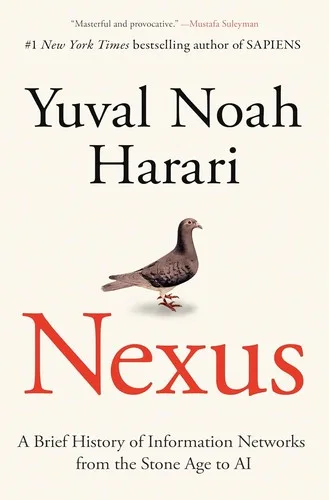
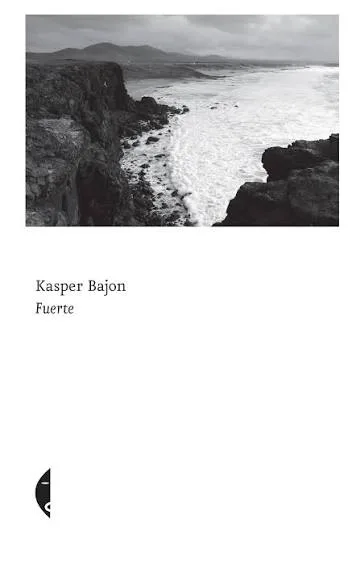
Bartosz: I do. I am reading "Nexus. A Brief History of Information" by Harari right now. And it is very smoothly written. I like it. So it is a bit on the basis of our conversation too, because it touches strongly on artificial intelligence. But what else could I recommend? Some time ago I read a nice, kind of meandering story by Bajon, the guy is called Bajon, who wrote a book "Fuerte". It is about Fuerteventura. I read it just before a trip. It may not encourage you to travel to Fuerteventura, but it has its atmosphere, so I recommend it. And I would also recommend, if we go beyond books, the Teatr Animacji in Poznań. Recently I was there with my kids and with my cousin and her kids at a performance. It is a kind of little theater, you could say. They are simply incredible.
Bartosz: Really. With each of my children we have gone there since they were little, and now we came back after a break, and they keep such a great level of these performances. There is a lot for kids there, but also a lot for adults. You can really take away nice things from their performances, so I will always keep recommending it.
Rafał: Thank you very much. I have not read Nexus yet, to be honest, I have read all of Harari's earlier books. I had not heard of it, I just googled it, so thanks. I will definitely write it down. I generally like such topics. As for the Teatr Animacji in Poznań, I have to admit that I have personally never been, but I will go now.
Bartosz: It sounds childish, right? But indeed there, because basically the target group is children, but I think not only. So I definitely recommend it.
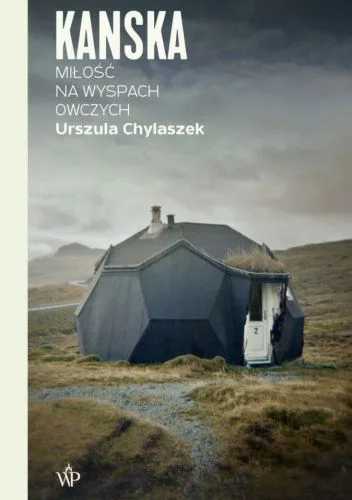
Rafał: I will gladly go. Everyone sometimes likes to feel like a child and rest mentally, really. From my side I would like to recommend very many things, but I will focus on one. I also like reportage very much and recently I read, for me a very revealing piece of reportage, because I practically knew nothing about the Faroe Islands, except that they were once invaded by Arabs from Algeria and Turks, and that is why some people on the southern island of Suðuroy have Turkish and Algerian roots. But there is a book "Kanska. Miłość na Wyspach Owczych" ("Kanska. Love on the Faroe Islands") by Urszula Chylaszek. It is a brilliant story, going very deep into the fabric of the people who live there, both historically and in the present. Published by Wydawnictwo Poznańskie, and in my opinion this book is very underrated, and it is written in a very good reporter's language, a very good style, and I really encourage you to find a moment and read it, all the more so since it is not a big volume and a longer afternoon will do the job. It can really broaden your horizon and make you look completely differently at the Danes, at the Norwegians and at the Faroese themselves, that is, the people of the Faroe Islands.
Rafał: Great, thank you very much for your time. It really was a pleasure, as always, and I hope to see you soon.
Bartosz: Sure, great, thanks a lot. Take care.
Listen and watch
The same conversation in your favourite app.
The full edited transcript as a Markdown file, with the guest’s details and quotes.
Back to top