

Who is Ewelina Podrez-Siama?
- Who she is
- Ewelina Podrez-Siama, an SEO specialist with over 15 years of experience, founder of the agency Fox Strategy, which with a 12-person team runs SEO, SEM and content marketing campaigns for B2B companies, e-commerce, podcasts and mobile apps. She went through the full agency path from SEO assistant, through SEO manager, to agency owner. Since the end of 2023 she is no longer the company's CEO.
- What she does
- She worked with large brands (including Allegro, PayU, Santander), is the author of books on SEO, including "SEO for bloggers, influencers and personal brands", co-creates courses, speaks at conferences and runs a newsletter. She is also the author of bestselling books on the ketogenic diet and runs a food blog.
- What we talk about
- Books about SEO for beginners, demystifying SEO and the company's mission, building an agency as a teal organization, recruitment and feedback culture, Fox Strategy DACH, the impact of AI on the SEO service and copywriting, falling CTRs and the pricing model, scaling a company, and giving up one of her roles.
- Where to find her
- LinkedIn and Fox Strategy.
Best quotes
„SEO is really honest, solid work, it is not black magic.”
„It is not always the case that what is particularly smart is found at the top of search results.”
„In simplified terms you could say that teal organizations are organizations in which the decision is made by the person who is most competent in a given topic.”
„Creativity and emotions cannot be replaced at the moment.”
Recommended materials and sources
Guest’s pick
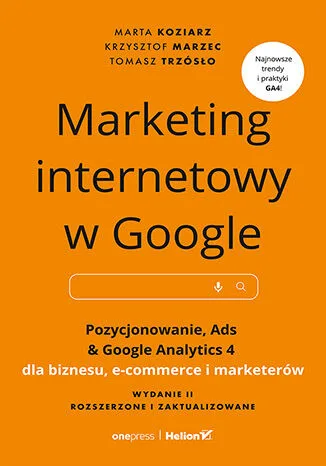 Book · Marta Koziarz, Krzysztof Marzec, Tomasz TrzosłoMarketing internetowy w Google. Pozycjonowanie, Ads, Google Analytics 4 dla biznesu e-commerce
 helion.pl
 Book · Artur Strzelecki (editor)A collective book on SEO written by about 50 SEOs (title not yet known)helion.pl

 lubimyczytac.pl



Related conversations



Transcript
Host: Rafał Moszkowców. Guest: Ewelina Podrez-Siama.
Introduction
Rafał: Hi everyone. Today's guest on Globalne Horyzonty is Ewelina Podrez-Siama, an SEO specialist with over 15 years of experience, founder of the agency Fox Strategy, which together with a 12-person team runs SEO, SEM and content marketing campaigns for B2B companies, e-commerce and podcasts and mobile apps. Ewelina went through the full agency path from SEO assistant to SEO manager and finally agency owner. She worked with the biggest brands in Poland, among others Allegro, PayU, Santander. She is also an active educator, co-creates SEO courses, regularly speaks at industry conferences, and shares her knowledge in a clever newsletter, which I encourage you to subscribe to right away. And that is not all: Ewelina is also the author of bestselling books on the ketogenic diet and runs a food blog. Today we will also talk about how she combines analytical SEO with a passion for cooking. Welcome, Ewelina, to the podcast.
Ewelina: Hi Rafał, thanks a lot for the invitation.
Rafał: The pleasure is all mine, so far, I always start like that. I am really glad you found time for us, because I have followed you for many years and basically we probably never had a chance to meet or get to know each other earlier. I hope that today you will tell a bit more about yourself, about why you are in SEO and why, for example, you write books about SEO, because that is quite rare.
Who does Ewelina Podrez-Siama write her SEO books for?
Rafał: Maybe we start with that book. I admit right away that I read not quite the whole of your latest book, "SEO for bloggers, influencers and personal brands". I hope I did not garble the title.
Ewelina: Almost right.
Rafał: The book is really nicely arranged. You can get it as an e-book, you can buy it in paper form. Can you tell what stands behind this book, what the idea was and who it is addressed to?
Ewelina: Because I have the experience of working also as a blogger and a bit of an influencer, although I do not think of myself that way at all, I was often approached by people who were starting their work with a blog based on WordPress. Those were usually people who on one hand do not yet have a budget to work with agencies, and on the other are only working on their personal brand. I had an idea to reach those people a bit and help them in the first work on their blog's SEO. We both know well, because you have been in this industry very, very long, that it is not always the case that what is particularly smart is found at the top of search results. That is a bit of my mission: we have great bloggers, let them also write so that it has a chance to appear in search results. The book was aimed at such people from the start, so I am not surprised you did not read to the end, because a person with your knowledge must have felt it is the basics of the basics. For people who were only starting, it was to be a guide from zero. More than once I talked with my editor and proofreader that you have to explain once more what FTP is or what a domain is. Very basic notions that for us SEOs seem okay, well everyone knows that, and very often people who are only starting their adventure with their own website have totally no idea. The book came about with that vision and reached such people.
Rafał: I had the feeling, reading it, that it is really nicely explained for people who are not yet in this industry, because why write a book about SEO for SEOs, let us be honest.
Ewelina: It is a dangerous pastime in general, writing a book about SEO for SEOs.
Rafał: Indeed, talking about SEO among SEOs is a dangerous pastime, it can end badly, because everyone has three sentences on the subject, what works, what does not, but let us not go there, because it is a swampy topic. I think this book is really sensibly arranged and, though it touches the basics, I told you before the conversation that I would most gladly send it to most of our clients on day one: please read this, because we will talk better. And do you think about continuing, or is it a one-off?
Ewelina: I am continuing even now, because together with my partner Kasia Baranowska we are writing a book about SEO for small, starting online shops. Again for people who either are starting their adventure with e-commerce, or have small shops based on Shopify, on Shoper and want to arrange their SEO, and do not necessarily have a budget for agency cooperation yet. Every time I write a book, I say it is the last, because it is a huge project. I am so tired that I say: no, no chance. But I am in another creative process, so I am not yet saying it is the last, probably in a few weeks I will be swearing never again, and then I will write another.
Rafał: Supposedly it is worth doing only things that are hard for us and rather uncomfortable, because it means we are growing. Even if you do not enjoy the process that much, the effect is fantastic. I looked at Lubimy Czytać, the book has really high ratings. If someone listening does not know what SEO is about and would like to find out, it is a very nice compendium to start and do things themselves. When I read this book yesterday, I thought it is a recipe to eliminate all pseudo-agencies: if a client, or a person from marketing who has not dealt with SEO, reads it, understands and asks the right questions, they cannot be talked into believing that someone for a month corrected 4 meta descriptions or created 17 words of content, or other nonsense one can very many times hear is stuffed into clients as a contract filler. Is this your educational mission too: let us inform clients so they do not get fleeced?
Why does Fox Strategy demystify SEO and what is its mission?
Ewelina: Yes, from the very beginning. When I founded Fox Strategy, early on in our slogans we demystified SEO, because SEO is really honest, solid work, it is not black magic. I have the feeling that if someone makes black magic out of SEO, it means they are not doing their work honestly, because they do not want to share it. It is not secret know-how, it can be learned. If thanks to this book and every next one we manage to cut out some of those pseudo-agencies, I am really content. There are very many very good agencies that unfortunately have to compete with pseudo-agencies and often it is a frustrating competition.
Rafał: Very often, because on this market competition is on price, and competition on price only lowers the overall quality of the service or product, no matter what we are talking about. I think the quality of this service in Poland is very low, generally.
Ewelina: We keep facing it. I am shocked: I have been in SEO for 15 years and we still have SEO for results and I wonder how, who benefits. It pays when those results come because very basic work was done for not quite well chosen phrases. We pay for results or do SEO for 300, 500, 700 zloty. In that budget it cannot be done honestly. Unless consulting-wise, on the basis that someone sells hours. We very often work as consultants, and then the client pays for something else, for having an SEO for an hour. In the general understanding SEO for a few hundred zloty or SEO for results has no connection to reality. We still have quite a few agencies that operate like that, and for me it is still a shock.
Rafał: Those are other business models, also incomprehensible to me, but they probably work so far. The actions you take in the context of this book are a step in the right direction. I think you should continue, because you do it really well, without sugarcoating, seriously.
Ewelina: Thanks. I like that process very much, I like the process of writing a book, I do not necessarily like the process of corrections from writing to publication. The moment when I always say never again is a moment of being overwhelmed by the amount of work, because it is a really big project that must be delivered. But it also gives incredible satisfaction, excitement and in some way helps people. Of course it is not saving lives, but helping to exist on the internet, and that is also good and nice.
Rafał: In your opinion can an SEO company have a mission that carries it?
Ewelina: I think so. We have a mission. As usually with a mission, it is a bit overreaching. Our mission is simply helping people. We try to help our clients on one hand, and on the other to build the organization so that it is friendly to our employees. However it sounds, in our mission we have written that we believe people should be helped, and we spell it out concretely in the vision: how we present it to clients, how we help them not so much run as promote their business, how we help our employees so they can develop in a direction adequate for them. For us this help and being a good person is part of the mission. And I think it is not a matter of SEO itself, every company can have this kind of mission, whatever it does.
Rafał: An interesting approach, but I think it is not even overreaching, because as you said, you want to do this service honestly and fairly, you encourage and push toward it, a well-done and honest service can help and does help companies break through, ones that very often would not have a chance to exist on the internet if they met other specialists.
Ewelina: We often work in a strongly educational way. Speaking plainly, in theory my target should not be people who want to learn SEO, because the business is often typical agency work. That we educate so strongly, that I am so involved in it, that those books are aimed at beginners who can do something themselves thanks to them, is an attempt to improve this industry and to reach people who may be exploited by a pseudo-agency.
Rafał: It is a good mission. I often ask about it, because many times I have met the statement in our industry that there is no such thing as SEO's mission being something other than making money, and any story around it is untrue. And I agree with you here.
Ewelina: Our mission literally says that we believe the world can be a better place, that is why we care for people. That does not mean we do not earn money. We are a business, not a foundation. It has to add up. But running a company only and exclusively to earn money, I do not believe in that. What competitive advantages you have, how you keep a team, I mean not financial keeping but keeping team members in the team, how you motivate them to work, if it is only: earn more money for me. Maybe I am a bit of a rebel, but if my CEO or boss said to me: you know, Ewelina, our mission is for me to have more in my wallet, I would be poorly motivated to work, I will tell you.
Rafał: We are entering the area of extrinsic and intrinsic motivation. I have the impression that you approach it more from the perspective of intrinsic motivation, the lasting kind, where you do not impose motivation on people, you evoke it. There is a theory I agree with that everyone is motivated, only sometimes they do not know for what, do not see for what. And when extrinsic motivation is imposed: earn more money for me, I will pass you something, and we will have money so that we have as much money as possible, it burns out. That is a recipe for burnout. Such chasing the bunny, no one knows what for, can end badly.
What is a teal organization and how does Fox Strategy work?
Rafał: I wanted to return to Fox Strategy. You are an organization, as I read, self-organizing, teal. A quick digression: I was once very interested in that topic. I read "Szef zawsze ma czas", the first book with a teal cover, and "Reinventing Organizations" by a French author.
Ewelina: Laloux, the bible of teal organizations.
Rafał: I was mega hooked for a long time, but I could not implement it, honestly. I had the impression I was doing it, and in the end it turned out I was not quite, and I got a mess. I am curious how you work, that you are effective thanks to this organization of work.
Ewelina: I recently had a conversation at an HR event and we talked about those teal organizations. I think I had it easier because I built my organization from the start. It is definitely harder to introduce teal into an organization that already functions than to build something from the start. When I started Fox Strategy, I thought I would be a freelancer and that would be it. I did not plan at all to grow the company to a dozen or so people. With time it turned out the business is growing and I had to think how to manage the company so my private goals and values would be realized. On one hand I had many counterexamples of how not to manage a company, I always had resistance to vertical organizational structures and wanted to transfer that to Fox Strategy. On the other hand I had a big need for freedom. To this day I am a free bird, but since the end of 2023 I am no longer CEO, so I could give up operational management and focus more on the company's development. It was important to me from the start, but I did not know how to go about it. I was lucky to meet good business trainers, where the idea of a teal organization appeared for me. I started reading, I got through most of Laloux, it is a very hard book, but "Szef, który zawsze ma czas" is a very nice introduction to teal. It turned out that the things that are important to me, meaning communication, that people have an influence on the company, that the company does not represent only me but gives people a sense of mission and agency, is a kind of teal.
Ewelina: So that we have clarity, because we both know what teal organizations are, and listeners may not: in simplified terms you could say that teal organizations are organizations in which the decision is made by the person who is most competent in a given topic. It will not always be the company's CEO, not always even the leader. Sometimes it will be the person who has the greatest competence. Therefore it builds an organization in which the team has a very large agency and influences how the company functions. I, as the founder, of course have an influence on how it develops and have my goals. But my team also makes autonomous decisions that are consistent with our mission, vision, values and the attitudes that follow from those values. Over those several years we did a good piece of work about how we want, not I want, but how we want the organization to function. Our culture book was created, in which we have the mission and vision written down, and it is worth stressing that I did not do it at the beginning of the organization, only in the sixth year of operation, and we worked on it as a team.
Ewelina: It is an organization built from the ground up. I had no business experience, so everything happened on the go, on the fly. We defined values. Every year we have workshops in which we tell each other what is important to us in our work, how we want to function, whether responsibility is important to us, or openness, how to combine those values. Every year we stand with post-its and talk about it. We also have it written out in the form of attitudes that follow from values, because it is easy to say that for me a value is assertiveness, but what follows? For me assertiveness will be that I say no at the right moment, and for someone it will be too aggressive. When we speak of responsibility, it is very easy to get carried away, meaning to say that I am responsible for work, meaning 24 hours a day I am committed to work, and I do not care at all that people in the organization function like that. We did a good piece of joint work that allows people to make decisions in line with how we want to function.
Ewelina: When we deal with a large organization, it is much harder to implement certain things. In a small organization, with a dozen or so people, everyone can be currently engaged in creating that organization. The whole process took us, I think, 7 years. At this moment every department can function autonomously, every specialist can function autonomously, and at the moment they need support, they simply come for help. We have ongoing feedbacks, ongoing debriefs and it works very well, people have very large autonomy. A specialist works, though within Fox Strategy's processes, because it is unavoidable that an organization has processes, and also has a large dose of individuality. That is why we can, for example, choose a specialist per project, because they work in a certain way that will fit best with a given client.
Why is recruiting for a teal organization so hard?
Ewelina: But it is much harder for us to recruit someone into the organization anew, because we must teach such a person feedback from the start, teach openness and show them that if they tell us we botched something, we will not take offence, but will even appreciate such an attitude. Responsibility at the level of a teal organization also means that you are actually involved in decisions, and not everyone wants to be decisive. Sometimes people prefer to close the computer at 4 pm and not make any decisions. It is our big challenge: recruiting new team members, looking for those who want to take responsibility, want to have an influence on the organization's development. It is a permanent challenge.
Rafał: You explained it very nicely, I think it will clarify for listeners what a teal organization is. I smiled because I sympathize. I do not call my organization teal, self-organizing, because, as I said, I failed here, but we work a bit so that we have a few key processes that are clear and must be, and that is normal, but I always say: do what is best for the project, for the client, where you are to achieve the goal. And how you do it, with that process or without a process, as long as you stay within budget and carry out the path we chose with the client, I am okay with it. The second rule: if you find something outside the scope of work, meaning outside the scope of the signed contract, it is still your responsibility to inform about it and to address it. You have no right to pass indifferently by something broken on the site, in the shop, anything. We will not always be able to fix it, because it will not always be within our competence and budget, but our duty is to find it and say so, and not stick strictly to a process. That is why, though I like processes and they help, I have long teeth for processes titled delivery of the SEO service. It smells of mechanization, a collective farm, doing for the sake of doing. I personally have big problems with recruitment: some people fit us technically and in skillset, but the problem is for the mindset to be: okay, I enter in this way, I am open to feedback. Creating an organizational culture where you get feedback, when we have a strictly hierarchical society with an enormous feudal remnant, is hard. I have the impression it sometimes works very hard, not even an impression, I see it works hard. You have to draw it out and I think it is the hardest work. I will add that I have experience working with other cultures and Polish culture is closer to Asia than to the West of Europe, in my opinion, in the context of openness in communication.
Ewelina: It is no longer in the education system. Where my feedback came from: we also have nonviolent communication implemented in the organization, according to Marshall Rosenberg, which is based on not judging a person, only talking about your expectations, emotions, needs. I will tell you that the approach to nonviolent communication in a team where we are so used to hierarchy, to being judged at every step, is really toil. In the education system we do not have anything like communication. We come out with patterns from school, from family, and come used to hierarchy. Although that is also changing, because nonviolent communication increasingly appears in families already. Suddenly it turns out that people have hierarchy deeply rooted, that it is a fight for years. And there will be those who are more open, but you first have to find them. Here the recruitment dilemma appears. We have a conviction, you summed it up very nicely, that when a client comes to us with some need, then since our mission includes caring for people and we see something is wrong, even if it is not within our competence, we get involved in the topic. Of course not for free, but it is in the price of the service, we often work hourly. We cannot pass indifferently by a client having a problem, something on the site not working. Finding people who will not pass indifferently is really hard, so I totally agree that the biggest challenge is recruitment. Because if people find their place in the organization, they learn and with time we really communicate nicely, they get nicely involved in the client's business. You have to find such people. And paradoxically it is certainly a longer recruitment.
Rafał: One hundred percent. Sometimes I laugh at myself at how our recruitment process looks, because I am not interested in the CV. Never. I do not even look at it. Show me what you've done. Show me what you did and let us talk about how we can apply it with us. Plus let us talk about how you think about the world. Because if you think the world is scary, closed and you have to beat each other with sticks, we will simply not get along, even if you are the best specialist in the world. I know it is hard to implement on a large scale in a large company. At most I managed to implement it in a company of up to 100 people and we kept following those principles. There were really very good people there. I encourage thinking that way in general, because in a CV you can write anything. I know there are AI CV scanners, but I joke a bit that those scanners eliminate, because they are biased, certain groups, certain keywords. But we will not go into those digressions, because about HR we could talk for a long time.
How did Fox Strategy DACH come about and whom does it help?
Rafał: Again a moment about Fox Strategy, because I was interested that you do not do services only for the Polish market. I read from the site that you also do one foreign market, Germany. Why Germany and for whom? Where did it come from?
Ewelina: It is in a way a result of, I do not like saying we are a teal organization, because I think teal is a kind of ideal, but we strive toward it and will keep striving, that we have on board Kamil Dymidowski, who grew up in Germany and has for, I think, already some 15 years worked in the SEO industry, because we started at a very similar time, and in fact we met at a completely different company. Kamil joined the Fox Strategy team as an SEO specialist. An idea appeared with him that maybe he would use his knowledge of the German market, because he had earlier experience and developed an SEO department for the DACH markets. That was a good 6-7 years ago. At present there is Fox Strategy DACH, a company dedicated to serving clients for German-speaking markets, and Kamil is its CEO and developed the product to such a degree that I, though in German I can say only a few sentences and my knowledge of German ends there, we can actually serve a German-speaking client, companies that go out to German markets. We have German copywriters, natives, we have Kamil, who communicates perfectly in German and Polish. That lets us function also on the market of our neighbors, though most of the company does not know German at all. It is the merit of teal organizations, that when that idea appeared, I said: okay, you have knowledge, you have competence, develop the company. Most often we work with clients who go from the Polish market to the German one, because the German market is a bit different from the Polish, maybe more conservative, even in SEO, in acquiring links, so Poles usually approach it a bit differently. Recently clients also come to us directly from the German market, because Kamil speaks at conferences in Germany. It is one branch of our services.
Rafał: It shows that the approach of openness works in practice. And you met a person who wants to do it, so a lot came together.
Ewelina: Kamil from the start had a very strong sense of duty, in fact I knew him earlier, and now he is able to run the organization himself with our support, so it is one of the successes of leading an organization toward teal.
Rafał: You said Germany, but I understand it also touches...
Ewelina: Austria, Switzerland.
Rafał: Do you already have many clients? Is it a large part of your business?
Ewelina: Percentage-wise I think about 25 percent of our business. It is quite a lot. The company was founded in May last year, so almost two years. The business is developing gradually and maybe does not yet have as large a scale as Fox Strategy, the main company, but it really is developing nicely.
Will AI replace copywriters at SEO agencies?
Rafał: Do you think that with the development of artificial intelligence foreign scaling will be easier, faster? Do you see it as potential benefits for you or threats? I ask, because I meet with many agencies and there is a dichotomy, opinions that diverge strongly. Some see, like me, enormous potential, but there are many companies that approach it very skeptically.
Ewelina: I, like you, think it is a huge potential to use, because I think that regardless of whether you operate on German-speaking markets, the Polish one or any other, if you do your work honestly, if you have a relationship with the client, automation can help you improve processes, make your work done faster. But it will not replace contact with a human. We work in a service industry. If an organization is built so that projects are run in bulk and very derivatively, automation may be a threat to employees. In a situation in which a client needs a caretaker, a consultant, someone who will be currently in the process, automation and AI are a brilliant tool we can use, improve our work, do certain things faster, better, more precisely. I think that in the context of going to foreign markets of course it will also help, if only because we can already use AI for really good content creation. Although, as in the copywriting industry, I think that here and now really good professional copywriters who do brilliant research, have access to scientific studies, create brilliant content, cannot at the moment be replaced by AI. It is a completely different kind of content. Derivative activity can be replaced, but as long as creativity, care, relationship, emotions come into play, not yet. I do not fear it, rather I consider these brilliant tools and potential to use.
Rafał: It sounds a bit like you assess it for the moment and do not quite believe these tools will go so far that they totally mimic, say, a brilliant content person who can do research. I have the conviction that it will go that way, looking at the speed of development, at deep research and the ability of models to learn styles and emotions. Content roles are threatened, but to clarify: if someone writes for OKO.press, for the Wall Street Journal, I would fear less. But if someone writes landing pages, describes scientific papers, develops blogs, I personally would spend every possible moment learning AI and tools for multimodal content, and if not, I would look for another job. That is my totally personal vision.
Ewelina: I totally agree with you. I mean that when you do your work honestly, you use all possible tools. I absolutely do not deny that in some time we will have brilliant content, copywriters can be replaced, but a good, brilliant copywriter will be able to manage it, review it substantively, edit it. We have a brilliant content manager who is now supported by an AI writer and her role comes down to managing it. In the future it will be different still. Why did the SEO industry throw itself at AI so quickly? Because we are used to dynamic changes and we already know that in a few years AI may take over our job. What is more, we know perfectly well that ChatGPT, or any other tool in that style, will gradually displace the search engine. So we look for a role for ourselves and use it. See how many AI trainings are run by SEOs. We talked about it before the recording. I think this progress is unstoppable. If you do your work, you are up to date, you will find a role. If someone wants to work creatively, maybe they will be replaced, but if someone has a dose of creativity in them, wants to deliver the best service possible, they already work very strongly with AI and will gradually adapt to changes. Whether in two years or five I do not know, but the pace is lightning fast. Two years ago, if we had talked about what is happening with AI, probably we would not have suspected we would be at the point where we are.
Rafał: With the development of this technology one never knows whether we are talking about what will happen in two years, or whether it already happened yesterday and we do not know it yet. The technology is amazing and at the same time frightening, but I try to look with optimism, with the thinking that it should be controlled. I think that people titled copywriter, content creator for SEO, my favorite term in this industry, will not exist, but with all respect to them as people, because those were dehumanizing tasks in my opinion. Writing content titled best brown oiled shelving with stain, 3 meters by 2, with such headings. People who have a knack for writing must open up to tools, and once they open up they can scale incredibly and will be irreplaceable, because it will be a piece of skillset. However far we go with artificial intelligence and multimodality, if you can use it, it will be hard to replace you, because you will no longer be the proverbial pen.
Ewelina: Your work will not be derivative: you will not write because someone ordered keywords and you stuff them in. AI can do that. All derivative things AI does here and now, it will do in some time. Derivativeness can be replaced, creativity in my opinion not at the moment, in the future I do not know, I am careful, because what seems impossible today may turn out possible in two years or maybe tomorrow. Creativity and emotions cannot be replaced at the moment. As long as we work relationally, as long as we must work creatively, we must also learn to use tools and thanks to that we become irreplaceable.
Rafał: I would very much wish that human emotions and relationships were never replaced by artificial intelligence, because we would wake up in a totally dystopian world in which I would not want to live. I know there will be such pulls, because capitalism abhors a vacuum, and late capitalism hates people, someone said. Let us put up resistance in a smart way.
Ewelina: I do not know how much our resistance will matter, but we can try.
Rafał: For example I do not enter interactions with AI bots on websites when I want to get something done. Not because I have resistance to AI, because I think the opposite about this technology, but I feel cheated: I have a relationship with that company, with some person in it. Recently I lost one of my SIM cards, I was in Asia, by accident I was changing a card, I lost it somewhere. It was not a Polish company. They asked me to talk to their agent, a charming AI avatar. I did not feel it was fair. I have had an account with them for 15 or 20 years and I would like to talk to a human who will sort it for me. I have maybe a boomer resistance. It seems to me that this resistance is right in the sense that okay, let us use it, but let us not flatten relationships, dear people, because we will go in a twisted direction.
Ewelina: On one hand yes, but I still remember the world without the internet, so we have a natural resistance. The generation of seven-year-olds is already talking with ChatGPT, they have their agents and thanks to that parents answer hard questions. It is my friend's case, who has ChatGPT for her son. The child asks a million questions about how many people there are on Earth, how far it is from here to something. That child grows up knowing they can use such a tool. As we remember the world without the internet, he will probably not remember a world without AI. How it will develop and whether that resistance will be maintained, I do not know, honestly.
Rafał: I suppose not, because I look through the prism of my experience, my age and my outlook. I sometimes prefer to do something slower but better rather than faster but cheaper. I wanted to convey that business is done relationally and it should stay so. It does not mean it should be unsupported by modern solutions like artificial intelligence, because it should be supported, but it is relational. I would like to keep it that way.
Ewelina: I would like that too. On the other hand I think about how much the market opens for people who build automation. It is interesting how over the last two years the marketing market has changed: how many AI-dedicated positions appeared, how many specialists are starting to build really incredible things, ones I cannot create at the moment. AI will take a bit from us, but it also opens completely new possibilities. We will see how it goes.
How do you justify the price of SEO when CTRs keep falling?
Rafał: Do you not fear, from your company's perspective, changes in how the Google search result looks, for now especially for e-commerce, where CTR falls and sometimes critically? And second, the impact of personalized search in large language models, ChatGPT, Claude, one can insert anything.
Ewelina: And AI Overview in search results. A lot is happening. Do I fear? Probably not, only and exclusively because when we started in SEO, there were so many changes that we even thought it was a lot. Working in SEO means you get used to changes, you live in constant change. I absolutely cannot say I ignore this fact, in no case. I watch closely and wonder how it will affect the SEO service in a few years. After all for 15 years I have heard it is ending. I still think it is not ending, but it will change very much. I am not afraid, but I think it is something one has to watch, to which one has to adjust one's strategy on an ongoing basis. About a year and a half ago we began a series of automations at Fox Strategy, because we were never especially good at automations, but we knew we had to do it. I may not be an automation expert, but I know I need tools that will improve my work and speed it up to have a competitive offer, because others will do it too. CTRs are falling all the time, I think. I remember results from a few years ago, when they were less varied, then CTRs were at a much higher level than now. More videos and distractions were introduced into search results. Now AI Overview appears, which will also steal traffic. Those CTRs will fall and we have to adjust our strategy, there is basically no other way.
Rafał: My question is honest, because we are in the same industry, we cook in the same soup: how to justify to a client a high price for an unpredictable service with constantly falling CTRs? I have an honest problem with that. The expectation is that the service will be affordable and at the same time more effective than ads. I wonder how you approach it, in the context of the future, but also for today, because falling CTR is to a large extent the service's effectiveness.
Ewelina: Truly so. What is the use of high impressions if we do not get visits to the site out of it.
Rafał: Not much. How do you justify it?
Ewelina: I will add some background, because it is not a fresh problem. Search results are getting harder. Some time ago we made the decision that we are more a consulting agency, working by the hour. We very often work with clients who have their own SEO departments, and we are their external consultants. We often work with clients who require a bit more than SEO from us, we help them manage websites. Those are usually small and medium businesses, but it is still a consulting service. Adding that background: we do not have a service model in which the client pays a certain amount and does not know what it goes to. If they pay a certain amount, they know perfectly well that this many hours of work, this much media budget, this much for content. That makes it easier to present to the client the benefits of the service, because they know what they pay for. I still think, and so I justify it to clients, that the SEO service is a long-term investment and SEO will exist anyway. With ads you cut the budget and you have no results. With social media it may turn out they block your Instagram or Facebook will cut organic reach, meaning you pay for ads, you pay the media budget all the time. In that sense SEO is still in my opinion much cheaper than pay-per-click advertising or any paid campaigns. We can not invest in SEO and be dependent only on campaigns, or we can look for solutions and keep developing it, knowing that search results will change and will get worse and worse. I say it plainly. I do not deceive the client at the start and do not promise any guarantees. The solution is on one hand to present what the client specifically pays for, which actions are carried out, and on the other not to promise the moon. Because of that sales is much harder. I must say honestly that more than once we tell a potential client that it will probably come to nothing. You will invest a lot of money, we will give you absolutely no guarantee, and in your case it will not pay off at all. We have no problem saying it. We are an organization that grows very organically and there is no great pressure from investors, so we can afford such things. If we do not see potential, we do not enter at all, we do not sell by force. Maybe thanks to that it is easier, I do not know.
How does the modular and consulting model of an SEO service work?
Rafał: A very interesting perspective. I refer to the modularity of the service: good day, dear potential client, here are 10 technical hours, 5 thousand for media budget and 3 thousand for content. Great minds think alike, because I did the same. At the very beginning of the organization I set up modules. The client has predefined modules, but can work like with blocks, adjusting them: here minus, here plus. I strive toward such full modularity, which is why we build AI tools where the client will add for example an Unlimited Content tool, with an asterisk of course, meaning Content AI according to our model and scheme, and many other modules where they can assemble it themselves. CTRs are falling, the service must be cheaper or can be just as expensive, but we have to do more. AI can help us here: we can do more thanks to it without critically raising the price, and maybe we will not achieve much greater effectiveness of the service, but at least it will not fall critically. I think there is a chance here.
Ewelina: Plus, since you work modularly, you know perfectly well that an hour of work is not equal to an hour of work. That is another recruitment dilemma: finding a person who will be equally effective, not only using tools, but having a baggage of experience that they can use and in that hour can do really a lot, versus a person who will really spend the hour on research and the client pays for it. What also works very strongly for us is that project teams are presented right at the start. The client gives us a credit of trust, knows with whom they will work and for whose hour of work they pay. It is nice to implement in an organization that has a dozen or so people, a few experts on board, each specializing in their own things, and the client then has an absolutely dedicated offer: such specialists were assigned to the project, we need this many of their hours, plus this much media budget. It is nice that you arrange it modularly. Besides that automation: we are already going very strongly into it so that hours are more effective, so that the hour that seems expensive is very effective for the client. After a month of work it usually turns out there is no discussion of hourly rates, because at the start such discussions appear. It is a very hard topic in the context of arranging a service model that will be unique and will fit, because it will not fit everyone. We either work with small clients who need such consultants, or with really big brands that have very high expectations.
Rafał: It is also hard, as it seems to me, to build a uniform service when there are both small and large, because it requires different competence in the communication context, but let us not go there, because we will drift, it is a very broad topic, serving clients on different levels, different clients by different people. It is interesting that you present the team, I like it very much. I wanted to do that and failed spectacularly. We show the project leader, but I tried to show also people responsible for off-site, on-site, content and development, because with us most often four people work on a project. I failed, because someone got sick, somewhere something could not be done. Operationally I did not manage to put it together, but there is a project leader and they manage resources, and that works nicely.
Does an SEO agency have to scale by headcount?
Rafał: A small digression: we say it cannot be scaled because it is consulting. Scaling by people: the more people, the more processes, the less de facto people in the project. We have a mistaken belief as humans that we must scale only that way. It is not the only model of scaling. I often hear: hello, Rafał, we already have 40 people. And I ask: and how much money do you have in your account? Or: we already hired the 80th person. I let three people go and little changed, because I used automation. For me the most important is not growth and scaling by headcount, but net margin, my EBITDA and whether the people who work with me earn well. You do not need to grow in one way, scale with people and then dehumanize the service and lower its quality, because the number of experts is limited. We do not have to live in a world where there are only large agencies. Thanks to AI, automation, openness and such pro consulting, you can earn much more per capita in a smaller organization than in a large one. I already see it through my own prism, and I like to call my company a small chicken coop.
Ewelina: I will add one more thing: when we have a small company, we can look after employees. With us the median length of service is nearly seven years. That means most of the people I work with built the organization with me. I do not have onboarding, I do not have recruitment costs, I do not have a process that is costly and takes about a year. In my opinion after about a year an employee is so embedded in the organization that they function without need for support. Of course after two, three, four months they can work effectively, but still will need support. Those are organizational costs that grow if the team often rotates. I prefer to have an organization of a dozen or so people, maybe in the future 20, maybe 30 after some time, I hope so, but there are no hundreds in my ambitions, that will be relatively stable, will not generate costs of further recruitment and large stress, and will consistently earn money, because that is what business is about: we must earn money to sustain the organization, so everyone earns decently. Let us turn it around: think about how to take care of an employee so that they want to stay with you longer and thanks to that save money you would lose anyway on further recruitments. I can scale at this moment and have 50 people. The interns market is doing very well, there are a number of organizations that are up to their ears in interns, although now it slowly loses sense, because having AI, why do you need an intern? It depends for what. We can of course measure an organization by people, only those people are very easy to multiply, and at the same time they may have dissatisfaction with work, may often rotate, have a short length of service, and so you bear further costs of managing that whole team. And the question is whether you feel like it. I do not. From what you say, you do not either.
What is onboarding in SEO like, and who survives it?
Rafał: No, not at all. I am just in the middle of onboarding one person who takes over part of my duties. It is heavy and expensive, no point deceiving ourselves. I remember my onboarding the first time I came to SEO. It was beautiful: wonderful onboarding, a beautiful skyscraper, Canary Wharf, London. I won at life, I am in SEO. Hi Rafał, hi. Here is a computer, here a phone, and there is the internet. Read about this SEO and from tomorrow you will work normally.
Ewelina: Brilliant onboarding.
Rafał: Brilliant, but I like to think of myself as a consistent and determined person, I create my own bubble. It worked with me. I remember I practically did not sleep for 5 days and nights, reading and learning everything I was supposed to learn. It is great when there is great onboarding, great when companies are nicely arranged, human-centric, like you, or like I try to be within my means and competence. But if you are the person being onboarded and you land in a place where the onboarding is a complete sham or does not exist at all, because that happens, then sometimes it is worth gritting your teeth and getting through it yourself, if you learn a lot.
Ewelina: A lot of determination that you had then. I think with this kind of onboarding in quotation marks only the strongest survive, the most determined. And those who will not have contact with the client too soon.
Rafał: They told me to call in that same week. I was determined and I met many such people. I felt it was the only path I could go down. And to this day I have it that when I do something, I do it. I encourage approaching it this way, because it is easy to get discouraged, companies are different, the market situation is what it is, so it is worth looking after yourself and getting through it.
Ewelina: Besides, SEO is an industry for determined people. If you want to work in SEO, you must have that trait.
Rafał: Once a well-known Polish SEO specialist, whom I will not name on purpose, told me it is an industry of sadomasochists.
Ewelina: There is something in it. You have to love change. It is not a calm job.
Rafał: Embrace the change, when every morning you wake up and never know. I think if anyone in the world will not go mad, it will certainly be us, looking at what is going on.
Which role would Ewelina Podrez-Siama give up?
Rafał: One more question at the end. If you had to give up one of your roles, you have many hats, which one and for what?
Ewelina: It is hard to give up any, because those roles, those hats make up my wardrobe a bit. I would not give up the cookbooks, because if I had not written that book then, I would not have dared to write the next ones. But if I had to make a decision here and now, I would probably hang up the cooking hat. I am already doing it a bit, I do not have much time for developing it. Being an influencer has changed too. When I ran that blog, it was based on photos on Instagram, Facebook still had nice organic reach, and now I would have to do TikToks, and that is no longer my vibe. I hung up that hat, because I no longer have the time and life space to do so many things at once. On one hand I want to write, on the other to speak, so I also had to hang up the hat of being strictly an SEO. I run a few projects, but it is a fraction of what I do now. I also gave up the management hat. It is not possible to combine absolutely all roles. If I had to hang up one here and now, it would be cooking, because I no longer have time for it. Writing cookbooks, you have to cook it, take photos, it is a whole demanding process.
Rafał: Unless you take AI.
Ewelina: That is true, I even thought about it, because I have a project to return and develop that blog a bit, because it stands. I look at the visibility, I am an SEO and I think I should do something with it. Before, I would look for stock photos, try to rework them, so as not to go through the whole process of culinary photography. Now I would do it completely differently: I would use AI and generate a good photo that looks almost like the dish I do not feel like photographing. Even that is changing.
Rafał: I think from a recipe you could make audio, meaning a step by step recipe that plays on any device, or video, put in a widget on the blog. If you download a similar photo from the internet and put it in with the right prompt, you get your photo. Scaling it makes sense, because I looked at your blog and it is very nice. I do not know the keto diet, though recently I read a lot about paleo and our addiction to meat. There is a great book "Mięsoholicy", which I recommend by the way, describing phenomenally where all this came from. I read some of your blog and wanted to say: nice, but I would gladly sell you some links.
Ewelina: I know.
Rafał: An SEO disorder.
Ewelina: And I have a disorder the other way round: once something is so mine, mine, I do not want to give anyone a link. I have a number of private projects that are not so mine, mine, and there links sometimes come in, okay. But with this blog there was always a problem giving a link. Maybe because I am an SEO and could theoretically use it, but I know where it would go.
Rafał: True, you can drift, toward selling guest posts or other things. Someday we will have a chance to talk. But with your blog I really think it is a nice space for experiments with AI, because if it is something you like doing, and you wrote three books about it, which are bestsellers, so congratulations, because it is not easy in Poland, where print runs are on average a thousand and that is already very, very good. We have a readership crisis. Maybe it is a nice space for experimenting with a human use of artificial intelligence.
Ewelina: Definitely, because the problems like find a photo drop out. If you know which ingredients to use, I will make it for you. It is a project that for now hangs on a hook, until probably I finish the book on e-commerce and suddenly think what I would do now. So give me some time.
End of the conversation and recommendation
Rafał: At the end I will ask for a recommendation. I ask each of my guests to recommend one course, film, podcast, book, anything, and we then inform about it and recommend it as something worth interest.
Ewelina: I think I will recommend the book "Marketing internetowy w Google", in which I had the chance to be the last guest. It now has a second edition, very updated, and in my assessment it very strongly, basically from the foundations, tells how to handle those search engines, not only focusing on SEO but speaking specifically about ads and analytics. I also very often start recommending it to my clients, because I am delighted by what Krzysiek Marzec, Tomek Trzosło and Marta Koziarz wrote there. It is also a very interesting book that we observe with my partner Kasia Baranowska, because it is very hard to write such a coherent book by three authors. If someone thinks about such cooperation, it is definitely worth it. And the second book is one that has yet to appear, I do not even know its title yet, but I would recommend following Artur Strzelecki, because Artur Strzelecki did the impossible: he took some 50 SEOs and told each to write a chapter. On that basis he created something like a Bible of SEO, which I do not yet know what he will call. Now he is buried in its editorial process. I am not surprised at all, because gathering 50 authors, chapeau bas, but I am totally curious what comes of it, because putting together 50 perspectives on SEO in one handbook may be something ultra interesting. I know which names appear there, I read some of the chapters, and I think if it appears this year, it is definitely worth waiting for.
Rafał: Thank you very much. I will follow it too, because it will be a great compendium of views, and in such an atomized industry it is nice to see so many people in one place, how they think about very similar things. It was a pleasure.
Ewelina: They will probably exclude each other.
Rafał: For sure. If they could, they would quarrel and throw eggs at each other, but that is also the beauty of this industry, because everyone loves and dislikes each other at once. Those are not my words, it is a quote from a person I will not name, because I asked about copyright.
Ewelina: I think it is quite accurate and it also affects the dynamics of this industry. It was super pleasant talking with you. Thank you once more for the invitation.
Rafał: The pleasure is still all mine. Thank you really for your time. It was great to find out how Fox Strategy works. As I said at the start, I have watched what you do for many years and finally I had a chance to find out who stands behind all those nice things. All the best and see you. Bye.
Ewelina: See you. Bye bye.
Listen and watch
The same conversation in your favourite app.
The full edited transcript as a Markdown file, with the guest’s details and quotes.
Back to top