

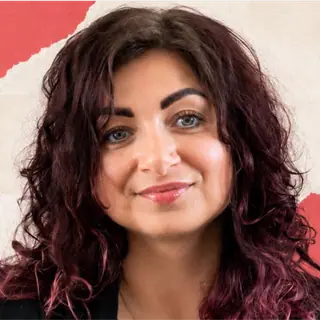
Who is Aleksandra Pszczoła-Hennig?
- Who she is
- Aleksandra Pszczoła-Hennig, an expert in HR and artificial intelligence in recruitment, founder of B-Talents. With over 10 years of experience in the IT industry, she went from developing mobile apps to creating a recruitment and consulting agency that helps companies find, attract and retain the best talent.
- What she does
- She runs trainings and talks on AI in HR. Besides B-Talents she creates two tools: Applausi, a startup for music teachers, and a Skills Intelligence Tool in the Space Bridge team, supporting managers in managing talent.
- What we talk about
- Skills-based hiring and competency profiles, dividing skills into lasting, semi-lasting and non-lasting ones, soft skills, feedback in recruitment, the impact of AI on recruitment (on the candidates' and recruiters' side), the employer readiness gap, reskilling, the future of the job market, and her own plans and recommendation.
- Where to find her
- LinkedIn (Aleksandra Pszczoła-Hennig), beetalents.com and applausi.io.
Best quotes
„We want to know what someone did.”
„AI is for everyone.”
„You streamline the work of the whole organization. Everyone benefits from it.”
„A good talent will have a natural desire to grow.”
Recommended materials and sources
Guest’s pick


Related conversations





Transcript
Host: Rafał Moszkowców. Guest: Aleksandra Pszczoła-Hennig.
Introduction
Rafał: Hi everyone. Welcome warmly to another episode of the Globalne Horyzonty podcast. Today I have the great pleasure of hosting an extraordinary person who combines the worlds of HR, technology and entrepreneurship into one fascinating whole. My guest is Aleksandra Pszczoła-Hennig, an expert in HR, artificial intelligence in recruitment and the founder of B-Talents. With over 10 years of experience in the IT industry, Ola went from developing mobile apps to creating a recognized recruitment and consulting agency that helps companies find, attract and retain the best talent on the market. Ola, welcome to Globalne Horyzonty.
Aleksandra: Hi, thank you very much for the invitation. I am very glad, Rafał, to be here today.
Rafał: The pleasure is all mine. I am really glad we can meet and talk about what is happening in HR, in AI and in your professional life in general, because a lot is happening from what I have seen.
Aleksandra: A bit is happening, but I think for me it is a natural state of things. There is something to talk about, someone to talk with, and that is very nice.
Why did LinkedIn replace personal profile websites?
Rafał: I have the feeling you have to refresh your LinkedIn daily to see what is new. There are always interesting things and concepts, very active.
Aleksandra: Yes, although I can say right away, by the way, because you raised an interesting thread: LinkedIn is these days very much a bit of a business card. In the past people made websites, I do not know if you remember those times, sites, business cards of a given person, and when you wanted to find out something about someone, you went to that page. There was a portal About.me and I remember I also had a page there some 10 years ago, and now that link is enough, if you more or less update those experiences, to get to know the professional experience of various people, also interesting people. That is convenient.
Rafał: Indeed it changed mega. You reminded me, I also once had About.me, you made a typical CV there.
Aleksandra: Exactly. Those were the times.
What is skills-based hiring and how does it change recruitment?
Rafał: I think now it is a bit easier, there is one place. Anyway, I wanted to talk today about a few matters that interest me personally, you surely, because you are in it, but I think they will also interest our listeners. The first is skills-based hiring and the future of recruitment, because a great deal seems to be changing there. Can we start with you explaining what skills-based hiring is and what this new era of talent management looks like, or will look like?
Aleksandra: Absolutely. In the notion of skills-based hiring there are really several threads. We, and I think every HR person is aware of this, but we are talking not only about HR people but also hiring managers, meaning all the people who decide whom they want on their team, we all like to say that we hire through the lens of competencies. You have to have some competencies to fulfil a role. In theory we create competency profiles, we have ideas about the competencies that the people who may join our team should have. But in practice it does not quite work like that. When it comes to the questions we ask in recruitment interviews, it turns out they are quite repetitive, banal: what did you do in that position. It is a small difference, but we do not quite want to know what someone was doing, only we want to know what someone did. It seems a trifle, but take for example a team leader. Very often in a CV we see that someone managed a team, let us say 10 people: I managed a team of 10 people that dealt with this, this and this. Is that enough information from the CV level for a recruiter? It might seem that in a CV we write what we did. But the point is to write what you as a leader managed to achieve with that team, meaning what value you brought. We have loads of leaders. We are in times, the situation has changed in recent years, when there are very many candidates for one place. Recruiters have a headache, because they have to make a selection somehow. How do you select when all CVs are written in an average way, like in the example I gave? There is a missing element that could distinguish that CV. So that is the first matter, if we talk about competencies: we talk, but as candidates we do not quite present it. And the questions we ask are also not quite strictly about competencies, meaning what we did, what problems we can solve and how we can solve them. Sometimes we focus too much on very basic matters, like tools for example.
Rafał: God, mea culpa. Totally. When I thought about how I ask questions, looking for a leader or anyone, basically that is how we do it: someone actually managed, was a leader, did something. Maybe I go a small step further and ask what it looked like, what values you are guided by, but it would probably be worth turning even more in that direction: what real skills you have and what you managed to achieve, and maybe I would even ask: hey, and what would you do with us in such a situation? That is what it seems to me, after what you said.
Aleksandra: Yes, but here behavioral questions generally come in, so rather than asking what you would do, we try to find a reference point in a situation someone has already been in. You had a crisis with a client. Tell me what next steps you took. We translate situations that happen with us, so we do not invent completely hypothetical situations, what if, but refer to our environment, organization, culture and check whether the information we get from the candidate, in behavioral questions or ones based on competencies, matches our style of thinking. Competency profiles are a bit of an old thing. But what is changing very strongly now is how teams will be built. We say that in the era of AI teams will be built because AI is popular and easy to implement, you can quickly make an MVP, quickly make a go to market. We will build small teams that achieve big results, meaning they will grow faster, but not in the number of team members, rather in the results they achieve. I assume we will focus even more on the cultural fit, on that team being better matched to the climate of the organization, to how that organization is built, what people it has, because those have to be super effective teams. That changes a bit for us. If we keep approaching it in a way that we talk about soft and hard competencies instead of lasting and non-lasting ones, which we will probably get to, but in a moment, the way we name what we want to get from our candidates will also change a bit. For me it is a fascinating approach, because managing the talent we have in the organization will become one of the key things for those organizations to be effective.
What are lasting, semi-lasting and non-lasting competencies?
Rafał: It always seemed to me that talent management was always important, only I never liked thinking about it in such categories, talent management, people management, because it seemed very technocratic to me, based on so-called hard and soft skills. That distinction into hard and soft skills is probably a relic already. I wonder how you divide those skills, now that people nicely say skills of tomorrow, but skills of yesterday, maybe, or even today.
Aleksandra: That is an interesting thread, because we got used to it, I also worked like that for years, at B-Talents too, for years we have had conversations with our clients where we describe competency profiles, meaning we talk about soft and hard competencies, profiles of our candidates, of the ideal candidate. But I am a supporter of a new concept, which rests on defining our skills as lasting, semi-lasting and non-lasting. Why? I have the impression that when we say something is soft, or compare soft to hard, in a sense we undermine its quality, importance, weight. Very often in technical recruitment we focus on specific competencies, a programming language like this, a framework like that, very much so-called specifics, and on the other hand we also talk about soft ones, about communication skills, about analytical thinking skills, but it is still a bit depreciated. If we change the approach, it can be easily imagined with the example of a tree. A tree has roots: those are the so-called lasting competencies, which are our core. Something we know how to do. An example may be leadership in general. If someone has many years of experience in leadership, they have worked out certain methods of operation, a certain style of operation, certain successes that confirm that someone is a good leader. That is some core. Further we have branches, which change, meaning grow, develop. Let us imagine those branches are the so-called semi-lasting competencies, for example frameworks. Scrum may be such an example, in project management. In the past many people worked in Waterfall, then some stayed in Waterfall, but the more modern ones, of course I am not a project manager, so I will not discuss the weight of one of those two frameworks, some later moved to Scrum, to agile management. It is an ideal comparison that shows that the same person who had the general skill of project management had to be reasonably flexible to acquire those further competencies. That is why that knowledge has to be constantly updated. Every tree has leaves. Those leaves are a metaphor, an analogy to tools. Great that we know Excel, it is a very important competency, but given such dynamically developing tools of generative artificial intelligence, we do not know whether that Excel will not soon be replaced by some other tool. Or whether for example we can use a chatbot, even a layperson can use a chatbot to help them formulate good formulas in Excel. That skill is also acquired ever faster. Those leaves are non-lasting competencies, not in the sense that they are worse, but that they are changeable. We must have an open head: today we use this tool for managing clients, but if I had to use another tool, it would not be a big problem, it is a technical matter. A seemingly obvious thing, but when we translate it to recruitment, we ask which client management system you used. And we do not ask how you would solve that problem. Those are two different questions. We should rather ask: I have such a problem, tell me how you would run this project, which tools you would use, but not necessarily whether we know something one to one.
Rafał: It changes the whole paradigm, because once everyone said we hire, as it is nicely put, attitude based, on your approach to work, and with respect that was untrue, because most hired simply: okay, 5 years you did React, great, needed for React, and later solving problems was on the manager. Then there is the structure, hierarchy. At least I experienced it so and still see it so today. It also results from the fact that we did not expect that freedom in people. We gave you processes, ABCD, you do it like this, that is how we operate. And it seems to me that now, if I understand correctly, set me straight if I drifted completely: Ladies and gentlemen, dear candidate, dear employee, this is the problem we are solving. What path do you propose? Find the path, I am not telling you how, there may be such requirements, such compliance of your action with the project's requirements, but do it so that it is good, and the errors and problems along the way, solve by any method. Is it changing in that direction thanks to artificial intelligence, can it weed out that feudal relationship that was in companies? I called it not even a hierarchy but a feudal relationship, on the principle of there is a lord and subordinates.
Why are generalists and soft competencies gaining importance?
Aleksandra: That is exactly what you say. I think a nice example is generalists. There are many people on the market who worked, let us say, going through the development of a fast growth of a given company. Those people really saw a lot, often played the role from specialists, later leaders, sometimes managers. They developed that path over the years. When they go out on the job market, they say we did everything and nothing. That is not true. If you looked closely at that profile, those people had very big achievements: for example that they built independent teams in some area or contributed in a concrete way to the company's growth. Only we are not taught to name soft competencies. Someone has good communication, so what is good communication? There are frameworks for it. One example is nonviolent communication, NVC. But the core lasting competency will be good communication, which in business does most of the work. All mishaps, failures in projects are resolved through good communication, through transparency, by saying what happened, by trying to find solutions, and not by writing a bit faster code, better code. We talk about it so that, being a generalist, we can name what we really achieved and what we can do. But I drifted a bit from the thread, because you asked whether that is the direction. Maybe we can return, because I drifted away.
Rafał: Sure. Let us sit for a second in the context of those competencies, because in the situation in which we have artificial intelligence, especially in the technology industry, broadly understood, because the technology industry is also in every other industry, to be clear. Once we thought for example about people who have the skill of running meetings, organizing, retrospectives in Scrum or not in Scrum, implementing OKRs, that those are soft competencies, a bit less important. Because there was such thinking, and I think it persists today: okay, but once you know PHP, the fact that you do not know how to organize your work, we will tell you, we will organize it and you will be hammering out that PHP. I do not belittle anyone who knows PHP, because I do not. But today you do not have to know that PHP very well to be a very good PHP programmer. You have to understand what a good output is, what good code is, what it should look like, but your clue is understanding the business, what we do it for, why, the ability to report, communicate errors, do iterations, retrospectives, add goals, punctuality, run meetings. As we talk now, it opens up even more in my head: hey, damn, those are real competencies, because today we are able to do a great deal with, let us put it in quotes, broadly understood generative artificial intelligence, and it will only progress. Those skills will lean even more toward those that today are still called soft, because they will decide whether someone will fit the team and whether they will help the project grow or not.
Aleksandra: I think it is simple math. If we talk about smaller, more effective teams, it does not mean those teams are to work more, 12 hours a day, but that they must have a range of competencies that would normally be distributed among many other people. I am not a programmer either, so it is hard for me to speak in that area, even though we employ many such specialists, but that whole package of competencies, and research says so, it is not only our experience, that one of the key competencies of the future, we are talking about 2025-2030, will be analytical thinking. And let us ask ourselves as managers how well we examine analytical thinking.
Rafał: Whether you can think analytically.
Aleksandra: Exactly. What do our tasks look like? I am not talking about tasks someone is to fill in, but about what tasks we solve in a recruitment interview. And I would like to stress that it is not that it happens nowhere, but my experience from talks with recruiters, with HR people is that those questions asked in recruitment are not quite about those competencies. There is one question I like very much, it goes roughly like this: how is your experience transferable to our projects? So what value can you bring? It is a super opening question, because it gives a nice door to a person who is not from your industry but applies for the position, and maybe it will turn out they have the competencies. When we talk with clients, clients say: we ask for candidates from this pool, from this industry, from such an area, in such positions. Many times I had experiences in recruitments I used to run, where I convinced for example the board: listen, I know it is not visible in the first line that this person from the CV is suitable for the position, but trust me and talk. And by the way, AI would probably reject such a CV from the start, because by keywords and context it would not match, and on the other hand that is exactly what it is about, to look wider, differently.
What is a “worst day experience” in recruitment?
Rafał: Definitely, to change and adapt to how the world changes, not stay in trenches. It came back to me in connection with soft skills, we will call it that at the beginning of this podcast, but I promise that when we finish the recording, I will never say it again. Once, frustrated that we hired smart people, with a good hard skill, and they dropped out, did not fit, for various reasons, I introduced something like this, we no longer have it. In my opinion it worked nicely, but then I quarreled about it with my HR person, it came to a knife's edge. I did something like a worst day ever experience. Hi candidate, come, we did not say it would be the worst day you can imagine, and we pretended to have mishaps. For example we interrupted meetings, called, here is a client, here you need that, in your position what can go wrong, here the code did not compile, what do you do now. We ran it for a while, we had a dozen or so candidates. A few people survived it and then we saw that work in an agency with clients is really more or less heavy crisis management. I perceive it that way all my life, that it can be a light crisis or a very big crisis. We saw in those people how they cope with stress, how they approach things non-standardly, because there is not a procedure for everything. They were really nice people who went through it and did not fall apart and in the middle of the day did not say: Jesus, you are crazy, I am going home, but stayed with us to the end of the day, where at the end I explained: hey, that was the worst day, and probably never will so many things come together at once, it was an experience. We saw that those people actually have a lot of the skills we were looking for.
Aleksandra: Did I understand correctly that it was a trial day?
Rafał: Yes. Not that we hired and straight away the first day.
Aleksandra: It varies. That is of course a matter of choice. I think you have to base very strongly on authentic situations that really happen, but on the other hand avoid super stressful situations, because the interview itself is stressful, people react in different ways and you always have to keep in mind that they take part in various recruitment processes, so it may affect the candidate experience, meaning the candidate's experience of the process itself. You have to take care of that too. We could discuss it, but generally as regards difficult situations, I think there are ways to check how such people cope with the dynamics of actions.
Why are resilience and flexibility skills of the future?
Aleksandra: Interesting that in the same research I mentioned, analytical thinking is at the top and very high right after it is a skill which we also do not write about. I do not see such job ads. In general I usually see ads that are not well written. We can also talk about that if you feel like it: what characterizes a good ad. But for example resilience, and right next to it flexibility. Why? Because we live in a very dynamic environment. Today we work on a solution that soon may not have a business justification and sense. Fighting the team's resistance is often the role of PMs: you must tell the team that actually we are not going in that direction. It is a very hard task, because the whole team has been working on project X for a few weeks and suddenly for business reasons that are surely justified it turns out it makes no more sense. We have to pivot, change the direction of action. And what will your team do with that? Will there be resistance? Will it say pointless? Will it have the competency of being flexible, of understanding that we live in a dynamic environment? It is not convenient or pleasant, but that is what business often looks like, that you have to adapt to a trend, changes, whatever. It is also about resilience, not only to stress but to the dynamics of what happens in the organization, whether someone is resilient to a lot happening at once. We at B-Talents, B-Talents has been on the market 10 years, went through various phases: phases of super growth, the covid crisis, the second economic crisis. We see very well where the foundations of trust, cooperation, despite everything some flexibility were built. Those are competencies I value very much in our team. People who could be flexible in their behavior, approach, so as to be able to keep doing things. Without those people we would not have survived. And yet such competencies exist. I have the impression that they are often at the stage of ads, competency profiles, unnamed.
Rafał: Very interesting, because if we went deeper still, we would say it is the core, because if we have technology available to everyone and that technology in 3 months makes 30 years of progress and only accelerates, we touch something that is in each of us: it is very hard for us to accept constant change, because it is a threat, we have an atavistic fear. We have to look for people and try to find in ourselves that adaptation. It is a fascinating topic, change as such. Once change happened in iterations: every few years certain things changed quite fundamentally. And now I have the impression, and I see it in my firm, that in the last two years we went through 5, 6 global, gigantic revolutions, from technological, economic, through marketing ones, economic collapse and so on. I learned to live with it a bit differently. When I now look at people I would like to work with, I look at how flexible that person can be, because today you do this. And I write in my ads, maybe we will have a moment on the topic of ads, that we do more than our work title says. We go beyond our work title. Because today you are a specialist in positioning in Google, but in 3 months we have to do the same in TikTok and you have to learn it, or you have to learn to analyze other data sets. Honestly I am not able to say what will be in my industry at the end of this year. Once I could more or less imagine what would be in a year, two, there was a clear direction, and today I completely do not know whether my industry will exist at the end of the year, in the technological conditions we are in. I think we touch a clue here, that this shift is happening and is in a good direction. Probably not everyone will cope, but it is worth trying.
How do you give candidates effective feedback after recruitment?
Rafał: I wanted to return to one thing in skills-based hiring and close it with a bracket. We have feedback, feedforward, everyone has some idea of it. I would like you to specify what effective feedback looks like in a recruitment process based on this new competency format and how that communication changes compared with the traditional approach.
Aleksandra: That is a very good question, because many people wonder which is better: to give feedback at all or not. Even recently such a question came from the conference hall during my talk. Of course I will always be for giving that feedback. I am for automating it somewhat, somewhat meaning not copy-paste and we send everyone the same. At different stages that feedback can be adapted, more personalized. In connection with our topic, skills-based hiring, the difference is fundamental. We often hear as recruiters from our hiring managers that the reason is cultural mismatch. Only what does that mean? We would like to understand more what specifically did not fit that person. That is one thing. What I like very much is a bit of a skeleton key: we first develop the competency profile and then in the feedback we refer to the fact that on the basis of the profile we created, we kind of shift the weight, that it is not quite your fault, candidate, but that on the basis of that hour-long conversation, or several hours of interviews, we assessed that this competency, which has to be named, for example cooperation with the team, is not sufficient in the context of the competency profile we created. And then we shift the weight a bit and say, because the worst feedback you can give is: we chose other candidates, in the sense that we chose better candidates. Such things happen. That does not tell us better at what, in what respect. Because I think I am good. What does better mean? That is why there is a bit of rebellion on the candidates' side when they get that feedback. Great that they get it, but they would like to understand it better. I would sum up this thread like this: we as the people giving that feedback, it is good for us to be specific and refer to the specific expectations we had before the interview. Those expectations are written around the competency profile. That makes it a bit easier. It is also our reference point in conversations between the recruiter and the hiring manager, because if the competency profile is well done, the recruiter should say: good, which of these points is not met? What do you mean by culturally mismatched? That is an opinion. But tell me specifically what you paid attention to, what made this candidate not work. It is okay that they do not work, I just want to understand so I can pass it on to the candidate. Feedbacks are hard, because many companies complain that they simply do not have time for it, and now there are, as I said at the beginning, very many candidates, so it is harder.
Rafał: A meme came back to me about cultural fit: a hiring manager comes to the CEO and shows, and the CEO says: well, that one will not fit us culturally. And the hiring manager: but why? Because he asked about the rate and raises. Half joking, half serious, but feedback is indeed hard work, but if you work out a pattern of action consistent with yourself and put yourself on the other side, you can work it out.
Aleksandra: And I will add that rebuilding it beforehand is simply important: let us write out those profiles, we know whom we are aiming at, and then of course we will not find the ideal candidate. There is none on the market, but generally we look for someone who approaches that ideal.
How does artificial intelligence change recruitment and HR work?
Rafał: Good, let us go on. We already started to talk a bit about AI, but let us try to organize it, because I honestly wonder how artificial intelligence changes recruitment processes. You mentioned that there are decidedly more candidates per position than not long ago. Do you have a positive or rather negative experience with using artificial intelligence in modern recruitment processes? An additional element of this question would be whether artificial intelligence is biased.
Aleksandra: Oh dear, those are very hard questions in the sense that we need a lot of time. As for the use of AI in recruitment, let us remember we have two sides of the coin. We have candidates who use AI: there are scripts that mean a candidate can apply independently to many positions without much time involvement, because a bot does it for them. That is one thing. It would not be a big problem if it did not work very often in such a way that it adjusts the CV to specific ads, so it also personalizes. Nice if it is true, worse if it is not true and then it cannot be defended during the interview. Besides that the problem is obvious: what does the selection process look like when applying is automatic, AI is also used to fabricate, maybe that is a big word, to patch up the CV, where theoretically everything matches, so even a human cannot really reject such a candidate, because they see a CV in which everything matches what we wrote in the offer. The effect is that later in the interview it turns out that the candidate does not have that information. The second thing on the candidates' side: deepfakes are happening more and more often, meaning people who pose as candidates are not those candidates, they have some AI masks on, filters that make them not who they claim to be. That is also something a recruiter should be alert to. It says a lot about recruitment itself, whether it is well done and whether we are alert enough to catch such things. The other side of the coin is of course the matter of the tools in recruitment. Here I think there is a very large field to show off, we run various trainings on it, because I encourage, especially in the area of the whole of HR, but recruitment is a very important element of HR, to stay up to date with the solutions AI gives for our department, because only then will we have the feeling that we understand this technology, and it changes very fast. What do I mean concretely? If we start using, besides administrative things, for example a notetaker, very simple for taking notes, our efficiency will already rise. If we use a tool for scheduling meetings between the hiring manager, recruiter and candidate that will do it in a few seconds, we are ahead. If we use an automatic tool for writing job ads, in a super good style, in our company quality, again we are ahead, we can do our work much, much faster than 2, 3 years ago. Not to mention more advanced things like semi-automation or automation of some parts of onboarding. There is a huge field to show off there. The key to success is that if you streamline the work of HR, and recruitment of course too, you streamline the work of the whole organization. Everyone benefits from it. That is why I want to pass on as much knowledge and inspiration as possible to HR teams, so they use it and observe what is happening on the market. For example Microsoft, if there are large companies, uses AI. They are a very good example, because they have a mass of data. They also use AI for selection. In connection with the biases you mentioned, it is very interesting, because I do not believe that an AI tool, for one thing there is the AI act, which limits us at all, we do not want AI to make decisions, to profile candidates and so on, that is one limitation, but Microsoft has written several times that it also makes that selection of candidates, because it has a great deal of data collected over the years. Normal, smaller organizations do not have that. We know that lack of data or unorganized data is an element companies often run into. It is hard to use AI if you do not have data, because then it simply will not work. The thread is very broad: AI in HR, in recruitment. I think there is still little awareness in that target group that we are agents of change as HR.
What is the employer readiness gap and how to approach reskilling?
Rafał: HR was always understood probably as an add-on. When it is good, there is a big HR and we do a lot, and when things are a bit weaker in the company, HR is less needed. At least that is my view of it, in my opinion it is still not understood and maybe that is changing. As you talk about so many ways, you got ahead of my next question, simple and more complicated ways of implementing artificial intelligence in processes or automation with contextual artificial intelligence. That is all nice, but there are companies, a great many companies, that really do not yet use chat, and those are whole armies of people in various companies who do not know where to start. I wonder what an effective reskilling program should look like, because it is not even upskill, though maybe you could say so, it depends how you understand it. I understand it as reskill, because the basics are probably good, but the whole use of those basics seems to be changing.
Aleksandra: Certainly. We return to the core of our conversation, to competencies that are lasting, semi-lasting. Let us give the example of a recruiter. A recruiter who traditionally has various tools, feels safe in their role, knows how to recruit, does their work very well. If that recruiter stops at that and is not active on the market in terms of observing how team building changes, naming competencies, skills-based hiring, or the topic of skills intelligence at all, because that is the core: we have artificial intelligence and we have skills intelligence, what I think HR people should deal with, then someone will be left behind. You cannot blame the organization that someone was left behind, although there is the notion of employer readiness gap, meaning a competency gap on the organization's side: the organization is not ready, for example does not give access to AI, to testing various things, does not have a culture of testing, a culture of making mistakes, because one is very connected with the other. If we want to test, mistakes have to appear. If that recruiter does not make that progress, will not develop those leaves that change every season, they will be left behind. It may end with their feeling misunderstanding, the injustice of this world, that it changes so fast. But there are people who know that talent management, I will hold onto this, is perceived as one of the competencies that will be very much in demand in the years 2025-2030. Because it is not only and exclusively about recruitment, but about understanding what talent we have, being able to retain the best talent, in a broad understanding, meaning people who have well-developed lasting and semi-lasting competencies. One of the transitions may be that such a recruiter or HR person, because that no longer matters so much, will lean toward a skills intelligence expert. Someone who in the organization will deal with knowing what talent we have, being able to match it to projects. All of this is happening now too. I am not talking about completely new things, but the approach is different. The way of thinking about what we do.
Rafał: I think it is above all about that, because for anything to happen, first some emotion must arise, then we have to think about it. We are at the stage of thinking. I could mirror it to my industry, because I ask this question perversely: I think HR is in a way similar to SEO. I do many more things, but it is assumed that I do SEO. What is key is the change, adjusting to change. And now that employer readiness gap. There are companies that are not ready or implement, as someone recently told me, in our company the implementation of AI consists in the CEO being able to write on LinkedIn using ChatGPT. That is the whole implementation.
Aleksandra: Exactly.
Rafał: Then there are no budgets for exploration, for making mistakes, for training. That is connected with technological debt, with fear of change, with unreadiness: it was good like that, it will be like that, it is arranged like that. There will be some turbulence, but it will stay like that. Hello? It will not stay like that. We are really at the stage of a revolution like the steam engine, our economic paradigm is changing completely and talents, competencies must change, but the thinking that encompasses all of it must keep up. Companies that do not keep up will be like Kodak: at some point they had such an enormous technological debt that there is not enough money in the world to fill it. It is not a lesson from me, God forbid, just my personal feeling about how I approach it. My approach is that it is better to spend 1000 dollars and be totally wrong, say: pity, 1000 dollars gone, than not earn a million, because we were sorry to spend 1000 dollars to be wrong.
Aleksandra: Companies make a problem with implementing or testing AI by testing only up to a point. I had such an example recently during a training: we tested in the Microsoft environment, on Copilot, a certain solution, a task to do. I get the information: but we do not have that function. How do you not have it? I thought you did. It was a very large organization, so it results from the limitations connected with the organization. I understand security, data matters. But the feedback was that it will not work for us. Who would want to test something they know from the start does not work. That is what we are talking about: the readiness gap. I am not talking about that specific organization. If organizations want to be modern, they have to take the risk of some margin of error and give space to employees, teams. The resistance because of data security, I am not a specialist in that area either, I absolutely understand and respect various limitations, but it means it is hard to implement, test and believe in artificial intelligence, that it is helpful, when we cannot see its potential at all.
Rafał: This change may start at the bottom, but the decision about it will be made at the top of the hierarchy, because that is most often the broadest view of the company, of security, even ISO certificates. That is a separate topic: how certification must change now, how to prepare certification given that our data will have to be processed. It is a very good question whether we want to send our data to an American, Chinese or any other corporation that for example is not covered by the AI Act and nobody knows what will happen to it, whether we can do it at all. We will not delve into it, because I do not feel competent in it, but I see there is a gigantic space for rethinking and reformatting, because that paradigm of certification is also changing in the context of security.
How will artificial intelligence change the job market?
Rafał: I wanted to go one small step further. Many listeners, and me personally too, are interested in the future of the job market in the age of AI. The World Economic Forum says that within five years some 170 million new jobs will appear and around 90 to 100 million will disappear. I wonder what that means for candidates, recruiters, companies, how to prepare for those changes in such a structure.
Aleksandra: That is an interesting conclusion, because after the recent waves of layoffs at many giants, in Poland and worldwide, we have the impression that there are very few jobs, and the data says something completely different. Exactly the data you cited shows that first, there is still a shortage of top specialists, as regards AI for example. I am talking about specialists connected with data, with NLP for example. There is a lot of demand, but in IT that is normal, it was always so that there is a shortage of candidates for top positions. But there is a second kind of talent, as I call it: people who work with AI, meaning who can use AI solutions. And that is an appeal to people who wonder whether AI is for them or not. AI is for everyone. It is not that it was reserved only for IT. In many industries outside IT there is much greater potential to use AI solutions than in a specific IT company. It is something everyone should be interested in, because besides technology specialists we have specialists in their own domain, for example in HR, in sales, in production management. If they use AI solutions and understand how the technology works, they will certainly not have to worry about their job. People who are afraid to take a step forward will have a much worse time finding their place in the job market. They are afraid to board that train. That train is already rushing a bit, but it stops from time to time. At certain stations there is a mass of courses, bridges, stops of that AI train where you can board, you just have to buy a ticket and board. I started myself. From my own experience I know that 2-3 years ago I did not feel this topic at all, because I was not interested in it. I was on maternity leave, I had other tasks in my head, but at the moment I entered this topic, I saw very many possibilities, both business and product. It is fascinating.
What is output awareness and how do you start working with AI?
Rafał: Definitely. I think artificial intelligence and solutions that use it still have a low entry threshold, because you do not have to have an engineering degree, you do not have to be a giant of mathematics. That is how people sometimes imagine it. I am able to understand it and I am a giant in neither. You have to have some self-discipline and consistency. From this place I would appeal, because even in the IT industry there is: God, copywriters will vanish, everyone will vanish, coders, vibecoding will code everything. Okay, probably it will, but we have already said everything about competencies and change: you have to broaden your competencies and enter it while it is possible. I agree that this train sometimes rushes like a TGV, but it stops in some Włoszczowa or Wschowa and you just have to board it and start using it.
Aleksandra: It is good to know where those stops are. That is the first step someone can take.
Rafał: Let us think of a timetable.
Aleksandra: Exactly, you have to find it. That is very important.
Rafał: What I am getting at in the context of those stops: I think about it starting from my own shoes, broadly understood marketing, IT, technology. Let us say I am an accountant, a person who keeps books. I have been fighting with things all my life, I hire interns. I hear about AI, it is such information noise. You have 150 clients, a firm of 20 people, life rolls on, and still this AI. I say: luckily it exists, because look, your data analysis can be done like this, your emails that you send, and you will forget to send half the clients the settlement, or your intern gets sick, or the tram does not arrive, they can be sent automatically and be contextual, meaning artificial intelligence can infer what next steps this taxpayer should take so as not to pay such a high tax, or forecasts can be made. You do not have to do it, you do not have to have a high skill, you have to have so-called output awareness. I try to say it to everyone I talk with on this subject. I have heard from that accountant, but also from others: I tried and it does not work, it is weak. I always have the question: did you see a perfect output on the paper next to you, on the monitor next to you? What result do you want? If you say, please write me a good LinkedIn post, that is so-called shit in, shit out. You do not know what a good post is, you do not know what a good output is. If you say, please run a logistic regression on this data, and you do not know what a well done logistic regression should look like, you will say it is pointless. Everything comes down to output.
Aleksandra: Exactly.
Rafał: That is the core of our skills as humans, because we know what a good result is, only we did not always have time for it, there were not always possibilities. Not always was there someone to go through those 100 thousand spreadsheets, and now there is someone who can go through them, so focus on the result, and if you cannot carry out the steps, you will find firms that will do it for you, prepare automation, or select a model for you. That is an appeal not to be frightened and to enter it. Sorry for the long statement, but I also heard that it is for firms that are growing and only growing. I say: no, because they may equally well not grow and work less, because say you work 8 hours.
Aleksandra: I will counter that a bit right away: what does it mean that a firm is not growing. I understand that we can have the same level of revenue. But if it really is not growing, even a freelancer, if a freelancer does not grow, will probably stop being a freelancer after some time, to put it delicately.
Rafał: They do it well, surely.
Aleksandra: That is the point, that the environment changes. Someone who paints pictures is probably a completely different type of profession. But if someone writes copy, they will probably use those AI tools, because they will do equally good copy as before, but more efficiently. They can have more clients, so they grow. That is my style of thinking.
Rafał: It is a good style of thinking and a good counter. I would add that if you do not want to grow, expand your client base, you have a steady base and that is what you want, that is also okay, only then thanks to using various solutions with artificial intelligence, instead of 8 hours of translating documents, because you are a certified translator, you must sign, read, check, but you will work half an hour or an hour, spending time reading what the AI, trained on your past documents, knows the nomenclature you use, knows what to pay attention to, prepared, and you will get the same money, you will work an hour and have time for yourself and for your life. I would encourage looking at it that way. I classically used one of my digressions to make an appeal, so cool.
How can companies retain talent in the age of AI?
Rafał: Let us go on for a second. What, in your opinion, should companies put emphasis on in the near future to retain good candidates? It is a question with a thesis, but maybe you will check it or defend it. Today we have loads of people who want to learn new technologies, develop in many areas. Do those people look for firms that do not have that employer readiness gap? Is the passport to nice candidates that we do not have that gap?
Aleksandra: Good question, because there are different needs on both sides. When I talk with candidates who are on the job market, firms that are not ready technologically, regardless of industry, are often a stop in their career. You have to earn somewhere, get a foothold somewhere, because there are financial obligations. Many conscious people on the market say that if there is an opportunity, they jump, or they do their own startup that will someday be wow, or they are involved in an additional project that is potentially their investment of time and knowledge in being close to that technology. That is the first threat: even if those people are there, they may want to jump further as soon as there is a better opportunity. We are talking about threats to organizations that do not develop that talent. The second thing: we have different employees, teams made of different personalities, but not everyone has the desire to develop, because development is often associated with change, but let us agree, a good talent will have a natural desire to grow, because we are in a period of life in which we want to learn, develop, also financially, to have a better job, we have to show we can do more than what we did a year or two earlier. It is also a challenge for us as employers to understand what talent we have. Skills intelligence tools come into it, meaning tools for managing talent, for understanding what talent you have in the organization and the ability to use that talent for further action: upskill, reskill and so on. I recently talked with a friend who works for a German company. He says he joined that company a few years earlier in a programming position and now the employer proposed two paths. I say: that is exactly it. Before you made the decision that you want to go one path or the other, the company came out upfront and proposed something very forward-looking. Who does that pay off for? Everyone. It pays off for my friend to choose one of those two paths, because it is his future, his career, he does not have to look for happiness outside the organization. And it pays off for the organization, because it will have talent valuable in the context of output, of the value it brings to the organization. It also certainly pays off financially, because recruiting new talent alone will be more expensive than upskill or reskill, depending on the path. That is how those organizations will arrange themselves a bit. And those that do it, great for them. Of course recruitment will always be needed, because we will always be looking for talent, I am convinced of that. But it may take different forms and may we all learn to pay attention to that talent, to look widely, and not through very, very narrow drawers.
Rafał: Exactly. We would all wish that we do not fall under the total rule of algorithms and that artificial intelligence supports us, and not that we are plugged mindlessly into artificial intelligence. We are slowly heading to the end, unfortunately, because I have not even asked half of my questions, and the other half has formed in the meantime. When you have a free week someday, call, we will sit down and talk.
What are Applausi and the Skills Intelligence Tool at Space Bridge?
Rafał: At the end I would like to ask you: what are your personal development plans in the field you undoubtedly combine today, meaning artificial intelligence and HR? What innovations are you working on, or what innovations is B-Talents working on?
Aleksandra: B-Talents is also developing. We are introducing various AI solutions in daily work, but also in streamlining the organization itself. It is not simple, but work is going on all the time, and Maciek Mazurek, who is CEO of B-Talents, has a very innovative mindset and introduces those changes. My plans are a bit on the side: I am creating two tools. One is strictly connected with my passion, meaning music. It is a startup called Applausi, I think I am talking about it publicly for the first time, I create it together with Adam. Applausi is a startup for music teachers. We want to introduce a very big change in the niche that is music education in Poland. We are creating a tool meant to streamline for music teachers managing their students, but also on the other side for students searching for those teachers. We call it in shorthand Booksy for music teachers. So that anyone who wants to learn, develop, play an instrument can do it using our system. We also use generative artificial intelligence among other things so that the way of choosing a teacher is more pleasant. When I can show more, I will show it. The second project is more connected with HR. It is a Skills Intelligence Tool that we are creating in the Space Bridge team. This tool is strictly meant to help managers better manage the talent we have in the team, by finding, we call it for now a competency gap, but that is probably open to discussion. First we enter what problem we have to solve as a manager. Then we get information on what talent there is in the organization. We make a decision with the help of AI whether to recruit that person externally, do an internal recruitment, or whether we can manage. It also serves to manage that talent effectively, not do empty runs, or, if we have HR teams, to go to HR as a manager and say specifically whom I need. And through the lens of broad competencies, a very important determinant for us at Space Bridge is organizational culture, meaning fit in terms of competency climate, the climate of the organization, because we strongly believe that the climate of the organization is a key factor for well matching people competency-wise to the team.
Rafał: Great, so as I predicted, a lot is happening with you, a lot and even more. I will certainly watch for both tools and gladly look when they are available.
End of the conversation and recommendation: EO Poland
Rafał: At the very end, Ola, a surprise. A recommendation. Do you have something you could recommend to me personally and to our listeners? It can be a film, an album, an exhibition, a tool, a conference, anything you think is valuable.
Aleksandra: Maybe I will surprise you a bit, because this is not a prepared answer, to be clear.
Rafał: Nothing is prepared, that is clear, which you can often hear in my rambling.
Aleksandra: I will recommend a reflection, asking yourself a question, because we are entrepreneurs, you are an entrepreneur, I am an entrepreneur, and often in this entrepreneurship we are a bit lonely. We have various ups and downs in our entrepreneurial life. I experience it myself all the time. There are organizations that support entrepreneurs on such a path, meaning meetings with other entrepreneurs where we exchange experience. One of them is Entrepreneurs' Organization, EO, in my case EO Poland, our local, Polish branch. It is a global organization that brings together entrepreneurs from different industries who have an entry threshold of at least a million dollars of revenue a year. If I could recommend something, I recommend getting interested in it, because since I have been in EO, I think for 4 years now, I feel that whatever happens, whatever business difficulties there are, I have someone to talk to about it and I know that someone has either been in the place where I am, or will be, and we exchange that experience. The golden rule in EO resonates with me very much, though I do not always keep to it, because it is hard: we do not advise, we share experience. We do not say: hey, you should do this and this, but for example: I went through a crisis and in the crisis we did this, this, this. Take from it what you want, but it is something from my experience. It cannot be undermined, but you can translate it into your own. I assume everyone has their own mind and their own experiences and goes through that time and then someone makes a decision. But it is an atypical recommendation.
Rafał: It is not a book, but good, because I have too many of them on my reading list, so I will gladly get to know it, and EO Poland sounds very interesting. I agree absolutely that the loneliness of a leader, founder, anyone who does something for themselves, is a big topic and it is normal to experience it, but indeed probably little was said about it before. Once again thank you very much for today. It was a great conversation. I learned a lot. I hope our listeners did too. And until next time.
Aleksandra: Thank you very much for the invitation.
Listen and watch
The same conversation in your favourite app.
The full edited transcript as a Markdown file, with the guest’s details and quotes.
Back to top