

Who is Łukasz Kacprzak?
- Who he is
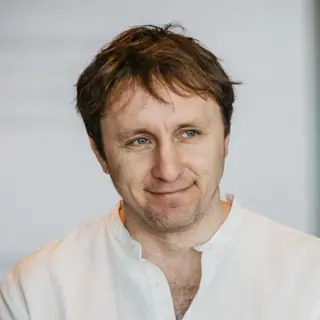
- Łukasz Kacprzak, an accidental SEO person: he was supposed to become a programmer and instead went from SEO specialist through product manager to SEO director at agencies, including Winnet Group.
- What he does
- He runs his own consulting practice and leads the SEO, content and GEO unit at the Sales More agency. He has also helped organizations set up KPIs and introduced an SEO product to foreign markets.
- What we talk about
- The numbers every manager needs to know (operating, gross and net margin, tokens per client, NPS, LTV), the foundations of a healthy agency and a good process, product market fit, backlog priorities and long-term product strategy.
- Where to find him
- The Sales More agency, the contact form at marketingplatform.pl and LinkedIn.
Best quotes
„A good process is one that delivers quality at a level a human finds acceptable.”
„Cheap is already behind us, because all those simple solutions are available to everyone.”
„As long as people need and search for information, we will be able to try to optimize that.”
„The complaining employee is the valuable one. Because if they complain, they still care and still want to.”
Recommended materials and sources
Guest’s pick

Mentioned in the episode


Related conversations




Transcript
Host: Rafał Moszkowców. Guest: Łukasz Kacprzak.
Introduction
Rafał: Hello everyone, welcome to another episode of Globalne Horyzonty. Today's conversation is for all of you who manage anything, a department, an agency, a product, and ask yourselves: gosh, which numbers should I know to really understand what I am selling, for how much and why. Łukasz, welcome to Globalne Horyzonty.
Łukasz: Hi. Hi everyone, nice to meet you.
Rafał: Say three words about yourself. Who are you, where do you come from?
Łukasz: I am an accidental SEO person. I actually got into the industry through my younger sister, who once sent a CV to an agency on my behalf. I was supposed to become a programmer, I became an SEO optimization specialist, and then step by step I moved from specialist through project and product roles all the way to SEO director in one agency, and later in another.
Rafał: A great story. I have already heard of people who applied to big Poznań agencies as web developers and became SEOs. Greetings here to Radek Paluszak, my partner, and Krzysiek Kilewski, who went through exactly the same path. And your path from SEO specialist through product manager to department director at Winnet Group, if I remember correctly. And today you run your own company and support the agency Sales More.
Łukasz: Exactly. I work as a consultant, and there I run the whole unit of SEO, content, now also GEO, AEO and all those kinds of things.
Rafał: GEO and AEO, meaning all the possible names for positioning in AI, let me explain that for our listeners, because the perspective of positioning has widened to include artificial intelligence models and we will talk about that a bit today. I have an idea for this conversation, that we have three areas: the managerial-director perspective, the agency one and the product one, because you have so much experience that I would like to squeeze as much as possible out of it. I am honestly mega curious about your views on many things. Is that okay with you?
Łukasz: Absolutely.
Which numbers should an SEO director know?
Rafał: Okay, let us go. The director-manager perspective: the numbers you must know. That was Gemini's idea for how to name this block. I like the name. You were SEO director at Winnet, you managed teams, you were responsible for the profitability of a product. Which numbers did you have to know day to day to make good decisions? I am not talking strictly about the balance sheet or profit and loss now, I mean operational metrics that you used every day. Can you share?
Łukasz: I think so. There is no secret here, no discovery. As for numbers, in my case margin is always important, because margin says the most about the health of the product and the business. Especially here, where we also have a link product that can often be a big part of our service and is an external cost. In addition, work typical for churn: looking at how many clients come in, how many clients we have to acquire, how to plan that. And then of course average order value, time, what is important. We can go even further, because people often say you should look at EBITDA, meaning operating profit before deducting taxes, depreciation and everything. That was important too. Still, the key thing in all this was one thing: both I and the board looked at the same product metrics. Thanks to that we could create a shared strategy that we were able to scale to other departments.
Rafał: I think it is mega key to look at the same metrics and also to understand them the same way. You talked about margin, so you were responsible for the profitability of that SEO product, and I wonder how you calculated margins per client, product, service, what you counted into costs, what the breakdown of those costs was.
How to calculate margin and tokens?
Łukasz: I will say it depends, and so as not to give away everything, I will answer more generally in business terms. If we have a big business that has to be scaled, then at scale every zloty counts. Because if we see that some fragment of the process costs us five working minutes, but we multiply it by the fact that it happens several thousand times a month, then it turns out those are very large numbers of working hours. Optimization, cost, matters with large numbers, so we try to quantify as much as possible: from the time to choose a photo for a publication, to putting it into the client's CMS, to all sorts of things, so as to reflect that process. Now I can say that this margin was at different levels. The first was a margin calculated purely operationally. By the way I still use that division today. That is, more or less everyone knows the time cost, the cost of an averaged working hour, and thanks to that we can average the margin of producing a given element.
Łukasz: If we look at that margin over time, going further, we come to the fact that an employee performing a given function also has to earn for their leader, their manager, who does not directly perform that function. So we have additional costs higher up. And when we go even further, you also have to earn for the office, electricity, cars, phones and all those things. So if I were to say how to calculate that margin: the first for me is operating margin, meaning the one directly tied to a given product. And staying up to date, today it is also worth starting to count tokens per client. Because if we look at it, it will turn out that in large e-commerce a lot of tokens may be used, tool costs are big, and they will be spread across everyone. It is worth starting to track those things slowly. Further I talked about gross margin, meaning before taxes, before all costs. And at the end net margin, meaning what remains for us after all the company's obligations. Now, being a product person, very often I will not know the exact value of net margin, because at that level of the company they often will not want to share, there is a policy of access to that data. But we can assume some percentage markup and assume that, say, 10-20 percent of costs added to operating margin will be a safeguard for all other overheads, offices and everything. That is how I would approach it.
Rafał: A very interesting structure. To sum up: three-layer calculation, meaning operating margin, gross margin and net margin, that is after everything, after totaling absolutely everything. I wonder now how I calculate it, and maybe I will keep that to myself. I certainly have a gap here and thank you very much for sharing. In the context of tokens per client: for some listeners who may not be super into the topic, could you explain what tokens are and how you understand them?
Łukasz: It is that part of artificial intelligence, of all those chats, that we most often do not see. If we build some applications and analyze large amounts of data flowing underneath, there is tokenization, meaning our queries are converted into sequences of tokens that the AI analyzes, and then we are billed for input and output tokens, depending on the model. Because of that, for example, a million tokens may cost us a few dollars, and in advanced models more. And now if we think we have a very large e-commerce site with 250 thousand products to analyze, and think about all the descriptions, and want to push it through automatically, we can quickly see that the number of tokens grows to astronomical amounts and processing it may be quite expensive. Say, through external models, because of course we can also set up local models and then we pay only for electricity.
Rafał: I think we would get into that on another occasion, because local models interest me from the angle that I would most like to move away from large language models calculated in the cloud, because I think it is a certain kind of business trap, but that may be for another time. You said many things, thank you. I have a small follow-up: when did good margin calculation first save you from a stupid decision? Do you remember something like that?
Łukasz: I had the pleasure of starting to work in a corporation that already had a finance director and had everything initially laid out. I had the pleasure of learning from others. I did not make errors in calculating margin as such, because I had a guide who sat down with me, explained, told me. I think that gives me a big advantage over others: I simply had the pleasure of comparing notes with a pedigreed finance director who devoted a few minutes to me so that I would learn in life which mistakes not to make. Thanks to that I did not have margin problems. Of course I am speaking from the side of calculating a product. Obviously, as a product person I have some influence on sales, and things like pushing sales and the demand for greater sales are another story. But fortunately I had no margin blunders.
Rafał: You were lucky that there were people there who knew, because if you do not know, it is easy to make a mistake or to count only one of those margins and think it is great, be very pleased with yourself, and in the end lose money.
What is the KPI pyramid and which three metrics matter most?
Łukasz: Many people, when they talk to AI models, chatbots today, ask them what to count, what to choose, and it turns out the models throw in a lot of metrics, a lot of questions, but it is not tailored to our business. There is no knowledge of the whole business. Many people are lazybones who do not want to spend a longer time properly telling the model about their business so it could even help them align the KPIs. As I said, it is good when the whole organization speaks the same KPIs. In my more consulting career I had the pleasure of helping to lay out KPIs. I created for my own needs something that probably functions under a proper name, and I called it the KPI pyramid. We choose strategic KPIs for the whole company, which we look at at different levels: in production departments, directly in campaigns. If we choose, for example, that we all look at margin, then everyone looks at that margin, operating or otherwise, so that it can be calculated, but it is reported at the level of the board, marketing, operations, and everyone has their own metrics. This pyramid arrangement serves for those metrics to expand. With the board we choose those five, six metrics that are most important. At the product level we have those metrics extended with typically product things. At the board level we will have things related to revenue, and I would always add NPS to keep an eye on how satisfied our clients are. And on the product I will also have whether clients use our product and have a good opinion of it. And then, moving on to the stage of marketing activities, we extend it with how many MQLs and SQLs we have, meaning marketing leads and sales leads, and we go deeper. Thanks to that at every stage we look at more or less the same thing. I think an organization is able to develop when everyone has the same top-down goals. Because otherwise the goals at the bottom will not match the goals at the top, so we will probably never reach them.
Rafał: I will stay in the spreadsheet forever, so I also know how it is. At the very end of this area of our conversation: you said a great deal about different kinds of metrics. You also mentioned Net Promoter Score, a metric that shows the degree of satisfaction of our clients with products. If you had to choose the three most important metrics that every manager should know, what would they be and why?
Łukasz: If I had to choose three: margin, and let us say that operating margin, because it is still fairly easy for everyone to calculate. I would throw in NPS, because if clients are not leaving us, they will probably stay with us. And the third I would choose depending on the business. If we have a larger business and it is not a SaaS business, I would probably go for average client value: how it looks over time, whether it is increasing. And if we have a smaller business, I would look at the length of the client's life cycle, whether we are simply losing them.
Rafał: So Customer Lifetime Value, that last metric.
Łukasz: Yes, absolutely.
Rafał: NPS will certainly tell us whether they like us or not, but the physical dimension of rustling banknotes should be told to us by LTV.
Łukasz: Exactly.
How to build a healthy SEO agency?
Rafał: We move on to the second perspective, the agency one. We will make a guidebook right away on how an agency should work and later sell this recording for 15 million. That is my idea.
Łukasz: So we have to find the answer to how to do it cheap, fast and good.
Rafał: Exactly. The triangle of possibilities with Łukasz today. You were at Winnet, as we already said, now you support Sales More. You see different business models. I have a question that you do not have to answer if you do not want to: how should a healthy SEO or digital marketing agency work at all? What are the foundations in your opinion?
Łukasz: I think the foundation is always the client's needs. That is, to fulfill that agreement between us and the client. That is how I would think, from the American definition of marketing: we generate value that someone wants to pay for, in both directions. If I were to say further how an agency should work: above all on time, in line with the contract and safely for both parties. Putting it very in slogans: on time. Of course backlogs, delivering things is hard, in agencies not only because of internal things, but also external processes. Working with large entities taught me that compliance departments and legal departments can hold content for months while we wait to publish something, and in SEO that is one of the key things we do, because we have to feed those algorithms with content somewhere. As for safety: according to the law we also answer for what we do for those entities. If we have industries with the financial supervision authority or the consumer protection office, meaning financial, insurance, health, then we also have to take into account that in case of errors we are the entity that will partly contribute to those errors, so we have to take care of all those legal matters. And certainly effectively, because if we are not effective, we will not have clients. And nowhere here did it say it has to be cheap, because sometimes I think cheap is already behind us. Especially when we talk about bigger solutions, more comprehensive visions, because the entry threshold today thanks to chatbots has become very low.
Łukasz: You could say that just as we used to have juniors, today the junior is the client, because they ask the chat and know. If we used to have specialists, today the specialist is the senior, because suddenly they can make Python scripts out of our SEO industry, process code, analyze. And seniors became experts, because they have no problem asking questions on how to look broadly at the whole vision of the business, because they can ask. For that reason I assume that cheap is already behind us, because all those simple solutions are available to everyone, and the combinatorics will be harder with bigger things.
Which processes does an SEO agency need?
Rafał: An interesting perspective. Basically the clients' needs, great that you put that first, I did not think about it at all, but then really everything comes down to structure and processes, as I understood.
Łukasz: Right, I am generally a fan of processes. I will not hide that at home, in everyday use, I have an app that supports our shopping: the shopping list, what we have in the wardrobe, what we keep where, what we are going to eat. It is a vibe-coded app for supporting the home. I have my own CRM, suited to my own process, thanks to which I handle tasks efficiently and can simply deliver things better, I have better knowledge, I have quick markdowns, in my case for a local Bielik or local Qwen if I need it. So I can use those local models to support me. And I am a fan of process for a very simple reason. If we operate in chaos, which is a very large part of agency businesses, without any structure, if we study something and have a hundred different cases because they are not repeatable, then it is hard to compare where the error lies. But if we have a process, better or worse, but repeatable, we roll that process out and after three days we see that everyone complains that an additional item is missing, we add it to the process. And then everyone remembers it. Thanks to that we eliminate routine and lack of repeatability and we can scale it. Because without process management there is no possibility of scaling, because people will not always deliver the same quality.
Łukasz: A useful comparison today is that if someone is an active user of, say, Claude, they started building skills, files that say what is to be done step by step so that it is repeatable and always at the same quality. So someone started dressing processes in skills so that the AI does not go off sideways and make things up. True, it kills creativity. But in such a repeatable business the question is whether creativity is always needed at that moment. I think it is better to dedicate other solutions to that, for example sit specialists down to cross-analyze their actions and exchange opinions: let us write down what can be done better, because everyone pays attention to something different. And only then work on improving the process.
Rafał: You anticipated my question. I was going to ask: what does a good process in an agency mean and how does it affect profitability? People talk about processes, whether they build them with AI, whether they are so-called SOPs, Standard Operating Procedures, or in any other way, but what does a good process mean and do you have your own definition?
Łukasz: Do I have a definition of a good process? I think over the years I would answer that no, because I used to be very deep in agile methodologies and I wanted my processes to be scaled with some agile methodology. And today I would answer that a good process is one that delivers quality at a level a human finds acceptable. So if a process has a mixed share of AI and human, but at the end the human says: okay, this is good, then today I would say it is a good process. I would focus more on what the effect of the process is than on how it will be processed, because that will change a lot in the near future.
Rafał: That is the crux, I think. I was curious what you would answer and you answered nicely, I made a note right away. It used to be that in the SEO environment Google or other search engines changed, so those processes had to be flexible in some sense, not like at Procter & Gamble where you wrote it down once every 30 years, they had to be updated often. And today I have the feeling that a static base of processes, without any automatic connection to what the agency does, is a bit pointless: every few, every dozen or so days there may be very big changes in such a process. Do you have any idea how to make such a flexible, dynamic process base? Maybe you have it solved?
Łukasz: I do not have an ideal solution, because there is none. But the truth is that at some stage it is enough to leave the main line of the process: we come in, we have data analysis, we have a result. We can divide the process so that data input and data output are always comparable. But what is in between, how we do that analysis, what things happen there, can be dynamic per person. For example, to give an SEO example: if we have a 404 analysis, the standard analysis provides for some crawl, checking whether there are 404s in internal linking, extracting the link profile from Ahrefs or Semrush, checking what is in Search Console. That is something we can enter as fixed things to check. And now we can always add an "other remarks" field. Later, because we also monitor people's other remarks, we may see that someone noticed, for example, that some subdomain generates extra links or things that generate those 404s, not even resulting from that standard check. Thanks to that we do not close the whole model, and the effect is the same. We had "verify 404 errors" as an element and the output: whether we wrote recommendations, whether it is fine or not, and a short summary. And the middle of the process can be dynamic. We can scale the same assumptions to everything else. Let us remember what the assumption of the process is: either we can do it automatically and then we check what comes out, or if we have, as I put it, efficient organic protein mechanisms that process data, we can make sure they also have good instructions and do not forget various elements.
Rafał: I laughed terribly at that term. I assume it means a human.
Łukasz: Yes, absolutely. Sometimes at work, analyzing a set of phrases, I feel like such a protein mechanism that simply tries to process it somewhere.
Will SEO people still be needed?
Rafał: From a biological-chemical perspective that is exactly right. We will probably live in some symbiosis with models. And here I have a small follow-up, a thought came to me, I am curious about your opinion: can you imagine a world in the short term in which we, you as SEO specialists, will practically not be needed at all?
Łukasz: Talking recently with Robert Niechciał during the Kulturalnie o SEO conference, I laughed to him that after some time we will have to learn to make graffiti. It is something I repeat x times and believe in, because in a moment we will swap phones for VR glasses connected to artificial intelligence. As you walk down the street and look at something, it will suddenly recognize that graffiti and tell you what brand it is. And so we have brand positioning in an organic way, in city search results. I do not know what to call it. But laughing aside: I am not afraid we will lose our jobs, for a simple reason. As long as people need and search for information, we will be able to try to optimize that and insert those brands, those mentions, some form of exposure, whatever the medium. Let us remember that today we are in a very comfortable situation: LLMs, meaning those large language models, are often mathematical algorithms that promote probability. And here we can say that by repeating the truth a thousand times, it will become the truth, because today for LLMs information is important when at scale we give it significant mathematical weight. Meaning we show that something is important. And who can do that better than SEOs, who create thousands of satellite sites for teaching LLMs?
Rafał: If you think about it well, you could reach the conclusion that all that nonsense produced by ChatGPT is the result of SEOs' activity, but I will not go as far, because that would be a sad conclusion.
How to launch an SEO product in Slovakia and Romania?
Rafał: I would like one more thing in the agency context, or maybe two, but one interests me and I think it will be valuable for listeners. I read that you introduced an SEO product to Slovakia. Foreign expansion in the product and agency context. I am curious what challenges you met, financial, operational, cultural. Can you say a bit about that process and what the product was?
Łukasz: It was simply scaling a Polish product abroad and I cannot say everything, but I will say the biggest surprise was the awareness of need in Slovakia and the fact that it turned out SEO in Slovakia is not as needed as it might seem, because not everyone has a website there. At the time when I did it, they still had a phone book, so there were no such things related to GDPR either. As for cost matters, the conversion is not zloty-based, rather closer to one to one, but building such a product need was probably the biggest challenge. Even though we had information that we could show we would deliver traffic, that there would be needs, first we had to educate that market that you need such a service, that you need to take care of your presence, whether in organic results or in Google Maps. Above all there, as for Slovakia. And then every international standard, meaning language: those linguistic complexities are hard in that you cannot always translate materials one to one, you have to hire a native who will help so that it is done in a sensible way. But as for that product awareness, it is not only here. The same happened in another project, in an attempt to enter the Romanian market. We had the same problem, in which people clearly said that a company does not need a website, does not need marketing on the internet. And those people then really had to be shown, a product need had to be created, so that they would want to have it, show the advantage.
Rafał: I understand. Something came back to me as you were telling that. Many years ago, when I was starting my first agency, God bless those times, how great it was, completely improvised, I called people in London, that was two decades ago. I remember trying to sell my first product, my own two-person, one-and-a-half-person agency, because my partner worked half time. I was talking to one man and it was a sales pitch, that I have more clients, this exposure and so on. And I remember he was so angry, I felt it, like sometimes when you talk to someone you feel they are angry on the other end of the phone, everything sounds somehow negative. He said that every next client is the next problem and he does not wish for more clients. That reminded me of that mentality you described about Romania. And that guy will stay in my memory for the rest of my life, I suppose.
Łukasz: Sometimes that happens. From cases in history, we had a client where, building an internal SEO quality evaluation system, it indicated the client would be dissatisfied, because it was a small location, small niche and all the statistics said there would be no traffic there. Contacting the client and asking whether she was satisfied with the services, she said very much so, because she types herself in and is first. So she is perfectly satisfied. The problem was that she was the only person providing that service in that small town, so there was no way she would not be first. And then I also realized that sometimes it is about making the recipient of the product happy above all. A product is supposed to give a feeling that someone is meeting their needs, that they are satisfied with the purchase. That is from the empirical side. And if we look at bigger clients, who look into Excel, then we are already dealing with there having to be results too.
What is product market fit and how to check it?
Rafał: Nicely said. Automatically we moved on to the third perspective that I came up with for today, the product one. We have already talked a bit about it, but I would like to talk with you as an expert on building a product that sells. I feel it would be nice to start with product market fit, meaning fitting the product to the market, to put it nicely in Polish. I assume that as a product manager you had to respond to market needs: how did you know the product was good, do you have your own methodology for measuring that a product fits the market? I am not saying in the context of that Slovakia or Romania, but maybe on your local, native market.
Łukasz: I think it is very often the case that first we get on with the product. We want to create something super and only later does it hurt that nobody on the market wants it. It is much easier sometimes to go to a conference of people who are in our target group and simply talk: whether such a solution would make their lives easier, whether they see it as sensible or not, whether they would like to sign up, say, for free tests, for consultations. That is when I am a small organization. And when I am a larger organization, in which there is also a sales department, there is no simpler method than asking them whether, if we have such a product, it will be attractive to them to offer to clients. And why? Because they are the first to ask me questions: what will it give them? What is it for? How will it be packaged? At what price? If they say it is too expensive, that they do not feel it, then we get to my favorite part and something very characteristic of me: challenging. I myself challenge all projects until they convince me. So as a product person I have the first opportunity to overcome objections at company level. If they do not feel my solution, but I overcome those objections, then I automatically know what I should communicate even at the start, so that they can also overcome their clients' objections. If, for example, we make an MVP that we go wider with, they will again collect questions from the market. We can work on those questions and see whether we manage to break through the objection. If after that stage we see that nobody wants it, we reached out to even 20 people and nobody wants it, then thank you. If we have, for example, a smaller agency and 20-30 clients, we are thinking about some solution, then we also have an excellent group to come to our clients even with an upsell proposal: we will increase their value, maybe sometimes reduce our margin, with the question of whether they would like us to start working on a solution that will give them x, y, z, whether it makes sense for them and whether they would be able to pay for it. In a very easy way we test our idea, whether the market needs it. And if we already have our clients, you can say they are our best target group, because they have our services.
Rafał: Exactly. Thank you. I thought one more thing: you said we test on our own clients or take it out in some form of iteration through the sales team, depending on scale. Do you see a trap here, that we can fall into our own hype, in the sense that ten people said it is great and that they would buy it once it is ready, and that we can fall into a rabbit hole of building and building, and release the product and it turns out they say: nice, but we will not buy it? Do you see what I mean, that the scale of that research is too small?
Łukasz: Nobody forbids us to say: okay, you were interested in this, it is the end of March today, we are communicating that we will deliver this at the end of May, can we sign a contract with you already today? And say honestly that we are collecting interest. Then we have verification of whether they will really want to buy it. If they bought it, then we know there will be interest. Alternatively we can always go wider, because if we see after that first step, without making a fuss, that there is a response, we can create a landing page that will say: leave your details here to have access to the tool. If ten people told us in the local survey that it is okay, we will release the landing page, post it in some groups, a Facebook group or wherever, where we solve the problem of a given group, with information that if it is interesting for you, you are ready to pay 49 zloty, leave your address, let us say. Then we also have verification. If we see there that there is scale, we can say the product is even more validated. Let us remember that very often today we learn that we buy something on subscription, but once nobody had a problem paying for a kitchen that does not yet exist. We sign the contract and the kitchen will only then be built. So if we have some solutions, we can sell them, honestly saying they will exist in a moment. And then we also have that principle of legalization, meaning someone is rather unlikely to back out. But I assume the idea is smartly made and we have a basic business plan for it. We can estimate how many clients we need for it to be profitable, what scale we must reach and what the plan is next.
Rafał: I think that is a very nice idea, to go decidedly wider. And you inspired me to think about selling something that is not even ready, with a promise to deliver later. For me these product things are a bit new, so it may sound that way too.
Łukasz: If you allow, I am not the best product person in the world either, but with no advertising, no collaboration: if someone wants to read, I recommend the Product Vision blog. There are people in Poland, Tomek and another lady, I do not remember, sorry, who talk a lot about product, in the form of webinars and posts for free. And they are sometimes good inspiration for reading about typical product things, how to do it, how to arrange it.
Rafał: Great, thanks. I will link that in the episode description, for sure.
How to set priorities in a product backlog?
Rafał: I wanted to ask a question about priorities. You managed a product backlog, if I understood correctly. I am curious how you handled it, because every day there are probably 100 ideas, 1,000 requests for changes in the product from clients or teams. On what basis did you decide what to build and what not to build? Did you have a framework for that?
Łukasz: I think not. My approach is very simple. Just like every day in campaigns we work with clients: first are the critical things we must eliminate so that the rest makes sense or can work, and then we assign priorities. I always divide those priorities into two things. The first is business, meaning how important it is for the business, because sometimes building a blog will matter more than adding structured data to a site, as an example. And the second is business impact, meaning how much it will translate into the business, how much I count on it bringing us some profit. Since I like prime numbers, I assign successive prime numbers and on that basis I have a simple scoring that lets me make a decision, to then arrange it. Because it is very easy to be smothered by those ideas. Besides creating the product backlog, where ideas will keep coming in, especially those after a night's sleep, where before closing your eyes there was an enlightenment with the best idea, there is also giving some voice to the team. Because as product heads, managers, directors, company owners, we often say this is the most important for me. The team feels differently. Even as today at Sales More I am developing the team and we are working now on adapting to various things in the team, how to adapt to AI things. If I have, for example, five slots for tasks, so that there is some finite, chosen number to finish them, rather than adding endlessly, then I take three and the team two. Thanks to that the team feels it has influence, we also carry out their things. And if we describe for ourselves what each of the solutions will give us, even in a descriptive way, what success will be: we cannot measure it, but it should affect a metric so that it goes up, whether more signups or better model performance, agency-style, then we are able to measure whether it made sense or not. I look more in that direction.
Łukasz: I like to be a dictator and infallible, but the truth is that you have to learn humility and say that this is only my vision, my projection of the world. Thanks to the fact that in the team I have often people smarter than me, it is better to listen to them, trust them and know that they are there and are so good so that we use their knowledge, and not only carry out our own vision of the world.
Rafał: You gave me a great headline. If I were Onet, I would write: Łukasz Kacprzak, I love being a dictator. I think in the crazy new media that would get clicks.
How to plan a long-term product strategy?
Rafał: We are slowly heading to the end, so I had loads more questions about product, but we will probably have to meet once more. I would have one last question in this context: how do you think about long-term product strategy? How to plan development so that in a year, two years, the product is still profitable and competitive, especially when there are so many tools today that appear so fast?
Łukasz: I agree. Every day I open LinkedIn and see someone vibe-coded something new. I think I am the same, every week I brag in the team that I made a new app, whether for language learning or something else. If I were to say honestly about planning: a product is a bit like life. We have some general life goal and some dreams we want to fulfill, which for me is the long-term vision of the product. So what would I like in those proverbial five years, two years, one year? Having milestones where I can see what the service would be like. And then coming down to earth a bit and, in my case, looking quarterly. Planning a quarter as a period in which we are able to produce some value and check whether it makes sense for the market. And after that quarter using that agile knowledge, doing a retrospective, checking whether it worked for us, whether it made sense and whether it affects the further vision of the product and the company. I propose an analogous approach not only for the product itself, but also for the product's finances: let us have a plan for functionality, let us have a plan for finances, meaning let us plan what revenue will be, whether it is going, not going, and why. Let us have it somehow connected, because in the end we all do these things so that the business adds up. Great if it gives value, great if it also gives employment, and maybe such a nice word: legacy, that at the end we leave something behind that is valuable for others.
The most important lesson and contact
Rafał: That is a big thing. And I had an idea for a final question. We talked about three perspectives: the director, say managerial, agency, product. And if you had to choose one most important lesson from all your years of experience about numbers in business, management, whatever, what would it be? Would it be exactly what you said, that we work in order to leave our legacy? Maybe not that, but legacy maybe.
Łukasz: A good question, it is a hard question. I would wish for everyone who hires anyone, and everyone who works anywhere, to feel that it is part of that company and that it is partly their piece of something, that they are an element of it. In my case it is actually nonstandard: I treat work with everyone as if it were my own company, and that comes from the fact that from a young age I watched my father, who ran a one-person business. I know how much, even as a child, watching, that small business costs and how much I would like to make it better so that everyone lives better. And it starts at the level of each of us. Sometimes we think we are a small, unnecessary cog. Sometimes we think our work means nothing. But often the feedback we do not pass on, the remarks we do not complain about, if they do not reach the top, nothing will improve in the company. In my daily work too I believe the complaining employee is the valuable one. Because if they complain, they still care and still want to.
Rafał: I am writing that down. It changed my perspective, I must admit. Łukasz, thank you for this conversation. I think when people listen to it, they will go and check their numbers, backlogs, processes and so on. If they wanted to find you, where can they find you?
Łukasz: As for things strictly connected with online marketing, I serve with my knowledge and help at the Sales More agency. And as for things related to various business processes, I invite you to marketingplatform.pl, where there is a contact form through which you can reach me. Also on LinkedIn.
Closing of the episode
Rafał: Great, thank you very much. So that is all for today at Globalne Horyzonty. If you liked this episode, I would really ask for a like, maybe a comment, a subscription. You know how it works. Thanks and until next time. Bye.
Łukasz: Bye.
Listen and watch
The same conversation in your favourite app.
The full edited transcript as a Markdown file, with the guest’s details and quotes.
Back to top